
Bookshop Business Plan Template
-
 ShopifyPut your brand on Shopify. Launch your online store with tools designed for growth and success. Ready to turn your idea into profit? Start building your e-commerce business today.
 -
 SquarespaceShowcase your brand with Squarespace’s sleek designs. Build a professional online presence with ease. Start with a template that already looks finished.
 -
 WixBring your ideas to life with Wix. Customize every aspect of your site with unmatched flexibility. Start creating your unique online space and let your creativity shine.
 -
 ElementorCraft captivating websites effortlessly with Elementor. Enjoy complete creative control without coding. Make your site stand out to your audience. Start turning your vision into reality now.
- Executive Summary
- Business Info
- Business Model Overview
- SWOT Analysis
- Bookshop Business Name Ideas
- Website
- Marketing Details
- Industry Trends
- Competitor Information
- Financial Information
- Startup Cost Breakdown
- Legal and Compliance
- Operational Plan
- Contingency Planning
- Building Your Bookshop With the Plan
- Models to Consider
- Adapt as You Grow
- Practical Uses for Your Plan
- Take Action
A bookshop business plan covers a retail operation with thin margins (typically 30 to 40 percent on new titles) and meaningful inventory risk on the long tail. The independent bookstores that survive in 2025 do so by mixing a tight new-release frontlist, a curated backlist tied to their local audience, an events calendar that pulls 30 to 50 attendees per month, and at least one secondary revenue stream like coffee, gifts, or used books. Founders building a broader cultural-and-commerce business in the book space should also review the literature business plan template for a cross-channel framework.
Define the plan around five concrete questions: how many titles you stock at launch, what your average margin per book sale is after returns, what your monthly events calendar looks like, what your secondary revenue mix is, and what your turn rate target is per title category. Operators planning a similar physical-first concept can also reference a bookstore business plan template for store layout and inventory ratios.
Executive Summary
Our mission is to create a welcoming and inclusive environment that fosters a love for reading and promotes local authors. We envision our bookshop as a community hub where readers of all ages can discover new literature, participate in events, and engage with like-minded individuals. Our value proposition lies in our curated selection of books, personalized recommendations, and cozy atmosphere. Financially, we aim to achieve break-even within the first 18 months and generate consistent profits by the end of the third year.
Business Info
We will offer a comprehensive range of books, including fiction, non-fiction, children’s books, and unique literary gifts. Our target market includes avid readers, students, and families within our local community, with a focus on promoting diverse voices and sustainable practices.
Business Model Overview
Our revenue will be generated primarily through direct sales of books and merchandise. We will also host events, including book signings, readings, and workshops, which will provide additional income streams. A community membership program may also be considered for added loyalty benefits. Entrepreneurs exploring related retail models may also find value in a Fran business plan template for structuring a versatile brand.
SWOT Analysis
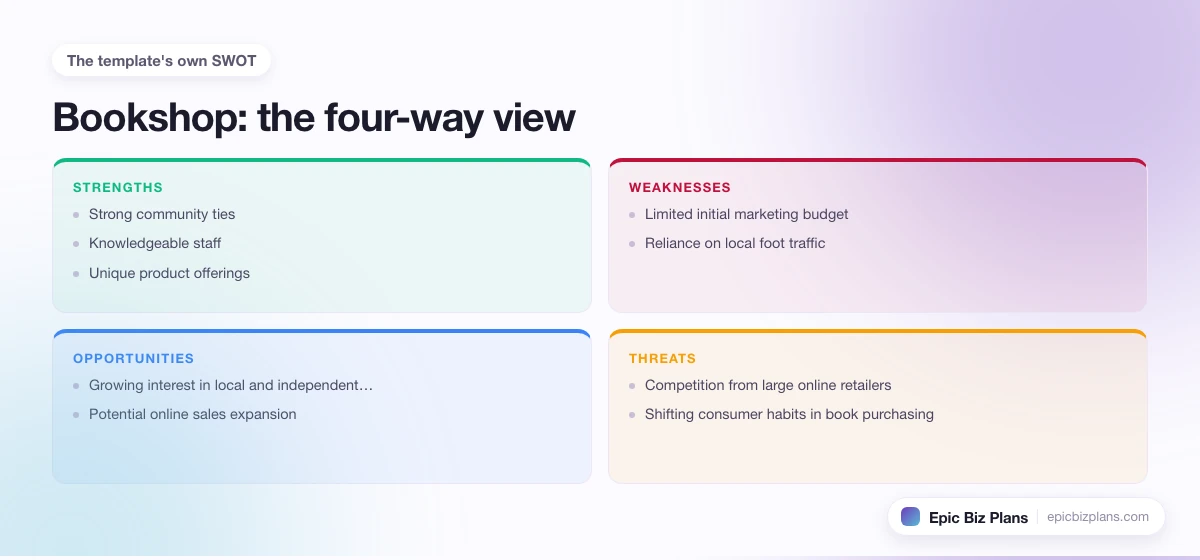
- Strengths: Strong community ties, knowledgeable staff, unique product offerings.
- Weaknesses: Limited initial marketing budget, reliance on local foot traffic.
- Opportunities: Growing interest in local and independent bookstores, potential online sales expansion.
- Threats: Competition from large online retailers, shifting consumer habits in book purchasing.
Bookshop Business Name Ideas
Website
We will establish our online presence using Shopify or Squarespace, which are ideal for e-commerce platforms. This will allow us to sell books directly to customers online, expanding our reach beyond local clientele. Alongside our primary sales platform, we will also focus on a visually appealing and user-friendly website to showcase our in-store events and promotions.
Marketing Details
Our marketing strategy will include digital initiatives such as utilizing Semrush for SEO optimization to drive organic traffic to our website. For email marketing campaigns, we will use HubSpot to communicate with our audience about new arrivals, events, and promotions.
We will also use social media platforms, particularly through TikTok ads, to attract younger demographics by showcasing book recommendations, highlights from events, and engaging content related to literature.
Industry Trends
The book retail industry is experiencing a revival, particularly among independent bookstores that offer curated selections and community engagement. Technological advancements in e-commerce and digital marketing are crucial in adapting to consumer preferences. Additionally, the demand for sustainable and ethically sourced products is on the rise, influencing consumer purchasing decisions.
Bookshops considering the addition of a coffee service should also review our books and coffee business plan template, which covers the operational and financial planning specific to that hybrid model. Stores planning regular reading-group events as a community draw can also reference a book club business plan template for membership pricing and event cadence.
Competitor Information
We will analyze both direct competitors, such as other local bookstores, and indirect competitors, such as online retailers. Our differentiation strategy will focus on exceptional customer service, unique in-store experiences, and targeted community engagement initiatives that larger retailers cannot replicate. Operators planning author events as a recurring draw can also reference an author business plan template for typical event scope and royalty-split norms. Owners specializing in pre-owned titles can adapt the buying tactics in the used book business plan.
Financial Information
Startup costs will include inventory acquisition, shop fitting, employee salaries, and initial marketing expenses. We anticipate initial revenue generation primarily through sales, with projections indicating a steady growth of approximately 15% annually after the two-year mark.
Ongoing expenses will include rent, utilities, employee wages, and marketing costs. Our P&L statements will be closely monitored to ensure consistent profitability and informed financial decision-making.
Startup Cost Breakdown
A 1,200 to 1,800 square foot bookshop typically requires $80,000 to $150,000 to open. Opening inventory, sized for 4,000 to 6,000 stock units at an average cost of $9 per book, runs $35,000 to $55,000. Fit-out for shelving, signage, a point-of-sale system, and a small event area lands around $20,000 to $40,000. The remaining budget covers first and last month rent, a security deposit, business registration, insurance, and the first three months of marketing and payroll. Operators adding a small cafe service should budget an additional $25,000 to $40,000 for espresso equipment, plumbing modifications, and food-handling permits.
Legal and Compliance
We will ensure that all legal requirements are met, including business registration, tax compliance, and potential intellectual property protection for our unique offerings and branding. This may involve registering our business name and any significant logos or slogans associated with our brand.
-
 SemrushSemrush is a platform with literally any online tool you will need to promote your business. Spy on your competitors, get search traffic, keyword research, social info, ad copies and much more. Used by most of the top online companies in the world. Besides all its tools, Semrush also has many available integrations possible with many other tools that will make your work even better.
 -
 Surfer SEOSurfer SEO is an incredibly smart AI tool that will give you exact explanations what to do in order to make your website rank better. They use hundreds of parameters, check your competitors and decide on the best course of action. Whether it be inner links, bold text, paragraphs, headers, images and much more. Surfer is a must-have in 2026.
Operational Plan
Our operations will focus on inventory management, sourcing books from local publishers, and establishing relationships with authors for events. We will simplify logistics for restocking and fulfilling online orders to enhance efficiency and maintain customer satisfaction.
Contingency Planning
Potential risks include economic downturns affecting consumer spending and increased competition from online platforms. Our mitigation strategies will involve diversifying revenue streams, emphasizing a strong online presence, and building community loyalty through events and personalized services.
Building Your Bookshop With the Plan
The bookshops that hit profitability inside 18 months tend to share three habits: they hand-sell every title they stock (staff can describe it in two sentences), they run at least two paid or sponsored events per month, and they track inventory turn by section every quarter. Pick one neighborhood and one core audience (general literary, romance, kids and YA, sci-fi and fantasy, or academic) and build the stock list around them before adding adjacent categories.
Models to Consider
The viable formats include a curated neighborhood store, a category specialist (mystery-only, kids-only, used-only), a hybrid bookshop with coffee or wine bar, and an event-led pop-up that rotates between markets and partner venues. Each model has different rent tolerance, inventory turn expectations, and customer return frequency.
Adapt as You Grow
Your bookshop business plan is a quarterly working document. Review inventory turn by section every 90 days, drop slow categories that fail to clear stock in two seasons, and only add a new category after a clear signal from customer requests or events.
Practical Uses for Your Plan
Use this plan to present to a commercial landlord, apply for a small business loan, pitch a local publisher partnership, or brief your first store manager. Each section maps to a real decision: location, stock mix, event cadence, or hire.
Take Action
Your bookshop business plan is 100% free, with unlimited edits, unlimited downloads, and unlimited chances to get it right.
