
Book Club Business Plan Template
-
 ShopifyPut your brand on Shopify. Launch your online store with tools designed for growth and success. Ready to turn your idea into profit? Start building your e-commerce business today.
 -
 SquarespaceShowcase your brand with Squarespace’s sleek designs. Build a professional online presence with ease. Start with a template that already looks finished.
 -
 WixBring your ideas to life with Wix. Customize every aspect of your site with unmatched flexibility. Start creating your unique online space and let your creativity shine.
 -
 ElementorCraft captivating websites effortlessly with Elementor. Enjoy complete creative control without coding. Make your site stand out to your audience. Start turning your vision into reality now.
- Executive Summary
- Business Info
- Products or Services
- Target Market
- Business Model Overview
- SWOT Analysis
- Book Club Business Name Ideas
- Website
- Marketing Details
- Industry Trends
- Competitor Information
- Financial Information
- Legal and Compliance
- Operational Plan
- Contingency Planning
- Recruiting and Retaining Members
- Embrace Your Book Club Business Vision
- Adapting Your Business Plan
- Start Building Your Future
The Book Club business plan is a clear path into an opportunity-rich industry with steady demand. People of all ages want connection, conversation, and a shared experience over great reads. This is not just any plan; your Book Club business plan will reflect your brand's voice and line up with your audience's tastes. It's about creating a space that connects and produces genuine friendships. You may also want to explore our enormous business plan.
In a changing cultural environment, a strong Book Club business plan can position you as a leader in engaging discussions and lasting friendships. Showcase what makes your club specific, whether that's indie authors, genre-specific themes, or interactive events. Remember, this plan isn't about the books on the shelf; it's about the conversations and inspiration around every page turned. Ready to turn a new leaf in the world of book lovers? Let's build a Book Club business plan that stands out and connects with the people you want as members. A related angle on community publishing can be found in our brotherhood business plan.
Executive Summary
We will establish a book club that brings together literature enthusiasts to build a strong community around shared reading. Our mission is to create a space where individuals can explore diverse genres, engage in real discussions, and develop friendships through literature. If you're considering adjacent ventures, check out our snooker club business plan.
Our vision is to expand across multiple communities, offering both in-person and virtual sessions that work for different interests and demographics. We will deliver value through curated book selections, expert-led discussions, and themed events that enrich the reading experience. Financially, we aim for sustainable growth over the first three years, with community engagement and member satisfaction as the leading metrics.
Business Info
Products or Services
We will offer a monthly subscription service that includes curated book selections, access to exclusive author events and discussions, and special themed gatherings. Members will also receive discounts on additional book purchases and exclusive merchandise.
Target Market
Our target market includes avid readers, book enthusiasts, and individuals looking for social interaction through literature. We will focus primarily on adults aged 25 to 50, including working professionals, parents, and retirees who care about reading and community. For a full lending-library model, the library business plan template is a useful reference.
Business Model Overview
Our business model uses a subscription-based revenue stream supplemented by event ticket sales, merchandise sales, and partnerships with local bookstores and publishers.
SWOT Analysis
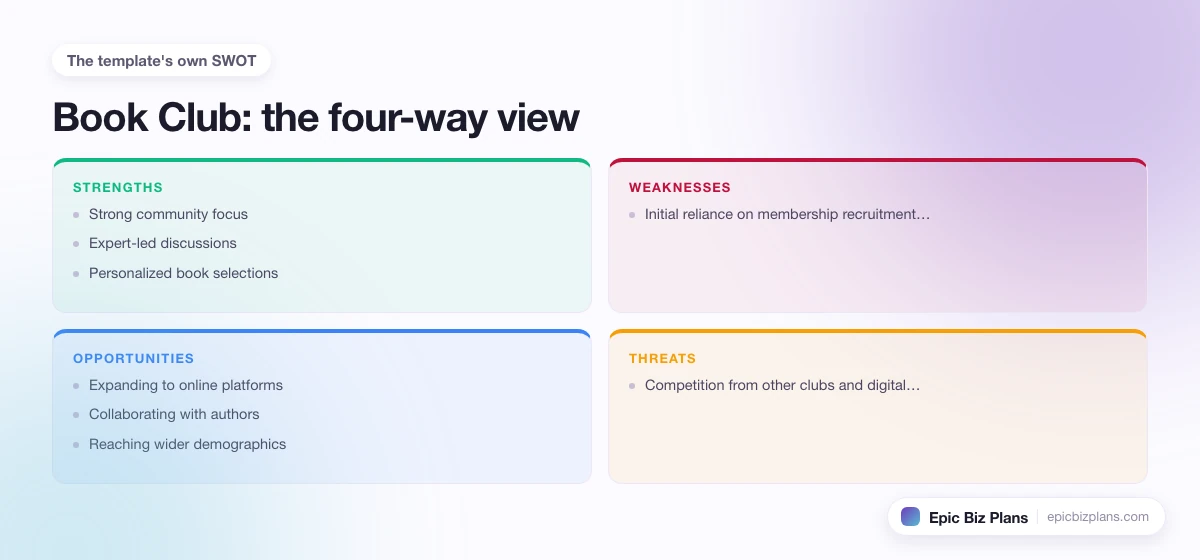
- Strengths: Strong community focus, expert-led discussions, personalized book selections.
- Weaknesses: Initial reliance on membership recruitment and dependency on book supply.
- Opportunities: Expanding to online platforms, collaborating with authors, and reaching wider demographics.
- Threats: Competition from other clubs and digital reading platforms.
Book Club Business Name Ideas
Website
We will build our website using Wix, which provides an easy-to-use platform for non-technical operators. This will let us maintain a clean online presence with minimal technical lift. If we need deeper customization later, we will consider WordPress.
Marketing Details
Our marketing strategy will mix digital marketing and social media. We will use Semrush for SEO to improve our online visibility, while HubSpot will run our email campaigns and keep members informed about upcoming events and new book selections.
To attract a younger demographic, we will run TikTok ads, using the platform's reach and engagement to promote the club's offerings and events. For owners who want to add coffee and casual hangout space, see our book cafe business plan template.
Industry Trends
The book club industry has seen a clear resurgence as readers look for community and good discussion. Tech has made hybrid models normal, where in-person meetups co-exist with virtual sessions. There's also a growing appetite for diverse and authentic storytelling, which will influence our book selection trends. Founders looking at the broader literary space can also reference our literature business plan template.
Competitor Information
We will analyze both direct competitors, such as other local book clubs and online platforms, and indirect competitors like online reading communities. To differentiate, we will focus on unique themed events and discussions led by guest authors or literary experts. For a related angle, see our cigar lounge template. Groups looking to sell as well as discuss titles can review the used book business plan.
Financial Information
Our projected startup costs will include initial marketing, website development, and inventory for book selections. We aim for steady growth, with projected revenue increasing as we build a strong membership base. Ongoing expenses will include operational costs, event hosting, and marketing. We will monitor cash flow regularly and develop P&L statements to assess financial health.
Legal and Compliance
We will meet legal requirements by registering the business and securing any necessary licenses. Intellectual property protection will matter as we develop original content (discussion guides, member newsletters, branded events).
Operational Plan
Key operations will include selecting book titles, scheduling events, and managing member logistics. Our supply chain will focus on partnerships with local bookstores and publishers for book sourcing and promotional materials.
-
 SemrushSemrush is a platform with literally any online tool you will need to promote your business. Spy on your competitors, get search traffic, keyword research, social info, ad copies and much more. Used by most of the top online companies in the world. Besides all its tools, Semrush also has many available integrations possible with many other tools that will make your work even better.
 -
 Surfer SEOSurfer SEO is an incredibly smart AI tool that will give you exact explanations what to do in order to make your website rank better. They use hundreds of parameters, check your competitors and decide on the best course of action. Whether it be inner links, bold text, paragraphs, headers, images and much more. Surfer is a must-have in 2026.
Contingency Planning
We will address potential risks such as low member engagement or unforeseen logistical issues. Our mitigation strategies will include flexible programming, regular member feedback, and a strong online presence to keep engagement high during slower periods.
Recruiting and Retaining Members
The hardest part of running a book club is not picking the books; it's keeping members coming back month after month. The clubs that retain best tend to share two traits: a strong host who actively facilitates the conversation (rather than just attending), and a clear social ritual that members look forward to (a themed drink, a guest author Q&A, a member-spotlight segment). We will design these rituals into our standard meeting format from day one.
For acquisition, the highest-converting channels are usually local: library bulletin boards, indie bookstore partnerships, and Instagram posts from book influencers who already share the same taste profile. Paid social tends to underperform here because book clubs are a trust-driven product; people join based on social proof from someone whose reading taste they already respect.
Embrace Your Book Club Business Vision
Picture a world where your love of literature meets your entrepreneurial drive. A Book Club business plan does that. Building this venture is not just about profits; it's a chance to create identity, build community, and shape the culture of reading in your area.
There are many directions to take in this niche, from e-commerce platforms selling curated book boxes to partnering with a local bookstore or hosting monthly read-a-thons at cafes. You could start a subscription service, build a mobile app connecting readers, or run literary retreats. The model is flexible, and the potential for real connection is high.
Adapting Your Business Plan
As your venture grows, revisit your Book Club business plan. Different audiences, products, or regions may call for tailored strategies. Consistent updates will keep your approach fresh and relevant.
Your plan is not just an outline; it's a toolkit for presenting to partners, planning a launch, securing funding, or sharpening your strategy. Every stage of building deserves a solid foundation.
Start Building Your Future
Your Book Club business plan is 100% free, with unlimited edits, unlimited downloads, and unlimited chances to get it right. Take the next step and bring your book-loving community to life.
