
Bookstore Business Plan Template
-
 ShopifyPut your brand on Shopify. Launch your online store with tools designed for growth and success. Ready to turn your idea into profit? Start building your e-commerce business today.
 -
 SquarespaceShowcase your brand with Squarespace’s sleek designs. Build a professional online presence with ease. Start with a template that already looks finished.
 -
 WixBring your ideas to life with Wix. Customize every aspect of your site with unmatched flexibility. Start creating your unique online space and let your creativity shine.
 -
 ElementorCraft captivating websites effortlessly with Elementor. Enjoy complete creative control without coding. Make your site stand out to your audience. Start turning your vision into reality now.
- Executive Summary
- Business Info
- Products and Services
- Target Market
- Business Model Overview
- SWOT Analysis
- Bookstore Business Name Ideas
- Website
- Marketing Details
- Store Design and Customer Experience
- Industry Trends
- Competitor Information
- Financial Information
- Legal and Compliance
- Operational Plan
- Contingency Planning
- Build Something Lasting
- Explore the Possibilities
- Evolution is Key
- Move Forward
A bookstore business plan defines how you will build a profitable retail operation in an industry that rewards community engagement and thoughtful curation. Independent bookstores have shown consistent growth in recent years, driven by readers who prefer personalized recommendations and local shopping experiences over algorithmic suggestions from online retailers.
Your business plan should address location selection, inventory strategy, revenue streams beyond book sales, and the marketing approach that will bring readers through your doors. Whether you envision a general interest bookstore, a genre-focused shop, or a hybrid model that includes a cafe, this plan turns your concept into a structured business with measurable goals.
Executive Summary
We are opening an independent bookstore that serves as both a retail space and a community gathering point for readers. Our inventory will span fiction, non-fiction, young adult, children's literature, and curated local interest sections. Stores with a strong YA section should reference the YA business plan for audience engagement and community-building strategies specific to young adult readers. Beyond book sales, we will generate revenue through author events, book club memberships, gift merchandise, and a small cafe serving coffee and pastries. Our target is $300,000 in annual revenue by year three, with profitability reached by the end of year two.
Business Info
Products and Services
Our core product is a curated selection of books across all major categories, supplemented by journals, literary gifts, and locally made bookmarks and prints Stores leaning into devotional titles can also pair this with the religious business plan template., with room for faith and spirituality titles tied to our religion business plan template. We will host weekly book clubs, monthly author readings, and seasonal community events that position the store as a cultural anchor in the neighborhood. Our book club programming will include genre-specific groups to build loyal, repeat customers.
Target Market
Our primary customers are adults aged 25 to 55 who buy books regularly and value the experience of browsing a physical store. Secondary audiences include parents shopping for children's books, students looking for assigned reading, and gift buyers during holiday seasons. Bookstore owners who also want to build a broader literary brand - including events, merchandise, and educational workshops - should review the literature business plan for a model covering multi-channel literary business development beyond core retail. We will focus on neighborhoods with walkable commercial districts and strong community identity. For a membership-based lending model, see the library business plan template.
Business Model Overview
Revenue comes from four streams: book and merchandise sales (70%), cafe sales (15%), event ticket and membership fees (10%), and online orders (5%). We will purchase inventory from major distributors like Ingram and Baker & Taylor, supplemented by direct relationships with independent publishers. Consignment arrangements with local authors will keep our local interest section stocked without upfront inventory risk.
SWOT Analysis
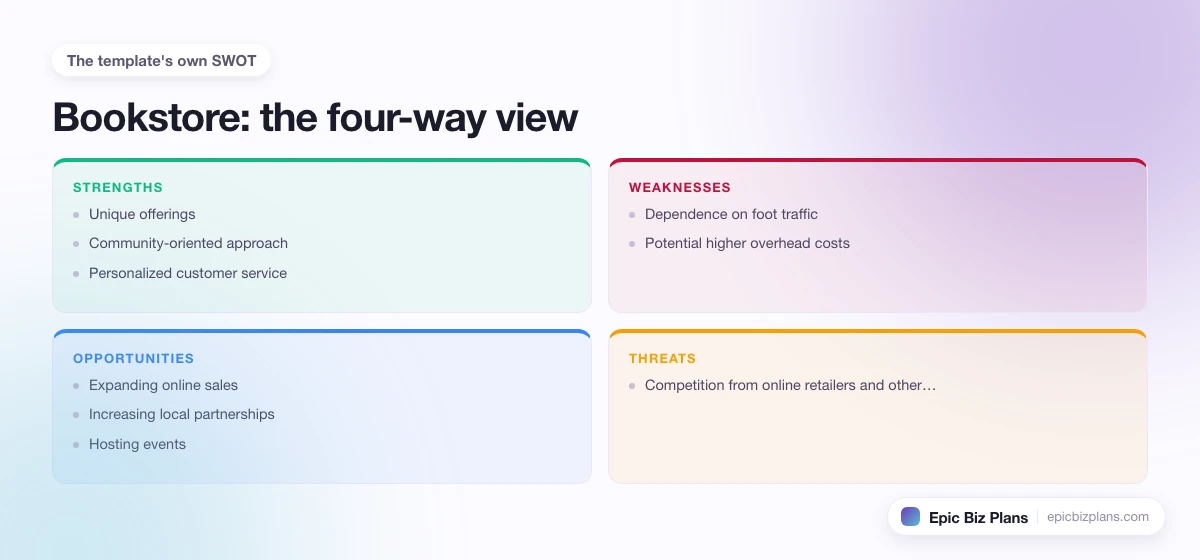
- Strengths: Unique offerings, community-oriented approach, and personalized customer service.
- Weaknesses: Dependence on foot traffic, and potential higher overhead costs.
- Opportunities: Expanding online sales, increasing local partnerships, and hosting events.
- Threats: Competition from online retailers and other local bookstores.
Bookstore Business Name Ideas
Website
We will build our website using Shopify, which handles both online book sales and event registration. The site will feature staff picks, new arrivals, an events calendar, and a newsletter signup. For stores that combine books with food service, platforms like Squarespace offer strong design templates that highlight the cafe experience alongside the book inventory. Entrepreneurs exploring the cafe-bookstore hybrid model should also review our book and coffee business plan for additional insights.
Marketing Details
Our marketing targets local readers through a combination of SEO, email marketing, and community partnerships. Semrush will guide our keyword strategy around terms like "independent bookstore near me," "book clubs in [your city]," and "local author events." HubSpot will manage our email list, sending weekly newsletters with new arrivals, staff recommendations, and upcoming events.
Social media will center on Instagram and TikTok, where BookTok content drives significant book discovery among younger readers. We will post short video reviews, behind-the-scenes looks at shipment arrivals, and event highlights. Partnerships with local schools and libraries will create referral channels that bring families into the store.
Store Design and Customer Experience
The physical layout of the store directly impacts how long customers stay and how much they spend. We will organize inventory into clearly signed sections with comfortable reading nooks and a children's area designed for browsing. The cafe counter will be visible from the entrance, drawing customers further into the space. Lighting, seating, and music will create an atmosphere that encourages lingering. Seasonal window displays and rotating featured collections will keep the storefront looking fresh and give returning customers something new to discover each visit.
Industry Trends
Independent bookstores have grown steadily as consumers seek alternatives to online retail. The BookTok phenomenon on TikTok has driven significant sales of both new releases and backlist titles, often catching publishers and retailers off guard with sudden demand spikes. Retailers who pair their storefront with an editorial review presence can amplify this effect - a book review business plan outlines how to build that complementary content platform. Print book sales remain strong despite the availability of ebooks and audiobooks, with many readers preferring physical copies for the reading experience. Stores that combine retail with events and food service report higher average transaction values and stronger customer loyalty.
Competitor Information
Direct competitors include other independent bookstores and chain retailers like Barnes & Noble. Indirect competitors are Amazon and other online book retailers that compete on price and convenience. Our competitive advantage comes from curation, personal service, and the in-store experience that online retailers cannot replicate. Staff who read widely and can make genuine recommendations build the kind of customer relationships that drive repeat visits. Stores specializing in used books compete on price, while we will compete on discovery and community.
Financial Information
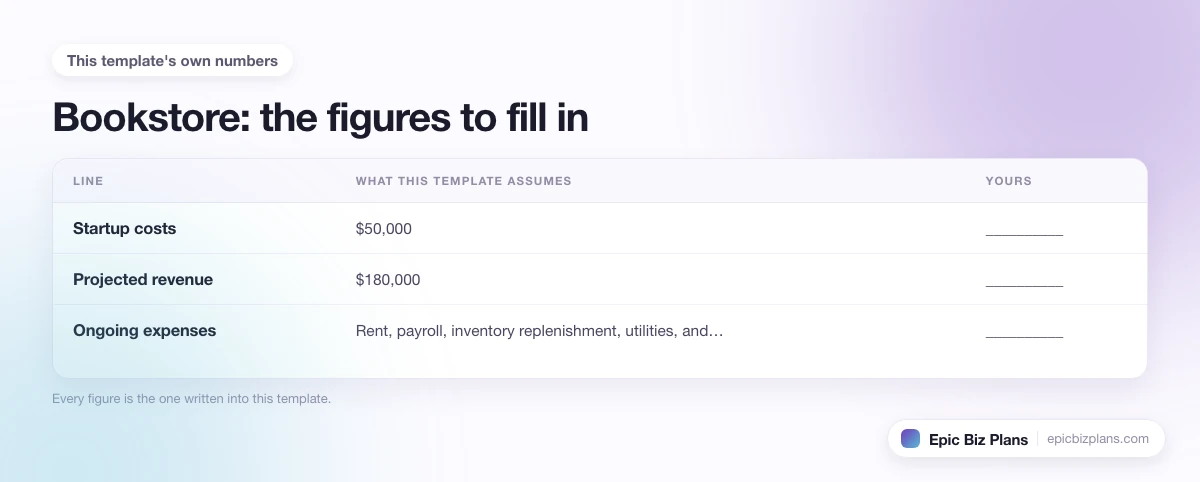
Startup costs are estimated at $50,000 to $75,000, covering initial inventory, lease deposit, store buildout, point-of-sale system, and launch marketing. Book retail typically operates on a 40% gross margin when purchasing from distributors. First-year revenue projection is $180,000, growing to $300,000 by year three as community awareness builds and event programming matures. Monthly expenses include rent, payroll, inventory replenishment, utilities, and marketing. We will monitor inventory turnover closely to avoid tying up cash in slow-moving titles.
Legal and Compliance
We will register the business, obtain a retail sales license, and collect applicable sales tax. If operating a cafe, food service permits and health department inspections are required. We will carry general liability insurance and consider business interruption coverage. Trademark registration for our store name and logo protects our brand as we build recognition in the community.
Operational Plan
Inventory management is the core operational challenge for any bookstore. We will use a bookstore-specific POS system like IndieCommerce or Bookmanager that integrates with distributor catalogs and tracks sales by category. Reordering decisions will be based on sell-through rates and seasonal trends. Staffing will include a store manager, part-time booksellers, and a cafe attendant. We will establish return policies with our distributors to manage unsold inventory efficiently.
-
 SemrushSemrush is a platform with literally any online tool you will need to promote your business. Spy on your competitors, get search traffic, keyword research, social info, ad copies and much more. Used by most of the top online companies in the world. Besides all its tools, Semrush also has many available integrations possible with many other tools that will make your work even better.
 -
 Surfer SEOSurfer SEO is an incredibly smart AI tool that will give you exact explanations what to do in order to make your website rank better. They use hundreds of parameters, check your competitors and decide on the best course of action. Whether it be inner links, bold text, paragraphs, headers, images and much more. Surfer is a must-have in 2026.
Contingency Planning
Risks include lower-than-expected foot traffic, supply chain delays from distributors, and economic downturns that reduce discretionary spending. We will maintain a cash reserve covering three months of operating expenses. If in-store sales decline, we will increase online marketing and expand our e-commerce catalog. Diversifying revenue through events, merchandise, and cafe sales reduces our dependence on any single income stream.
Build Something Lasting
Opening a bookstore means creating a space where people come to discover, connect, and slow down. The most successful independent bookstores are the ones that become part of their community's identity. Whether you picture a cozy neighborhood shop, a genre-focused destination store, or a bookshop cafe that brings readers and coffee lovers together, the model works when you know your audience and stock your shelves accordingly.
Explore the Possibilities
The bookstore niche includes many variations. You can operate a new-book shop focused on literary fiction, a children's bookstore serving families, a specialty shop for rare and collectible editions, or a combination store that sells books alongside gifts and local art. Each model serves a different customer and requires different inventory and marketing strategies.
Evolution is Key
Revisit your bookstore business plan quarterly. Update sales projections based on actual data, adjust your inventory mix based on what sells, and refine your event calendar based on attendance patterns. A plan that evolves with your business keeps your decisions grounded in reality rather than assumptions.
Move Forward
Your bookstore business plan is 100% free -- with unlimited edits, unlimited downloads, and unlimited chances to get it right. Start building your plan now and take the first step toward opening a bookstore that your community will value.
