
Books And Coffee Business Plan Template
-
 ShopifyPut your brand on Shopify. Launch your online store with tools designed for growth and success. Ready to turn your idea into profit? Start building your e-commerce business today.
 -
 SquarespaceShowcase your brand with Squarespace’s sleek designs. Build a professional online presence with ease. Start with a template that already looks finished.
 -
 WixBring your ideas to life with Wix. Customize every aspect of your site with unmatched flexibility. Start creating your unique online space and let your creativity shine.
 -
 ElementorCraft captivating websites effortlessly with Elementor. Enjoy complete creative control without coding. Make your site stand out to your audience. Start turning your vision into reality now.
- Executive Summary
- Business Info
- SWOT Analysis
- Business Name Ideas
- Website
- Marketing Details
- Industry Trends
- Competitor Information
- Startup Costs and Revenue Streams
- Financial Information
- Legal and Compliance
- Operational Plan
- Contingency Planning
- Building a Books and Coffee Business Worth Returning To
- Types of Books and Coffee Businesses
- Embrace Growth and Adaptation
- Practical Applications for Your Business Plan
A books and coffee business brings together two experiences that customers actively seek out when they want to slow down and disconnect from the pace of daily life. Building this type of venue successfully requires more than a good aesthetic - it demands a clear understanding of your inventory model, your revenue mix, and the community you want to serve. Your books and coffee business plan is the document that translates a compelling concept into a financially structured and operationally viable business. Cafes that want to roast their own beans in-house can pair this with a roast business plan for the sourcing and roasting details.
The strongest concepts in this space succeed by committing to a specific identity: a neighborhood literary hub, a student study destination, a curated gift shop with an espresso bar attached. Without that clarity, the business risks trying to serve too many customer types without excelling for any of them. Define your customer, your space, and your experience before you sign a lease or place your first inventory order.
Executive Summary
Our mission is to create a warm, inviting space where quality literature and expertly brewed coffee combine to offer customers more than a transaction. Our vision is a recognized community hub known for thoughtful book curation, exceptional coffee, and programming that brings readers together. Our value proposition rests on the combination of high-quality products and a genuine community atmosphere that larger chains cannot replicate. We target $500,000 in gross revenue in our first year while building sustainable margins and a loyal local customer base.
Business Info
We will offer a curated selection of books across popular genres alongside artisanal coffee sourced from local roasters. Our target customers are book lovers, students, remote workers, and community-minded professionals who value a thoughtful, comfortable third space. Our revenue model combines coffee and food sales, book retail, event hosting, and online sales of curated book bundles and merchandise. Operators focused on the early crowd can pair this concept with a morning business plan.
SWOT Analysis
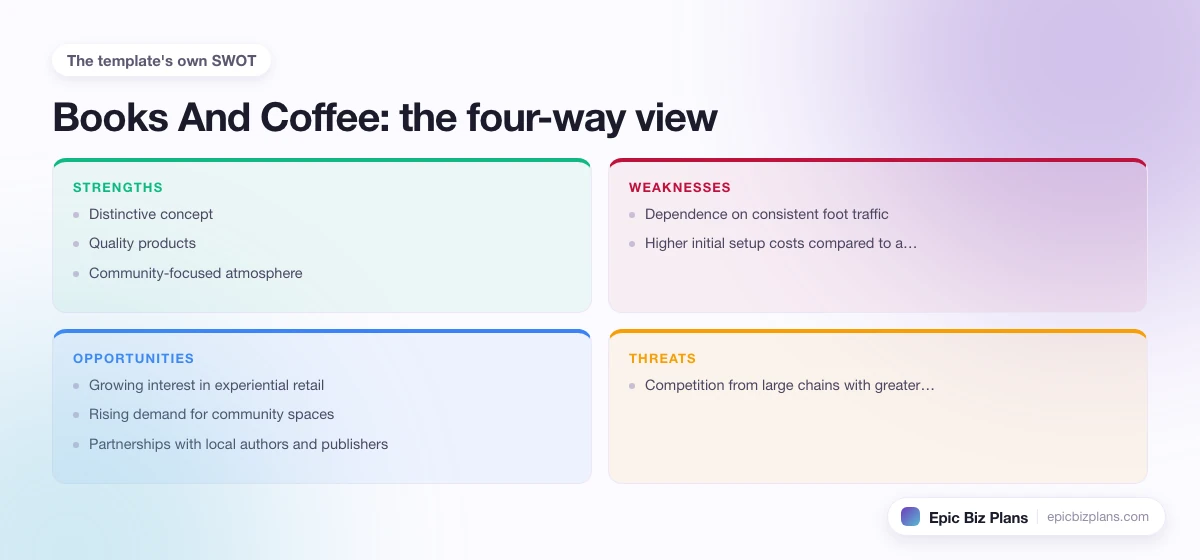
- Strengths: Distinctive concept, quality products, community-focused atmosphere, and multiple revenue streams.
- Weaknesses: Dependence on consistent foot traffic, higher initial setup costs compared to a coffee-only operation.
- Opportunities: Growing interest in experiential retail, rising demand for community spaces, and partnerships with local authors and publishers.
- Threats: Competition from large chains with greater purchasing power and economic downturns reducing discretionary spending.
Business Name Ideas
Website
We will build our website on Shopify to support online book sales and merchandise, with event listings integrated directly into the site. The online store extends our revenue beyond the physical location and allows us to reach customers who discover us through search or social media before visiting in person. A clear, visually appealing site communicates the warmth and character of the brand before a customer steps through the door.
Marketing Details
Our marketing strategy will blend local community outreach with digital channels to build awareness and drive foot traffic. Semrush will guide our SEO strategy so we rank for local searches related to coffee shops, bookstores, and community events in our area. HubSpot will manage email marketing to subscribers, promoting events, new arrivals, and seasonal specials.
Social media platforms will showcase the atmosphere, coffee preparation, and featured books in a way that builds an audience beyond our immediate neighborhood. For a related venue concept with an alcohol license, see our coffee cocktails business plan template.
Industry Trends
Experiential retail continues to outperform transactional retail across most consumer categories, and the books-and-coffee hybrid benefits directly from this shift. Independent bookstores have seen consistent growth in recent years as customers seek curated alternatives to algorithm-driven online retail. Event programming such as author readings, book clubs, and writing workshops is increasingly central to the business model rather than a supplementary activity.
Sustainability in coffee sourcing and a focus on local authors resonates strongly with the target demographic. See our bookshop café business plan template and bookshop business plan template for related planning frameworks.
Competitor Information
Direct competitors include other independent coffee shops and bookstores, while indirect competitors include any venue competing for the same customer leisure time and spending. Our differentiation lies in executing both offerings at a high standard - not a bookstore that sells drip coffee, and not a café with a spinner of paperbacks. Event programming and community engagement create competitive advantages that product alone cannot replicate.
Startup Costs and Revenue Streams
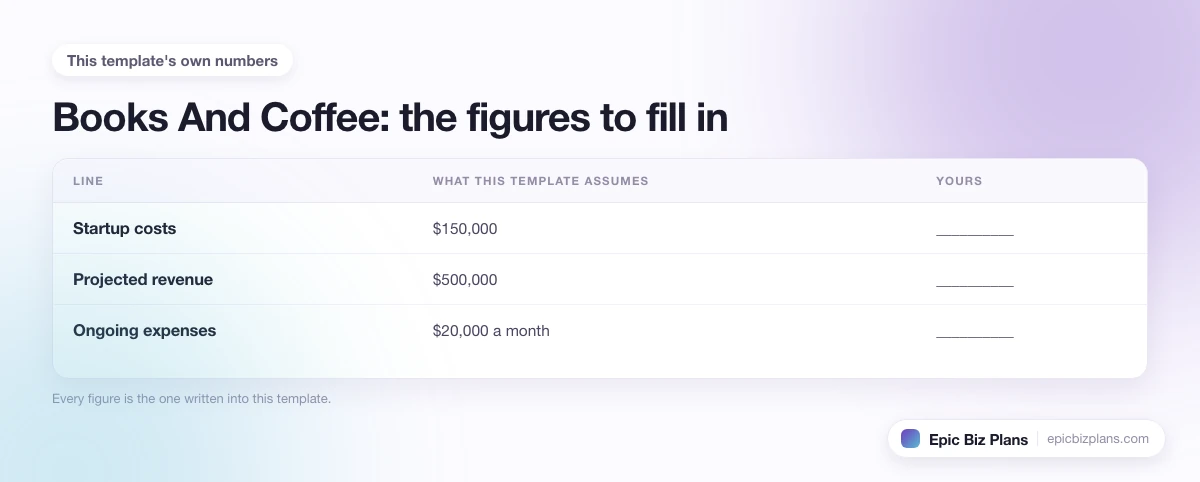
Startup costs are estimated at $150,000, covering lease deposits and fit-out, coffee equipment, initial book inventory, opening staffing, and marketing. The primary revenue stream is coffee and food sales, which typically account for 60 to 70% of total revenue in this format. Book retail, event ticket sales, merchandise, and online orders provide important supplementary income that improves overall margins. For a closely related approach, see our Book Cafe business plan template.
Event hosting - paid workshops, author evenings, and book clubs - generates revenue while also building community and encouraging repeat visits. Target a minimum of two to four events per month from the opening month. For a related angle, see our book club business plan template.
Financial Information
Startup costs are projected at $150,000, covering the lease, inventory, equipment, and renovations. Ongoing monthly expenses of approximately $20,000 include staff salaries, utilities, and supplies. Our first-year revenue target is $500,000, with surplus reinvested into expanding book inventory and event programming. Cash flow will be reviewed monthly to ensure the business stays on track against projections.
Legal and Compliance
We will register the business and obtain all required permits including food service and applicable retail licenses. Our brand name, logo, and any proprietary programming formats will be protected where appropriate. Staff will be trained in food handling compliance and customer service standards before opening.
Operational Plan
Core operations cover daily coffee service, book inventory management, event coordination, and online order fulfillment. We will work with local roasters and publishers to maintain a product range that reflects the brand values and keeps the offering fresh. Staff training will cover both product knowledge and the community-oriented customer experience that distinguishes us from standard retail.
-
 SemrushSemrush is a platform with literally any online tool you will need to promote your business. Spy on your competitors, get search traffic, keyword research, social info, ad copies and much more. Used by most of the top online companies in the world. Besides all its tools, Semrush also has many available integrations possible with many other tools that will make your work even better.
 -
 Surfer SEOSurfer SEO is an incredibly smart AI tool that will give you exact explanations what to do in order to make your website rank better. They use hundreds of parameters, check your competitors and decide on the best course of action. Whether it be inner links, bold text, paragraphs, headers, images and much more. Surfer is a must-have in 2026.
Contingency Planning
Key risks include foot traffic fluctuations driven by weather, local events, or economic conditions, and volatility in coffee bean and book wholesale pricing. We will diversify revenue through online sales and events to reduce dependence on daily walk-in trade. A cash reserve covering three to four months of operating expenses will provide a buffer during slower trading periods.
Building a Books and Coffee Business Worth Returning To
The most successful books and coffee businesses become landmarks in their communities - places that customers return to regularly and recommend to friends not just because of the product, but because of how the space makes them feel. That kind of loyalty takes time to build, but it starts with a clear concept, quality execution, and genuine investment in the community you serve. Your business plan is where that intention becomes operational reality.
Types of Books and Coffee Businesses
The format can range from a compact neighborhood café with a curated book wall to a full-scale independent bookstore with a specialty coffee bar, event space, and online retail operation. Each format requires different capital, staffing, and inventory investment. Choose the format that matches your available resources and the specific gap you see in your local market.
Embrace Growth and Adaptation
Revisit your business plan regularly as you learn what your customers respond to. Which events sell out? Which book genres move fastest? Which coffee drinks drive repeat visits? Let the data from your first six to twelve months inform meaningful updates to your product mix and marketing approach.
Practical Applications for Your Business Plan
Use your books and coffee business plan when approaching landlords, investors, or lenders - it demonstrates that you understand the economics of the business, not just the aesthetic. A well-structured plan is also an internal management tool, keeping your team aligned on priorities and financial targets as the business grows.
Your books and coffee business plan is 100% free - with unlimited edits, unlimited downloads, and unlimited chances to get it right.
