
Apparel Business Plan Template
-
 ShopifyPut your brand on Shopify. Launch your online store with tools designed for growth and success. Ready to turn your idea into profit? Start building your e-commerce business today.
 -
 SquarespaceShowcase your brand with Squarespace’s sleek designs. Build a professional online presence with ease. Start with a template that already looks finished.
 -
 WixBring your ideas to life with Wix. Customize every aspect of your site with unmatched flexibility. Start creating your unique online space and let your creativity shine.
 -
 ElementorCraft captivating websites effortlessly with Elementor. Enjoy complete creative control without coding. Make your site stand out to your audience. Start turning your vision into reality now.
Your apparel business plan is the foundation for building a brand in a fast-changing industry. This work is not just about fabric and stitches; it covers culture, expression, and lifestyle. To compete well, your apparel business plan should match your brand and speak directly to the customers you want to reach. The goal is to turn your vision into a clear blueprint that reflects what you stand for and where you want to go. Entrepreneurs in related planning categories may also benefit from the burn business plan template as a complementary strategic reference. Entrepreneurs building in closely related niches should also explore the lounge wear business plan template for parallel planning frameworks. If you are drawn to heritage styling or period-accurate pieces, the Colonial Clothing business plan template shows how to build an apparel brand around historical detail.
With trends shifting quickly and consumer demands moving fast, a clear apparel business plan gives you a real advantage. This plan should lay out your goals, define your brand identity, and reflect why you care about what you sell, much like a trend-led Mania business plan built for young shoppers. The aim is to build a brand that people want to wear and also believe in. Use this document to map your future in the outdoor apparel business plan outdoor adventure brand business plan world. For the unit economics behind a direct online brand, and the rules governing how reviews may be used, see our direct-to-consumer brand plan.
Executive Summary
We will focus on establishing a contemporary apparel business that caters to environmentally conscious consumers. For a full worked example of a green clothing brand, see our example business plan template. Sellers who want to test products without holding inventory can review the dropshipping clothing business plan template. Our mission is to deliver high-quality, sustainable clothing that combines style and comfort while minimizing environmental impact. Our vision is to be a leader in the sustainable fashion industry, promoting ethical practices among consumers and retailers alike. For a related approach, see the skateboards business plan template. For a related model, see our women's clothing business plan.
Our value proposition lies in our commitment to sustainability, using eco-friendly materials, and ethical production methods, the same standards a focused jumpsuit line would follow. Brands building nature-inspired sustainable apparel with a distinctive visual identity should also review the Peacock business plan for aesthetic positioning and materials certification frameworks. We will aim to achieve financial goals of reaching $500,000 in sales by the end of our second year and ensuring profitability by the third year of operation.
Business Info
We will offer a range of sustainable apparel, including casual wear, activewear, uniform lines built along the lines of a medical scrub business plan template, and a merch line made from organic and recycled materials, with room to add occasion lines like those from a graduation business. Brands adding decorated tees and printed pieces to the line can map out that side of production with a dedicated screen printing business plan. Brands branching into performance categories can also reference the sport clothes business plan template for athletic-wear product planning. Our target market includes environmentally conscious individuals aged 18-35 who prioritize sustainability in their purchasing decisions. Apparel businesses serving the combat sports and fitness training Christian apparel line should also review the boxer business plan for a model covering performance gear sales, gym channel partnerships, and the growing boxing fitness market. Founders leaning toward a curated boutique format can also review our Bobyreff Botique business plan template for a store-focused approach. Labels expanding into protective face coverings can pair this with a mask business plan template to cover that product line.
Business Model Overview
Our business model will revolve around direct-to-consumer (DTC) sales through our online platform, supplemented by pop-up shops and collaborations with eco-friendly retailers to increase brand awareness. Brands targeting a male audience can adapt this model alongside our Him business plan. Operators expanding into headwear should review the cap business plan template for customization and production specifics.
SWOT Analysis
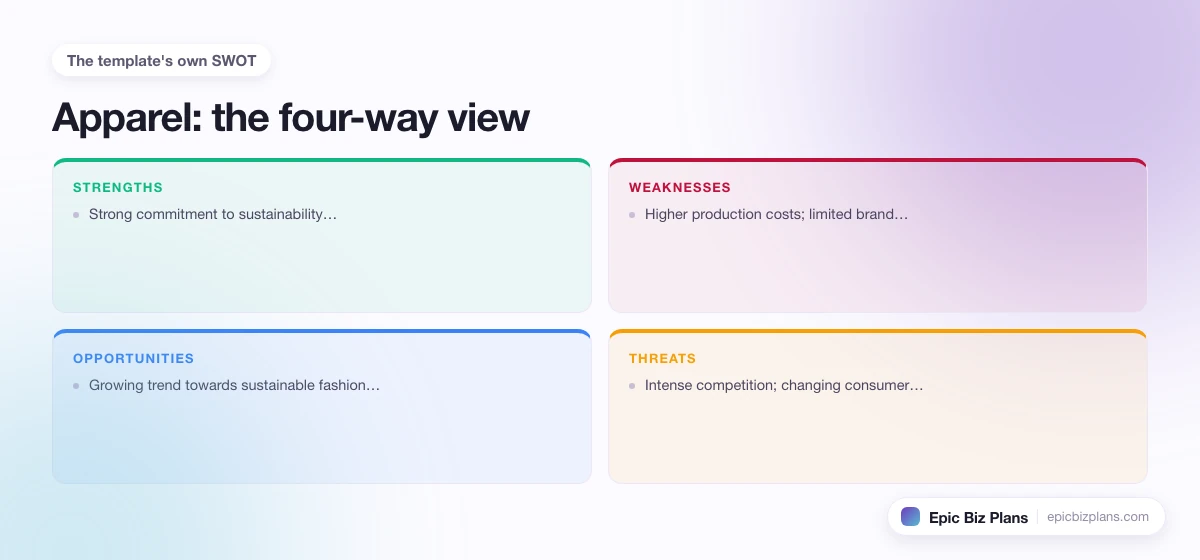
- Strengths: Strong commitment to sustainability; high-quality products; dedicated team.
- Weaknesses: Higher production costs; limited brand recognition initially.
- Opportunities: Growing trend towards sustainable fashion; collaboration with influencers; expanding online sales.
- Threats: Intense competition; changing consumer preferences.
Apparel Business Name Ideas
Website
We will build our online store using Shopify as our primary option, as it is well-suited for e-commerce businesses. Shopify provides a user-friendly platform with various tools tailored for selling apparel. Alternatively, if we decide on a more visually-oriented website, Squarespace is also an excellent option for showcasing our sustainable clothing with style. For a closely related angle, see the Cubs business plan template.
Marketing Details
Our marketing strategy will incorporate both digital marketing and social media outreach. We will use Semrush for SEO to improve our visibility and organic search rankings, ensuring our target audience can easily find us online.
For email marketing campaigns, we will implement HubSpot to engage with our customers and keep them informed about our new product launches and sustainability initiatives.
To target younger consumers, we will use TikTok ads to effectively reach and engage our audience, showcasing our products through engaging and creative content.
Industry Trends
The sustainable apparel industry is witnessing significant growth as consumers increasingly demand eco-friendly products. Technological advancements in fabric production, such as recycled materials and innovative dyes, are paving the way for more sustainable practices. Companies adopting transparent supply chains and ethical standards are becoming more popular, which aligns with our business objectives. Founders working on related operating models often reference the T-shirt printing business plan for a parallel framework. Operators in adjacent weather-driven niches often look at the rain gear business plan for waterproof and seasonal apparel angles.
Competitor Information
Our main competitors will include established sustainable brands, focused t-shirts and sweaters labels, and fast fashion companies that are beginning to adopt eco-friendly practices. To differentiate our business, we will focus on our unique value proposition of uncompromised quality and thorough transparency in our sourcing processes. Engaging storytelling about our brand and products will set us apart from these competitors. Founders building a streetwear-leaning lifestyle brand can also reference the dank business plan template for positioning ideas. Apparel brands targeting subculture buyers sometimes reference a gloomy business plan template for the aesthetic-led model. For a niche apparel angle, the wearable turtle plush business plan template shows how plush wearables fit the same market.
Financial Information
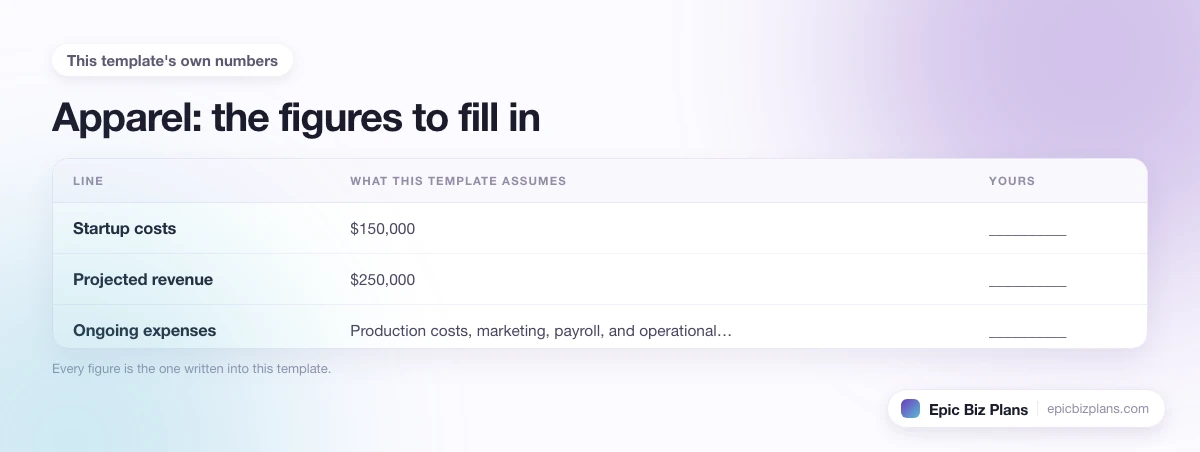
Our projected startup costs will include website development, initial inventory purchases, marketing efforts, and operational expenses. We will estimate our startup costs at around $150,000.
Projected revenue for the first year is approximately $250,000, with an expected growth of 100% in the second year. Ongoing expenses will include production costs, marketing, payroll, and operational overheads. We anticipate reaching a positive cash flow by the end of year three, and we will prepare detailed profit and loss (P&L) statements to track performance.
Legal and Compliance
We will ensure that our business is legally registered and complies with all local regulations regarding clothing products. This includes obtaining necessary licenses, following safety standards, and protecting our intellectual property through trademarks. It is essential to protect our brand identity and product designs. For additional context, see our shoes and clothes business plan template. For the sustainability-led version of this model, with the certification and extended producer responsibility costs set out, see the sustainable clothes business plan template. The fibre content, country of origin and responsible-company details every garment label must carry are set out in the fashion dropshipping business plan.
-
 SemrushSemrush is a platform with literally any online tool you will need to promote your business. Spy on your competitors, get search traffic, keyword research, social info, ad copies and much more. Used by most of the top online companies in the world. Besides all its tools, Semrush also has many available integrations possible with many other tools that will make your work even better.
 -
 Surfer SEOSurfer SEO is an incredibly smart AI tool that will give you exact explanations what to do in order to make your website rank better. They use hundreds of parameters, check your competitors and decide on the best course of action. Whether it be inner links, bold text, paragraphs, headers, images and much more. Surfer is a must-have in 2026.
Operational Plan
Key operations will involve sourcing eco-friendly materials from certified suppliers, including natural fibers covered in our silk business plan, managing our production schedule, and maintaining excellent quality control. We will work closely with ethical manufacturers to ensure our supply chain is sustainable and transparent. For a related angle, see our cross business plan.
Logistics will include an efficient distribution network to handle online orders, with a focus on minimizing our environmental footprint. We will explore partnerships with distribution companies that share our sustainability ethos. For another angle, see our K-pop merch business plan.
Contingency Planning
We recognize potential risks such as supply chain disruptions, changes in consumer preferences, and economic downturns. To mitigate these risks, we will establish strong relationships with multiple suppliers, including production partners like those outlined in our clothing manufacturer business plan, continuously monitor market trends, and maintain financial flexibility to adapt to changing conditions.
Through detailed planning and proactive strategies, we will ensure that our business remains resilient in the face of challenges, allowing us to thrive in the apparel industry.
Conclusion
Launching an apparel business is about more than clothing; it is a chance to express identity, reflect culture, and apply your own creativity. Whether you draw from current fashion trends or your own vision, an apparel business plan is the roadmap that turns that interest into a working brand. From independent streetwear labels to locally produced sustainable fashion and large ecommerce sellers, this niche has room for many models. Many apparel brands widen their range with accessories, and a dropshipping sunglasses business plan template shows how to add eyewear without holding stock.
Adapt and Evolve
Your apparel business plan is not a static document; it should evolve as you do. As your audience shifts, or as you explore different pricing models, product lines, regions, or sales channels, updating your plan will keep you aligned with your goals. This allows you to change confidently when necessary, ensuring your vision remains focused and effective. Brands targeting alternative and subculture audiences can also use our punk business plan template. Labels expanding into outerwear can map that category with the coat business plan template.
Put Your Plan to Work
Effectively use your apparel business plan to present to potential partners, strategize your launch, secure funding, or clarify your overall direction. If you intend to print licensed characters or brand artwork on your garments, set the terms first with a licensing business plan so you stay on the right side of intellectual property rules. It serves as an essential tool that transforms ideas into actionable steps, providing structure as you build your brand.
Remember, your apparel business plan is 100% free, with unlimited edits, unlimited downloads, and unlimited chances to get it right. Use it to set up your future success.
