
Fashion Dropshipping Business Plan Template
-
 ShopifyPut your brand on Shopify. Launch your online store with tools designed for growth and success. Ready to turn your idea into profit? Start building your e-commerce business today.
 -
 SquarespaceShowcase your brand with Squarespace’s sleek designs. Build a professional online presence with ease. Start with a template that already looks finished.
 -
 WixBring your ideas to life with Wix. Customize every aspect of your site with unmatched flexibility. Start creating your unique online space and let your creativity shine.
 -
 ElementorCraft captivating websites effortlessly with Elementor. Enjoy complete creative control without coding. Make your site stand out to your audience. Start turning your vision into reality now.
- Executive Summary
- Business Info
- Business Model Overview
- SWOT Analysis
- Business Name Ideas
- Website
- Marketing Details
- Industry Trends
- Competitor Information
- Startup Cost Breakdown
- Financial Information
- Legal and Compliance
- The import rule that changed the maths
- Whose name goes on the label
- Operational Plan
- Contingency Planning
- Embrace Your process with a Fashion Dropshipping Business Plan
- Evolving Your Business Plan
- Using Your Business Plan
- Take Action Today
The fashion dropshipping model has become one of the more practical entry points into e-commerce, particularly for entrepreneurs who want to sell apparel without managing inventory. Instead of buying stock upfront, you partner with suppliers who ship products directly to your customers. This keeps overhead low while giving you flexibility to test different styles, price points, and niches before committing to a specific direction.
That said, fashion is a competitive space. Margins can be thin, supplier reliability varies significantly, and customers expect fast shipping regardless of where their order originates. A well-structured business plan helps you think through these realities before they become operational problems. It should define your niche, your supplier vetting process, your marketing channels, and your financial targets, not just describe the concept in general terms. Sellers exploring fast-moving, trend-led products can also review the Dropshipping Crossy business plan template for a related approach.
Executive Summary
We will establish a fashion dropshipping business focused on delivering quality apparel and accessories to trend-conscious consumers aged 18 to 35. Eyewear is a strong add-on category here, detailed in our spectacle business plan template. Founders launching a name-led apparel brand can also reference a Levi business plan template for brand-naming and positioning frameworks. Our mission is to provide a straightforward shopping experience with consistent access to current styles, without carrying physical inventory. We aim to become a trusted online destination for a defined fashion niche rather than a generic all-category store. Sellers targeting a bold, individuality-driven niche can also review a funky business plan.
Our financial targets include reaching $500,000 in annual revenue within three years, keeping customer acquisition costs under $20, and maintaining a net margin of 30% on all sales. We will achieve this by concentrating on high-margin product categories, building repeat purchase rates through email marketing, and minimizing return rates through careful supplier selection.
Business Info
Our store will carry clothing, footwear, and accessories, including curated luxury handbag drops: for men and women, with a focus on casual-to-streetwear styles that perform well on social media platforms. Our primary target market is adults aged 18 to 35 who shop online regularly and respond to trend-driven content. We will operate exclusively online using a dropshipping model, meaning our suppliers handle warehousing and fulfillment.
Business Model Overview
We will partner with vetted dropshipping suppliers who meet our standards for product quality, shipping speed, and return policies. Our role in the supply chain is marketing, customer service, and brand building, not logistics. This model allows us to run a lean operation while offering a broad product catalog. For context on how this differs from a traditional retail approach, reviewing a clothing business plan template can be instructive.
SWOT Analysis
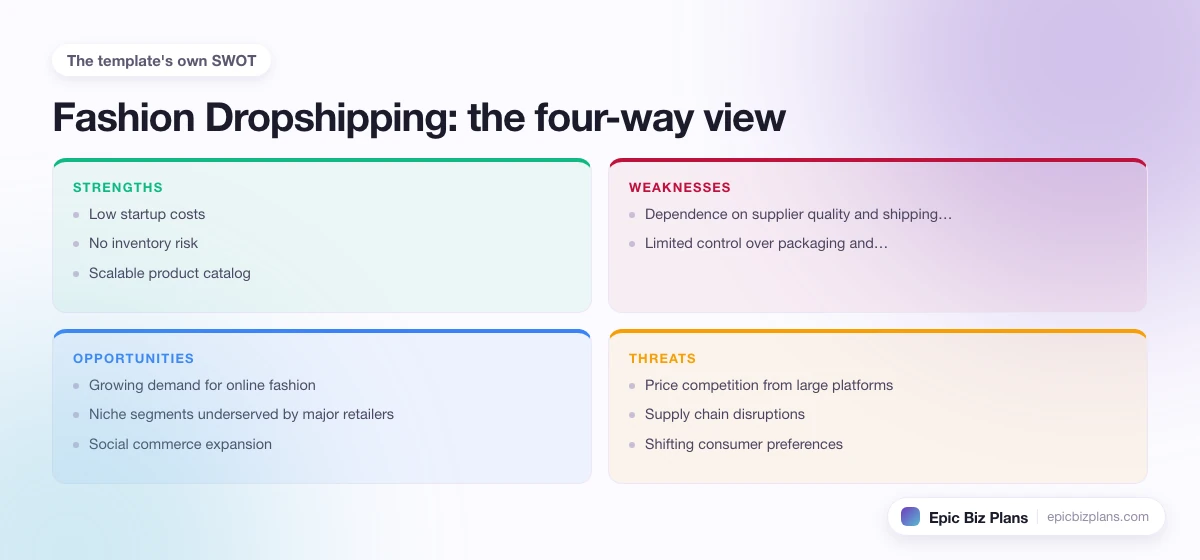
- Strengths: Low startup costs, no inventory risk, scalable product catalog, flexible pricing.
- Weaknesses: Dependence on supplier quality and shipping timelines, limited control over packaging and fulfillment experience.
- Opportunities: Growing demand for online fashion, niche segments underserved by major retailers, social commerce expansion.
- Threats: Price competition from large platforms, supply chain disruptions, shifting consumer preferences.
Business Name Ideas
Website
We will build our storefront on Shopify, which is purpose-built for e-commerce and integrates directly with major dropshipping platforms like DSers and AutoDS. Shopify handles payment processing, inventory syncing, and order routing out of the box. Squarespace is a viable alternative for businesses that prioritize visual presentation, though its dropshipping integrations are more limited than Shopify's.
Marketing Details
Our marketing strategy centers on paid social, SEO-driven content, and email retention. We will run TikTok and Instagram ads targeting our core 18 to 35 demographic with short-form video content showcasing products in real-world settings. SEO work will be managed through Semrush, with content optimized around product category terms and style guides.
HubSpot will handle our email campaigns, including welcome sequences, abandoned cart recovery, and seasonal promotions. Email marketing typically delivers the strongest return on investment for fashion e-commerce, particularly for repeat buyers.
Industry Trends
Consumer preferences in fashion are shifting toward sustainability and transparency, and an increasing share of shoppers are choosing secondhand alternatives: operators tracking that channel can compare against our thrifted clothing business plan template. Shoppers increasingly ask where products are made, how workers are treated, and whether brands are taking environmental responsibility seriously. Dropshippers who source from suppliers with ethical production practices gain a meaningful competitive advantage. Augmented reality try-on features and AI-powered size recommendations are also reducing return rates for forward-looking fashion brands. Fashion dropshippers looking to evolve beyond individual products into curated complete looks should review the Outfit business plan for guidance on building a branded outfit retail model with coordinated product curation and a DTC strategy built around sustainable sourcing.
Competitor Information
Key competitors include large dropshipping stores operating on generic fashion verticals as well as established boutique e-commerce brands with loyal followings. Differentiation comes from niche selection, product curation, and brand voice, not price. Entrepreneurs expanding their dropshipping catalog into accessories should review a dropshipping jewelry business plan to understand how accessory-focused stores approach supplier relationships and margins. Similarly, operators interested in seasonal or trend-driven products can find useful frameworks in a dropshipping clothing business plan template. Fashion dropshippers targeting the premium lifestyle sportswear niche (including polo and equestrian apparel) should review the polo business plan template for how heritage sport brands structure their product lines, event marketing, and DTC channel strategy. For lifestyle fashion brands building a branded DTC store with a specific aesthetic targeting young adults, the Starz business plan template covers brand identity strategy, limited-edition drop models, and DTC fashion e-commerce operations for lifestyle-focused product lines.
Startup Cost Breakdown
Understanding your actual startup costs is essential before launching. For a fashion dropshipping business, initial expenses typically include Shopify subscription fees, domain registration, professional theme purchase, initial ad spend, and any software tools for supplier management. A realistic budget for a well-set-up store runs between $3,000 and $8,000 before generating consistent revenue.
The largest variable cost in year one is paid advertising. Many dropshippers underestimate how much testing is required to find profitable ad creatives and audiences. Budget at least $1,500 ($2,000 for ad testing before expecting consistent returns. Monthly ongoing costs) platform fees, apps, marketing, and customer service tools (typically run $800) $1,500 for a small operation.
Financial Information
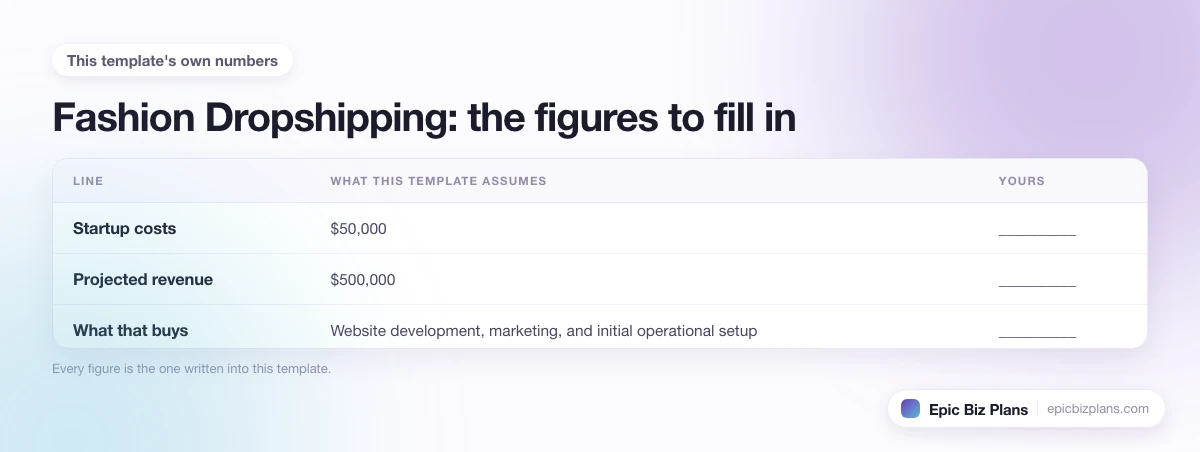
Startup costs are estimated at approximately $50,000, covering website development, marketing, and initial operational setup. We project revenue of $500,000 within the first three years, with monthly fixed and variable expenses of approximately $15,000. Our financial model targets a 30% net profit margin by year three, achieved through optimized ad spend, strong email retention, and supplier negotiation as volume grows. Entrepreneurs exploring the broader e-commerce landscape should also consider how a standard e-commerce business plan template structures its financial projections for comparison.
Legal and Compliance
We will register our business as an LLC to limit personal liability and establish a professional structure for supplier agreements. A business bank account and dedicated bookkeeping system should be set up before the first sale. We will trademark our brand name once operations are established, and monitor for infringement as the brand grows. All supplier contracts should clearly define return and refund responsibilities, since in a dropshipping model, the store owner is ultimately accountable to the customer.
-
 SemrushSemrush is a platform with literally any online tool you will need to promote your business. Spy on your competitors, get search traffic, keyword research, social info, ad copies and much more. Used by most of the top online companies in the world. Besides all its tools, Semrush also has many available integrations possible with many other tools that will make your work even better.
 -
 Surfer SEOSurfer SEO is an incredibly smart AI tool that will give you exact explanations what to do in order to make your website rank better. They use hundreds of parameters, check your competitors and decide on the best course of action. Whether it be inner links, bold text, paragraphs, headers, images and much more. Surfer is a must-have in 2026.
The import rule that changed the maths
Fashion dropshipping was built on parcels from overseas suppliers entering the United States duty free under the $800 de minimis allowance. That allowance is gone. Customs published an indefinite suspension of the de minimis exemption for merchandise valued at $800 or less arriving through the international postal network on 24 June 2026, effective 24 July 2026, and the notice says any later change will be announced in the Federal Register rather than setting a restoration date. Pending legislation terminates the exemption outright from 1 July 2027. Shipments now need formal or informal entry with duty collected, and the new postal process requires filers to transmit classifications and calculated duties by the 7th of the month after arrival.
Model landed cost with duty in it, per style, before you set prices. A plan built on the old assumption will show margins it cannot deliver.
Whose name goes on the label
The second thing to settle is labelling, because dropshippers often assume the supplier owns it. Under the Textile and Wool Acts the obligations reach anyone who manufactures, imports, sells, offers to sell, distributes or advertises a covered product, and internet advertising counts. The Trade Commission is explicit that an importer is legally responsible for the proper labelling of imported textile goods and should periodically test fibre content to verify the labels are accurate. Each product needs fibre content, country of origin on the front of the label, and the identity of the responsible company or its registered identification number. That number is optional, not a licence to trade.
Selling into Europe adds a timetable. The first working plan under the EU ecodesign regulation, published on 16 April 2025, puts textiles and clothing in the first group of priority products, with requirements indicatively adopted in 2027 and a digital product passport attached. Related models are covered in the dropshipping clothing business plan template and the clothing resell business plan template.
Operational Plan
Daily operations will focus on order processing, customer service, and marketing campaign management. Supplier relationships require regular review. We will audit supplier performance quarterly on metrics including shipping time, defect rate, and stock reliability. An inventory management tool connected to our Shopify store will flag stock-outs automatically so we can deactivate listings before customers order unavailable products. Entrepreneurs running similar product-based online operations should review the dropshipping sportswear business plan for a practical comparison of operational workflows.
Contingency Planning
The most common disruptions in fashion dropshipping are supplier delays, unexpected stock shortages, and platform policy changes affecting advertising accounts. We will maintain relationships with at least two alternative suppliers for our top-selling product categories. Marketing will be diversified across at least three channels so that a ban or algorithm change on one platform doesn't cut off traffic entirely. A three-month operating cash reserve will provide runway to navigate disruptions without compromising customer service quality. Fashion dropshipping businesses considering a pivot to curated boutique inventory purchasing should review the Maryam business plan template for how to structure startup costs, inventory sourcing, and marketing for a boutique retail model.
Embrace Your process with a Fashion Dropshipping Business Plan
Building a fashion dropshipping business is a legitimate path to a profitable online store, but success comes from execution, not just concept. The entrepreneurs who do well in this space are the ones who choose a specific niche and stick to it, vet their suppliers rigorously, and invest in building a real brand rather than a generic storefront. A clear business plan helps you stay focused on what actually drives revenue instead of chasing every new trend. Dropshippers who want to build a fashion brand centered on inclusive sizing and silhouette-conscious design (carrying inventory rather than dropshipping) should review a silhouette business plan for how that DTC apparel model is structured from product development through fulfillment.
Evolving Your Business Plan
As your store grows, your business plan should grow with it. New suppliers, expanding product categories, additional sales channels, and international shipping all introduce new operational and financial considerations. Revisit your plan quarterly in the early years to make sure your targets and strategies still match the reality of your business.
Using Your Business Plan
Your business plan is a working document, not a one-time exercise. Use it to evaluate partnership opportunities, justify marketing budget decisions, and communicate your direction to contractors or investors. A plan grounded in specific numbers and realistic assumptions is far more useful than one built around general aspirations.
Take Action Today
Your Fashion Dropshipping business plan is 100% free: with unlimited edits, unlimited downloads, and unlimited chances to get it right. Now is the time to take charge of your future and turn your plans into a working business.
-
ShopifyPut your brand on Shopify. Launch your online store with tools designed for growth and success. Ready to turn your idea into profit? Start building your e-commerce business today.
-
SquarespaceShowcase your brand with Squarespace’s sleek designs. Build a professional online presence with ease. Start with a template that already looks finished.
-
WixBring your ideas to life with Wix. Customize every aspect of your site with unmatched flexibility. Start creating your unique online space and let your creativity shine.
-
ElementorCraft captivating websites effortlessly with Elementor. Enjoy complete creative control without coding. Make your site stand out to your audience. Start turning your vision into reality now.
