
Cap Business Plan Template
-
 ShopifyPut your brand on Shopify. Launch your online store with tools designed for growth and success. Ready to turn your idea into profit? Start building your e-commerce business today.
 -
 SquarespaceShowcase your brand with Squarespace’s sleek designs. Build a professional online presence with ease. Start with a template that already looks finished.
 -
 WixBring your ideas to life with Wix. Customize every aspect of your site with unmatched flexibility. Start creating your unique online space and let your creativity shine.
 -
 ElementorCraft captivating websites effortlessly with Elementor. Enjoy complete creative control without coding. Make your site stand out to your audience. Start turning your vision into reality now.
- Executive Summary
- Business Info
- Products and Services
- Target Market
- Business Model Overview
- SWOT Analysis
- Cap Business Name Ideas
- Website
- Marketing Details
- Industry Trends
- Competitor Information
- Financial Information
- Pricing Strategy
- Legal and Compliance
- Operational Plan
- Contingency Planning
- Conclusion: The Power of Your Cap Business Plan
- Keeping Your Plan Current
- Practical Uses for Your Business Plan
Your Cap business plan is the foundation for building a profitable headwear brand. It is not just about crunching numbers; it is about laying out a clear strategy that reflects your brand identity and reaches the right buyers. The cap market is crowded with established players, so your plan needs a sharp angle that explains exactly what makes your product different and why customers will pick you.
This document is your chance to define your vision and map the steps to reach it. Whether you are launching a small custom brand or scaling toward national distribution, your Cap business plan should set clear goals and detail how each part of the business will operate. Plan the production side, the marketing side, and the cash flow side with equal rigor. See our trucker hat business plan for related planning.
Executive Summary
We aim to provide high-quality, stylish caps for various demographics and occasions. Our mission is to create a product line that balances fashion and function, with cap styles that fit different tastes and activities. We plan to become a recognized headwear brand within five years, known for quality construction and considered design.
Our value proposition is customizable caps that appeal to both individual consumers and businesses placing bulk orders. Financially, we target $500,000 in revenue within the first year of operation and sustained 20% annual growth after that. Founders building a broader headwear line beyond caps should also review the hat business plan template, which covers multi-category headwear product mix, DTC margin benchmarks, and customization options across hat styles.
Business Info
Products and Services
We will offer a range of caps including baseball caps, trucker hats, beanies, and snapbacks. Customization will be a core service, with embroidery and patch options for clients who want personalized designs. Operators planning to run embroidery in-house can review our embroidery business plan template. We will use recycled and organic materials where practical, both to reduce environmental impact and to meet demand from buyers who care about sourcing.
Target Market
Our primary customers are adults aged 18-35, outdoor enthusiasts, and businesses ordering branded headwear for events or staff uniforms. We will start in urban areas where streetwear and lifestyle brands have strong demand, then expand geographically as we build inventory capacity. Founders building a wider apparel identity around their caps can also study our streetwear business plan template.
Business Model Overview
We will run a direct-to-consumer e-commerce model as the primary sales channel and pursue B2B bulk orders as a secondary revenue stream. Sales channels will include our online store, local pop-up events, and creator collaborations on Instagram and TikTok. For founders considering related apparel categories, the apparel business plan template walks through inventory and SKU planning at this scale.
SWOT Analysis
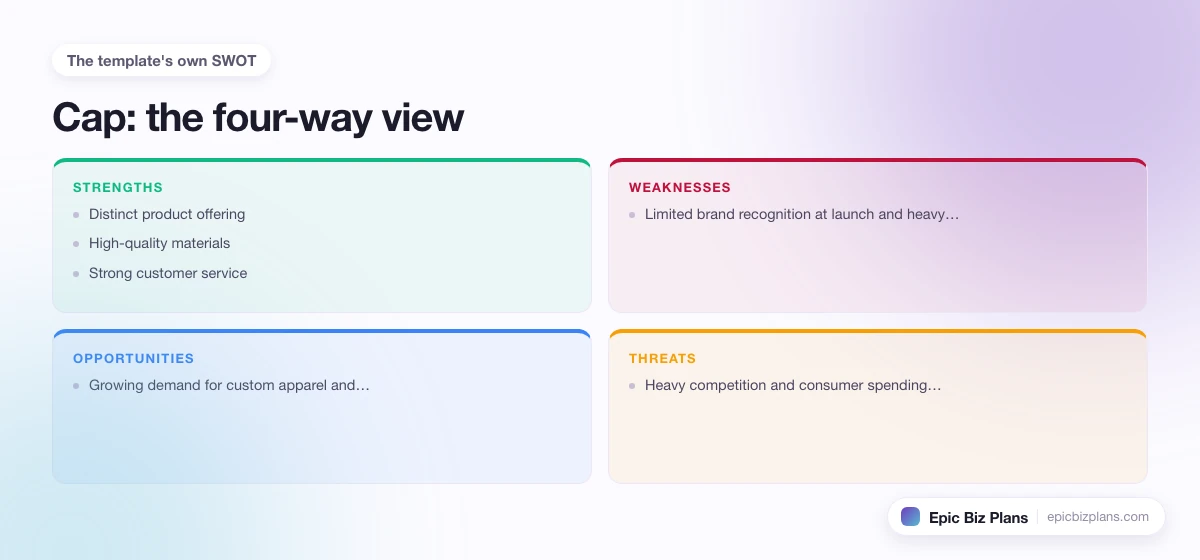
- Strengths: Distinct product offering, high-quality materials, and strong customer service.
- Weaknesses: Limited brand recognition at launch and heavy dependence on online sales.
- Opportunities: Growing demand for custom apparel and continued online shopping growth.
- Threats: Heavy competition and consumer spending shifts during economic downturns.
Cap Business Name Ideas
Website
We will build our website on Shopify because of its ease of use and feature set tailored for e-commerce. Shopify lets us manage the storefront, handle inventory, and process payments with minimal setup overhead. Apps and themes designed for apparel brands also let us showcase product photography without custom development work.
Squarespace is a possible alternative because of its design templates, which suit visual product presentation. Both platforms will support our cap sales and let us focus more time on product and marketing than on site maintenance.
Marketing Details
Our marketing strategy combines paid acquisition, content, and email. We will use Semrush for SEO research and on-page work so we show up for cap-related searches over time. HubSpot will handle email campaigns including post-purchase sequences, abandoned cart recovery, and seasonal product launches.
To build awareness with younger buyers we will run TikTok ads using short product demos and styling clips. Instagram and Facebook campaigns will pair organic content with creator partnerships, focusing on accounts whose followers actually buy headwear. We will track CAC and LTV by channel monthly to keep spend efficient.
Industry Trends
The headwear industry is shifting toward sustainable production and personalization. Better print and embroidery technology now makes small-batch custom runs profitable, which we will use to differentiate from mass-produced competitors. Headwear businesses looking for a creative retail concept that combines cap sales with an experience-driven venue should look at the trucker hat bar business plan, a hybrid model that pairs a bar environment with trucker hat retail and events.
Casual wear has also become more accepted in workplaces and other settings that once required formal attire, which widens the addressable market for caps beyond traditional sports and outdoor use.
Competitor Information
We will analyze direct competitors (established cap brands) and indirect competitors (general apparel brands that include headwear in their lines). Studying their marketing tactics, price points, and product mix will inform our positioning and help us avoid expensive mistakes in our first year.
Our customization options and sustainable material choices will be our main differentiators, both because they add value for customers and because they are difficult for high-volume competitors to match profitably.
-
 SemrushSemrush is a platform with literally any online tool you will need to promote your business. Spy on your competitors, get search traffic, keyword research, social info, ad copies and much more. Used by most of the top online companies in the world. Besides all its tools, Semrush also has many available integrations possible with many other tools that will make your work even better.
 -
 Surfer SEOSurfer SEO is an incredibly smart AI tool that will give you exact explanations what to do in order to make your website rank better. They use hundreds of parameters, check your competitors and decide on the best course of action. Whether it be inner links, bold text, paragraphs, headers, images and much more. Surfer is a must-have in 2026.
Financial Information
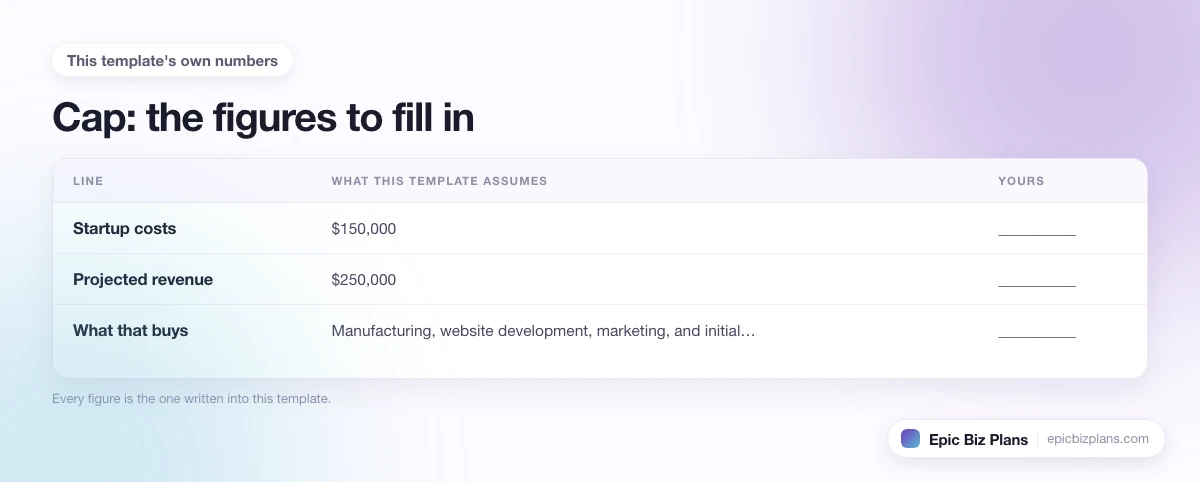
Projected startup costs are about $150,000, covering manufacturing, website development, marketing, and initial inventory. We aim for $500,000 in first-year revenue with associated ongoing costs of roughly $250,000. Cash flow and P&L statements will be reviewed monthly to track profitability and catch issues early.
Pricing Strategy
Standard caps will be priced at $25-$35 retail, custom orders at $35-$60 depending on personalization, and bulk B2B orders priced by quantity tier starting at $12 per unit for 100+ pieces. We will protect margin by setting minimum order quantities on custom and by negotiating volume pricing with manufacturers as production scales.
Legal and Compliance
We will register the business according to local laws and obtain any required licenses. Intellectual property protection will cover the brand name and original designs. Compliance with manufacturing standards and labor laws will be a hard requirement for all supplier relationships.
Operational Plan
Key operations cover sourcing materials, production, inventory management, and order fulfillment. We will build a reliable supply chain with at least two manufacturers per product category to avoid single-supplier risk. Third-party shipping partners will handle logistics for cost efficiency, and we will negotiate rates as monthly order volume grows.
Contingency Planning
To handle risks like supply chain disruption, we will keep multiple supplier relationships warm at all times. A cash reserve will cover unexpected costs or slow sales months. Quarterly reviews of the business plan will keep us adaptable as the headwear market shifts.
Conclusion: The Power of Your Cap Business Plan
Starting a cap business is about more than the product; it is about building a brand customers trust and an operation that runs efficiently. Whether you are selling handcrafted caps at local fairs, building an e-commerce brand, or scaling a fashion label with national distribution, the route to profitability runs through a clear plan. From streetwear-focused brands to functional outdoor gear, the cap niche has room for many specific positions.
Keeping Your Plan Current
Your cap business plan is not a one-and-done document. As you grow, update it to reflect new audiences, refined pricing models, new product lines, or expansion into new regions and sales channels. A plan that stays current is genuinely useful for making decisions; a plan that sits in a drawer is not.
Practical Uses for Your Business Plan
Think of your cap business plan as your operating manual. Use it to present your concept to partners, plan a launch, secure funding, or simply keep your strategy clear in your own head. With a solid plan, you are ready to compete in a crowded market with a clear answer to the question of why your brand exists.
Your cap business plan is 100% free, with unlimited edits, unlimited downloads, and unlimited chances to get it right. Start building the headwear brand you have been planning.
