
Cattle Business Plan Template
-
 ShopifyPut your brand on Shopify. Launch your online store with tools designed for growth and success. Ready to turn your idea into profit? Start building your e-commerce business today.
 -
 SquarespaceShowcase your brand with Squarespace’s sleek designs. Build a professional online presence with ease. Start with a template that already looks finished.
 -
 WixBring your ideas to life with Wix. Customize every aspect of your site with unmatched flexibility. Start creating your unique online space and let your creativity shine.
 -
 ElementorCraft captivating websites effortlessly with Elementor. Enjoy complete creative control without coding. Make your site stand out to your audience. Start turning your vision into reality now.
- Executive Summary
- Business Info
- Business Model Overview
- SWOT Analysis
- Cattle Business Name Ideas
- Website
- Marketing Details
- Industry Trends
- Competitor Information
- Financial Information
- Legal and Compliance
- Operational Plan
- Contingency Planning
- Putting Your Cattle Business Plan to Work
- Types of Cattle Businesses
- Adapt and Grow
- Practical Uses for Your Plan
- Get Started
A cattle business plan gives you a clear structure for what is a capital-intensive and highly regulated industry. Raising cattle for beef, dairy, or breeding involves land, feed, veterinary care, and a long runway before profitability, so planning matters more here than in most businesses. A written plan forces you to work out your herd size, your target buyers, and the margins you need to cover ongoing costs. It also gives lenders and partners the detail they expect before backing an agricultural venture.
Cattle operations succeed on consistency and cost control rather than trends. Decide early whether you are selling grass-fed beef to local restaurants, supplying wholesale buyers, or building a breeding operation, since each path has different requirements. Understand your competitors, map out your supply chain, and set prices that reflect your real production costs. The sections below break the plan down so you can adapt each part to your own operation.
Executive Summary
Our mission is to provide high-quality cattle products while ensuring sustainable and ethical farming practices. We envision becoming a leader in the cattle industry, recognized for our commitment to quality and customer satisfaction. Our value proposition is centered around delivering premium beef products that meet the highest standards. Financially, we aim to achieve profitability within the first three years of operation, with a projected revenue increase of 15% annually thereafter.
Business Info
We will be focusing on beef cattle production, targeting local markets and restaurants that prioritize sourcing quality, farm-fresh products. Our core offerings include various cuts of beef, along with specialty products such as organic and grass-fed options. Producers who also supply feed may want to review the cattle feed business plan.
Business Model Overview
We will operate on a direct-to-consumer model, selling our products through farmers' markets, local butchers, and online channels. Our hybrid approach will also allow us to engage in collaborations with restaurants and catering services, facilitating bulk orders and maintaining long-term relationships.
SWOT Analysis
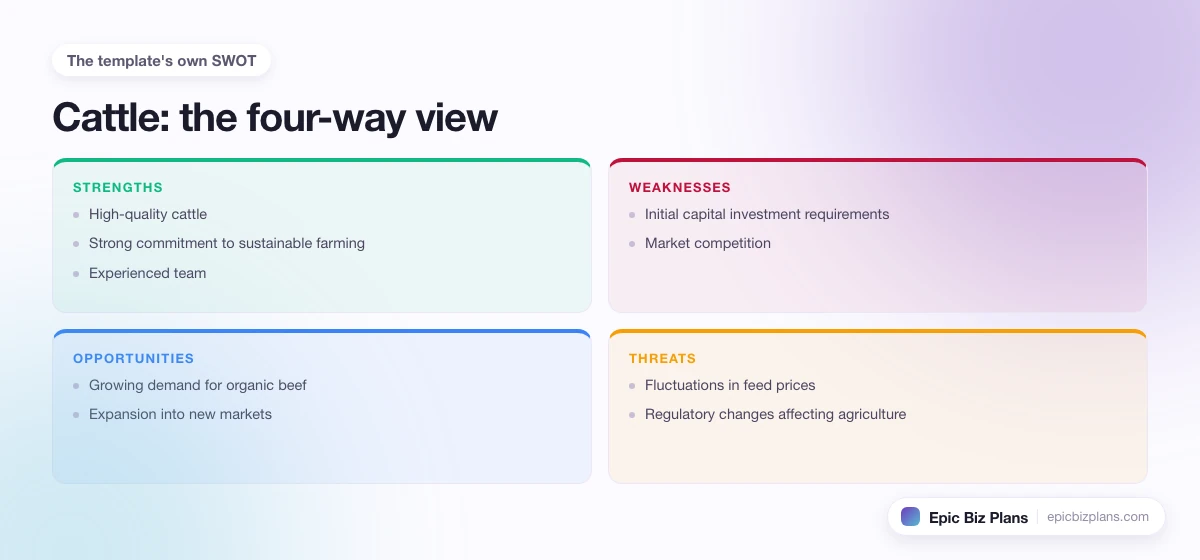
- Strengths: High-quality cattle, strong commitment to sustainable farming, experienced team.
- Weaknesses: Initial capital investment requirements, market competition.
- Opportunities: Growing demand for organic beef, expansion into new markets.
- Threats: Fluctuations in feed prices, regulatory changes affecting agriculture.
Cattle Business Name Ideas
Website
We will build our website using Shopify, as it is the best option for businesses focused on eCommerce. Shopify will allow us to create an attractive, user-friendly site to sell our beef products directly to consumers. We will ensure that the site is optimized for mobile users and facilitates secure transactions.
Marketing Details
Our marketing strategy will use digital marketing tools such as Semrush for search engine optimization to enhance our online visibility. Additionally, we will implement HubSpot for email campaigns targeting our customer base, keeping them informed about new products and promotions.
Social media will play a crucial role in our outreach, using TikTok ads to engage with younger demographics. Engaging content will be created to highlight the quality and benefits of our beef products while also sharing behind-the-scenes farm operations.
Industry Trends
The cattle industry is experiencing technological advancements such as precision farming and genetic testing to improve herd quality and productivity. There is also a rising consumer trend towards organic farming and sustainably sourced meat, prompting a shift in sourcing practices within the industry.
Competitor Information
We will analyze our main competitors, who include both large-scale commercial farms and smaller niche producers. Our strategy to differentiate ourselves will be rooted in offering superior service, establishing a strong brand presence, and ensuring transparency in our farming practices.
Financial Information
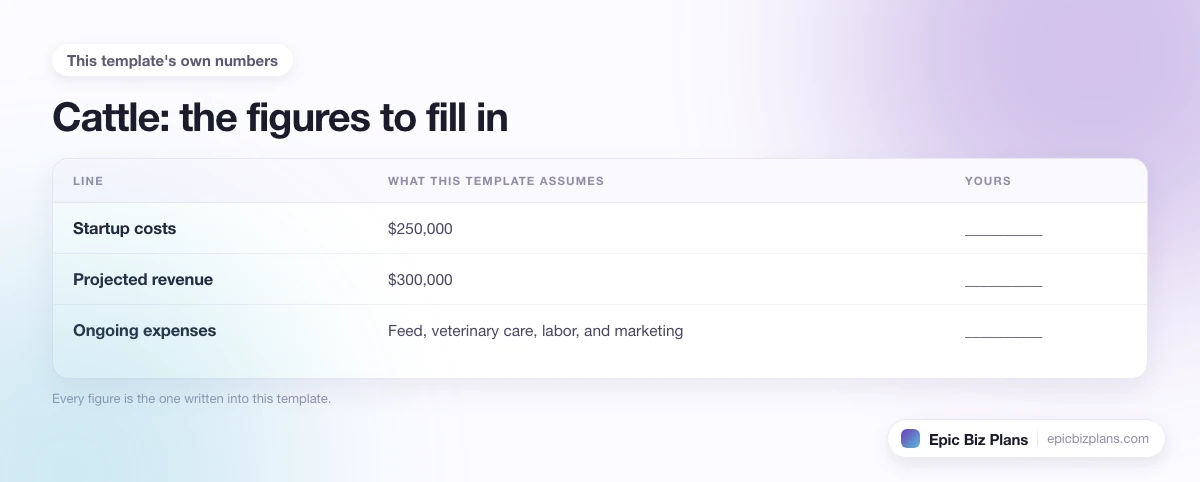
The startup costs for our cattle business are estimated to be around $250,000, which includes land acquisition, livestock purchases, equipment, and operational overhead. We project our first-year revenue to reach $300,000, increasing steadily as we establish our market presence.
Ongoing expenses will include feed, veterinary care, labor, and marketing. Our cash flow is projected to become positive by the end of the second year, with profits reinvested into expanding operations. We will prepare detailed profit and loss statements every quarter.
Legal and Compliance
We will register our business as a limited liability company (LLC) and obtain all necessary permits for operating a cattle farm. Additionally, we will ensure compliance with local and federal regulations regarding animal welfare, hygiene, and product labeling.
Operational Plan
Our key operations will involve managing the cattle herd, optimizing agricultural practices, and maintaining facilities. A strong supply chain will ensure access to high-quality feed and veterinary care. We will establish partnerships with local suppliers to simplify logistics and ensure timely delivery of our products.
Contingency Planning
We recognize potential risks such as price fluctuations, disease outbreaks within the herd, and regulatory changes. Our mitigation strategies will include establishing a financial reserve, maintaining good relationships with veterinarians, and staying informed about industry regulations to adapt swiftly.
-
 SemrushSemrush is a platform with literally any online tool you will need to promote your business. Spy on your competitors, get search traffic, keyword research, social info, ad copies and much more. Used by most of the top online companies in the world. Besides all its tools, Semrush also has many available integrations possible with many other tools that will make your work even better.
 -
 Surfer SEOSurfer SEO is an incredibly smart AI tool that will give you exact explanations what to do in order to make your website rank better. They use hundreds of parameters, check your competitors and decide on the best course of action. Whether it be inner links, bold text, paragraphs, headers, images and much more. Surfer is a must-have in 2026.
Putting Your Cattle Business Plan to Work
The cattle business is rooted in land, livestock, and long-term relationships with buyers. A solid plan ties those elements together so your day-to-day decisions support a clear financial goal. Whether you run a working ranch, sell high-quality beef direct to consumers, or produce dairy, the plan keeps your operation focused as it grows. Related paths such as a dairy business plan or a butchery business plan can help if you plan to process or sell your own products.
Types of Cattle Businesses
The industry covers a wide range of operations, from large commercial ranches to smaller producers selling grass-fed beef or organic dairy. Some businesses focus on breeding and selling livestock, while others build direct-to-consumer channels that ship products to buyers. Each model has its own capital needs, margins, and regulatory requirements. Choosing your focus early makes the rest of the plan far easier to write.
Adapt and Grow
Your cattle business plan should change as the operation does. Update it when you expand into new markets, adjust pricing, or add product lines. Revisiting the plan keeps your projections realistic and your decisions aligned with current conditions. A plan you actually maintain is worth far more than one written once and set aside.
Practical Uses for Your Plan
Your cattle business plan is a practical tool. Use it to present to partners, outline a launch strategy, apply for funding, or clarify your own direction. Each section should reflect the specifics of your operation and keep your goals in view.
Get Started
Your cattle business plan is 100% free, with unlimited edits, unlimited downloads, and unlimited chances to get it right. Fill in each section with details that match your land, your herd, and your market.
