
Butchery Business Plan Template
-
 ShopifyPut your brand on Shopify. Launch your online store with tools designed for growth and success. Ready to turn your idea into profit? Start building your e-commerce business today.
 -
 SquarespaceShowcase your brand with Squarespace’s sleek designs. Build a professional online presence with ease. Start with a template that already looks finished.
 -
 WixBring your ideas to life with Wix. Customize every aspect of your site with unmatched flexibility. Start creating your unique online space and let your creativity shine.
 -
 ElementorCraft captivating websites effortlessly with Elementor. Enjoy complete creative control without coding. Make your site stand out to your audience. Start turning your vision into reality now.
- Executive Summary
- Business Info
- Business Model Overview
- SWOT Analysis
- Butchery Business Name Ideas
- Website
- Marketing Details
- Industry Trends
- Competitor Information
- Financial Information
- Legal and Compliance
- The limit that decides whether you need federal inspection
- Operational Plan
- Contingency Planning
- Embrace Your Passion with a Butchery Business Plan
- Business Types in the Butchery Niche
- Adapt and Grow
- Practical Uses of Your Plan
- Open up Your Future
A butchery business built on quality sourcing and genuine expertise has something that supermarkets simply cannot replicate: knowledge, relationships, and care at the counter. Customers who find a good butcher stay loyal, because the alternative (navigating an impersonal meat case without anyone who can answer a question or recommend a cut) doesn't compare. This business plan gives you the framework to build that kind of business, from your sourcing and product range through your marketing and financial planning.
The key decisions you'll make at the start are about positioning: will you focus on locally sourced meats, specialty and artisan cuts, organic and grass-fed products, or a combination? Your answers will shape your supplier relationships, your pricing, and who your customers are. This plan is designed to be specific rather than generic, so use it to reflect the actual butchery you're building.
Executive Summary
Our mission is to provide our community with high-quality, locally sourced meat products that are fresher, better raised, and better cut than what's available in supermarkets. We will offer a full range of beef, pork, chicken, and specialty meats sourced from farms we know and trust, alongside expert advice on preparation and cooking that turns first-time buyers into regulars. Our target customers are health-conscious consumers, families who cook seriously, and gourmet cooks who treat ingredient quality as non-negotiable.
We are targeting $500,000 in year-one revenue through a combination of retail store sales, online ordering, and community market presence, with plans to expand our product range and explore additional revenue streams in subsequent years.
Business Info
We will sell fresh and aged cuts of beef, pork, chicken, and specialty meats through our retail store, supplemented by an online ordering platform for customers who want to shop in advance or order for delivery. Our direct relationships with local farms are central to our value proposition: we know exactly how the animals are raised, what they're fed, and when they were processed. That level of transparency is something larger competitors genuinely cannot offer.
Business Model Overview
Primary revenue comes from retail sales. A complementary online platform will extend our reach to customers who can't always visit in person and will support subscription box offerings for regular buyers. Participation in local farmers' markets and community events will drive new customer acquisition and reinforce our positioning as a locally rooted business.
SWOT Analysis
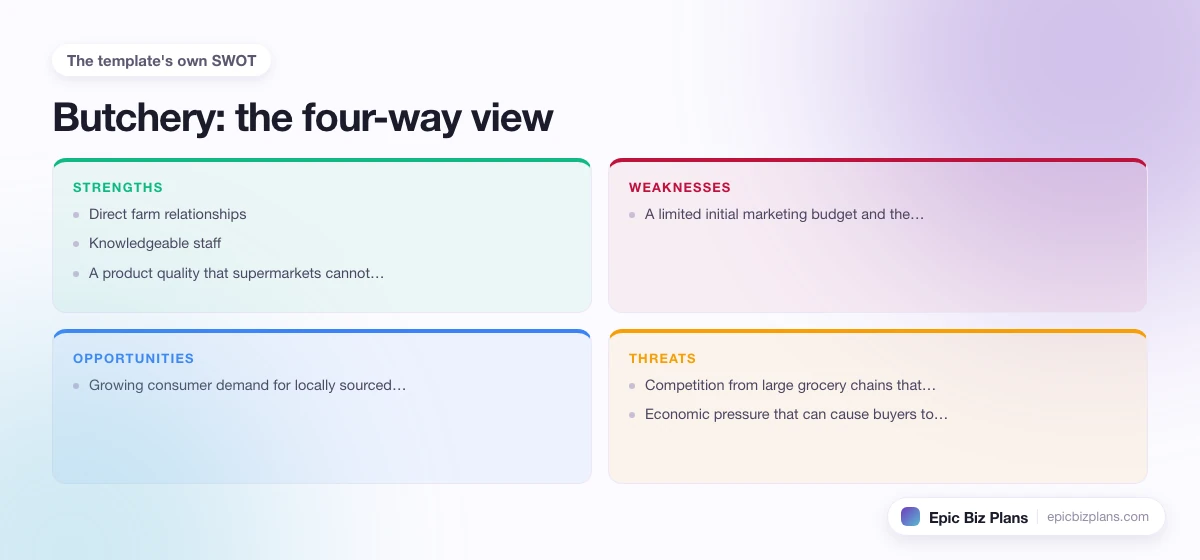
- Strengths: Direct farm relationships, knowledgeable staff, and a product quality that supermarkets cannot match.
- Weaknesses: A limited initial marketing budget and the time required to build a regular customer base from scratch.
- Opportunities: Growing consumer demand for locally sourced food and increasing willingness to pay a premium for products with transparent supply chains.
- Threats: Competition from large grocery chains that have expanded their specialty meat sections, and economic pressure that can cause buyers to trade down on food spending.
Butchery Business Name Ideas
Website
We will build our online platform on Shopify, which gives us the eCommerce tools to handle online orders, subscriptions, and gift box sales alongside our retail operation. The site will feature our farm partners prominently (photos, farm names, and sourcing stories) because this information is a core part of what differentiates us from competitors. We will also maintain a content section with recipes, cutting guides, and cooking tips that serves both SEO and customer education purposes.
Marketing Details
Our marketing strategy focuses on the local community first and online search second. In the community, we will participate in farmers' markets, sponsor local food events, and build relationships with restaurants and catering businesses that value the same sourcing standards we uphold. Word-of-mouth from satisfied customers is the highest-value marketing channel for a local food business, and we will earn it through consistent quality and service.
Online, we will use Semrush to identify the search queries local buyers use when looking for quality meat and local butchers, and we will build content that captures that organic traffic. Email campaigns through HubSpot will keep our customer list engaged with new product announcements, seasonal specials, and recipe ideas. TikTok content showing our cutting techniques, farm visits, and behind-the-counter process will build brand awareness with a younger food-interested demographic. For related business models in the meat and food space, see our meat business plan template and our charcuterie business plan.
Industry Trends
Consumer interest in locally sourced, transparently produced food has grown substantially and shows no sign of reversing. Buyers at every income level are paying more attention to where their meat comes from, how animals are treated, and what practices their money is supporting. Butcheries that can tell that story clearly (and back it up with actual farm relationships) are well positioned to capture buyers who have been disappointed by vague claims from larger retailers.
Online ordering and subscription boxes for meat are also growing, particularly since consumers became more comfortable with food delivery. A subscription model for weekly or monthly meat boxes can provide predictable revenue and reduce the variability that comes with retail-only operations.
Competitor Information
Our main competitors are local grocery stores and larger supermarket chains that carry meat, as well as any other independent butchers operating in our area; the groceries business plan template shows how those full-line retailers structure their meat departments. We compete with grocery chains on quality, knowledge, and sourcing transparency: areas where we have a structural advantage. We compete with other independent butchers on the depth of our farm relationships, the range of our cuts, and the expertise of our staff. Our indirect competitors include meal kit services and online meat delivery platforms; we respond to them by being more local, more personal, and more flexible than any national platform can be. For context on processing-focused operations, see our meat processing business plan.
Financial Information
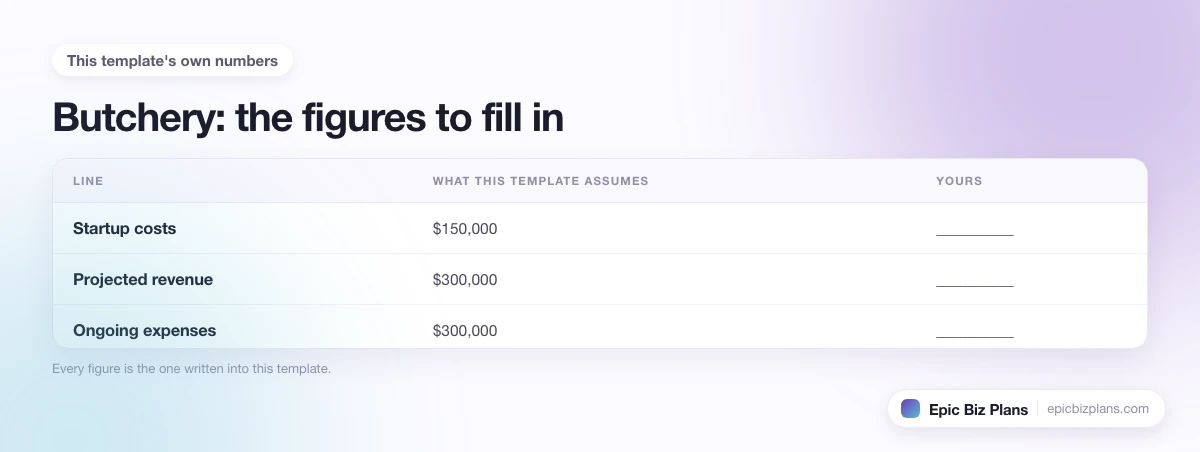
Startup costs are estimated at $150,000, covering equipment, initial inventory, store fit-out, lease costs, and six months of operating capital. We project $500,000 in year-one revenue, with ongoing expenses of approximately $300,000, yielding a healthy operating margin. Monthly P&L reviews and detailed cash flow tracking will be maintained from day one, because managing perishable inventory efficiently is critical to profitability in a food retail business.
Legal and Compliance
We will register the business and obtain all licenses required to operate a food retail business in our jurisdiction, including health department permits and any certifications required for handling specific meat types. All products will be labeled in compliance with applicable food labeling regulations. Our brand name will be trademarked, and our supplier contracts will clearly document the sourcing standards we require.
The limit that decides whether you need federal inspection
A retail butchery can prepare and sell meat without operating under federal inspection, but only inside limits that are re-set every year, and crossing one changes what kind of facility you need. The current figures were published on 28 April 2026 and became applicable on 28 May 2026: $109,600 for meat and meat food products, including Siluriformes fish and fish products, and $76,100 for poultry and poultry products. There is an alternative test of 25 percent of the dollar value of total retail product sales.
-
 SemrushSemrush is a platform with literally any online tool you will need to promote your business. Spy on your competitors, get search traffic, keyword research, social info, ad copies and much more. Used by most of the top online companies in the world. Besides all its tools, Semrush also has many available integrations possible with many other tools that will make your work even better.
 -
 Surfer SEOSurfer SEO is an incredibly smart AI tool that will give you exact explanations what to do in order to make your website rank better. They use hundreds of parameters, check your competitors and decide on the best course of action. Whether it be inner links, bold text, paragraphs, headers, images and much more. Surfer is a must-have in 2026.
What the limit measures is the part most people get wrong. It applies to sales to hotels, restaurants and similar institutions, not to sales to household customers. So a shop can serve as many walk-in customers as it likes, but a wholesale side selling to local restaurants is what eats the allowance. The figures move with meat prices each year, so build the check into your annual review rather than treating it as a one-time decision, and track institutional sales separately in the accounts from day one.
If the wholesale side is the plan rather than the sideline, the meat processing business plan template describes the inspected route. Supply-side models are covered in the livestock farming business plan template.
Operational Plan
Daily operations center on three priorities: sourcing and receiving fresh product, in-store cutting and display, and customer service. We will place orders with our farm suppliers on a set schedule to ensure consistent availability without over-purchasing perishable inventory. Every cut on the counter will be clearly labeled with its origin, because that transparency is a core part of our brand promise. Our staff will be trained not just in butchery technique but in advising customers on cooking methods and cut selection, because that knowledge is a genuine competitive advantage. For customers who regularly need knife maintenance, we can refer them to professional sharpening services; see the knife sharpening business plan for how that model operates. For those interested in expanding into wholesale supply for restaurants, our local food business plan covers distribution models for local food producers.
Contingency Planning
The risks most likely to affect our business are supply disruptions from our farm partners (due to weather, disease, or farm closures), food safety incidents, and economic pressure that reduces consumer spending on premium food. We will maintain relationships with backup suppliers for our key product categories and carry product liability insurance appropriate to a food retail operation. A cash reserve of three months of operating expenses will cover unexpected disruptions without forcing us to compromise on quality to cut costs.
Embrace Your Passion with a Butchery Business Plan
A butchery business built on genuine quality and community relationships creates something lasting. Customers who trust their butcher become loyal in a way that's rare in retail: they come back every week, they bring their friends, and they spend more per visit because they trust your recommendations. That kind of customer relationship is built through consistency, honesty, and genuine care about what you're selling. If those values describe how you want to run your business, this is a space worth building in.
Business Types in the Butchery Niche
The butchery space supports several different business formats: traditional retail shops, farmers' market stalls, online-only meat delivery services, wholesale supply to restaurants, and hybrid models that combine two or three of these channels. Most successful independent butchers start with one primary format and add complementary channels as the business grows and they better understand their customers. For an adjacent specialty food model, see our delicatessen business plan.
Adapt and Grow
Your business plan should change as your business does. The products that sell best in year one may not be the same ones driving revenue in year three: customer feedback, seasonal patterns, and shifting local food trends will all inform how your product range evolves. Build the habit of reviewing your plan regularly and updating it based on what you're actually learning from running the business.
Practical Uses of Your Plan
Use this business plan when applying for a business loan, presenting to potential investors, negotiating your commercial lease, or onboarding a business partner. A detailed, well-organized plan demonstrates that you understand the operational and financial realities of running a food retail business: something lenders and partners will specifically look for.
Open up Your Future
Your Butchery business plan is 100% free: with unlimited edits, unlimited downloads, and unlimited chances to get it right. Start building today and use it as the foundation for a business your community will rely on.
