
Cattle Feed Business Plan Template
-
 ShopifyPut your brand on Shopify. Launch your online store with tools designed for growth and success. Ready to turn your idea into profit? Start building your e-commerce business today.
 -
 SquarespaceShowcase your brand with Squarespace’s sleek designs. Build a professional online presence with ease. Start with a template that already looks finished.
 -
 WixBring your ideas to life with Wix. Customize every aspect of your site with unmatched flexibility. Start creating your unique online space and let your creativity shine.
 -
 ElementorCraft captivating websites effortlessly with Elementor. Enjoy complete creative control without coding. Make your site stand out to your audience. Start turning your vision into reality now.
- Executive Summary
- Business Info
- SWOT Analysis
- Cattle Feed Business Name Ideas
- Website
- Marketing Details
- Industry Trends
- Competitor Information
- Financial Information
- Startup Cost Breakdown
- Legal and Compliance
- Operational Plan
- Contingency Planning
- Why Start Your Cattle Feed Business?
- Types of Businesses in the Cattle Feed Niche
- Adapt and Evolve
- Practical Uses of Your Business Plan
- Your Path to Success
Starting a cattle feed business requires a solid understanding of livestock nutrition, local agriculture markets, and the supply chain dynamics that connect raw ingredients to the farm gate. This business plan template gives you a structured starting point to define your product mix, target the right farmers, and build a financially sound operation from the ground up.
Cattle producers are increasingly selective about what they feed their herds. Quality, consistency, and nutritional transparency are now competitive differentiators - not just nice-to-haves. Your cattle feed business plan should reflect this reality and demonstrate how your operation will meet these higher standards.
Executive Summary
Our mission is to provide high-quality cattle feed that improves the health and productivity of livestock, helping farmers achieve better yields and lower vet costs. We will become a trusted regional supplier known for consistent product quality, responsive customer service, and sound environmental practices. Our value proposition is built on custom feed formulations tailored to specific herd types and production stages - something most large feed manufacturers do not offer. Financially, we are targeting 15% annual growth over five years, with the business reaching profitability by the end of year two.
Business Info
We will offer a core product line that includes protein-rich pellets, mineral and vitamin supplements, and certified organic feed blends. Our primary customers are cow-calf operations, stocker producers, and feedlot operators within a 150-mile radius of our facility. Revenue will come from direct farm sales, online orders with regional shipping, and wholesale accounts with local farm supply stores. Operators interested in related supply businesses may also find a livestock farming business plan useful for understanding how their customers operate.
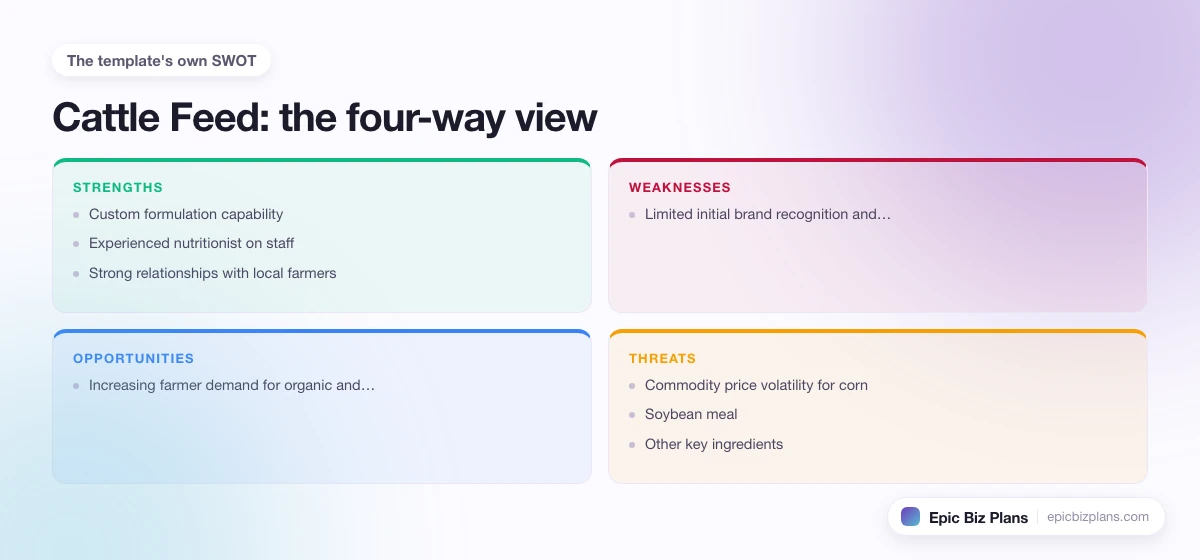
SWOT Analysis
- Strengths: Custom formulation capability, experienced nutritionist on staff, strong relationships with local farmers.
- Weaknesses: Limited initial brand recognition and regional distribution reach.
- Opportunities: Increasing farmer demand for organic and non-GMO feed options.
- Threats: Commodity price volatility for corn, soybean meal, and other key ingredients.
Cattle Feed Business Name Ideas
Website
We will build our primary website on Shopify to support direct online ordering from farmers, with product pages organized by herd type and production stage. For farmers less comfortable with digital ordering, a static informational site on Wix will provide product specs and contact options. WordPress with Cloudways hosting and Elementor is available if content volume grows and we need a more robust blogging and resource section.
Marketing Details
Our marketing will focus heavily on reaching working farmers through channels they actually use. We will use Semrush to identify high-intent search terms around cattle nutrition and local feed supply, then build content that answers those questions. HubSpot will manage our email list, which we will build by offering a free cattle nutrition guide as a lead magnet.
Social media targeting will focus on Facebook and YouTube rather than TikTok, as these platforms better reach our core demographic of working cattle producers aged 35–65. We will also attend regional livestock shows and agricultural extension events to build direct relationships. For businesses supplying multiple farm types, reviewing a goat farm business plan highlights how nutritional needs vary across livestock species.
Industry Trends
Precision livestock feeding is gaining traction, with data-driven ration balancing replacing one-size-fits-all formulas. This trend benefits smaller suppliers who can offer customized blends that large commodity feed manufacturers cannot easily match. Organic and non-GMO certifications are commanding a 20–35% price premium in many markets, creating margin opportunity for operations willing to meet certification standards. Related businesses expanding into hay and forage may also want to review a family farm business plan to understand adjacent revenue streams.
Competitor Information
Regional feed mill operations and national brands like Purina and Nutrena are our primary competitors. Their advantages include established brand recognition and deep distribution networks. Our differentiation lies in custom formulation capability, local sourcing transparency, and personal relationships with farmers who want a supplier that knows their operation by name. We will position ourselves explicitly as the alternative for producers who feel underserved by commodity feed suppliers.
Financial Information
Total startup costs are projected at approximately $150,000. This covers feed processing equipment ($60,000), initial raw material inventory ($40,000), facility lease and setup ($25,000), and first-quarter marketing and sales costs ($25,000). First-year revenue is targeted at $250,000, based on 50 active farm accounts purchasing an average of $5,000 annually. By year three, with expanded distribution, we project $500,000 in annual revenue. Monthly cash flow and quarterly P&L reviews will keep us on track.
Startup Cost Breakdown
A detailed view of anticipated costs helps prevent underfunding in the critical first year:
- Feed mixing and processing equipment: $50,000–$75,000
- Facility lease deposit and improvements: $20,000–$30,000
- Initial raw material inventory (3-month supply): $35,000–$50,000
- Delivery vehicle or freight account: $10,000–$25,000
- Website, marketing, and brand launch: $5,000–$10,000
- Operating reserve (90 days): $20,000–$30,000
Total estimated startup range: $140,000–$220,000 depending on equipment age, facility terms, and initial inventory levels. Those comparing this to other agricultural supply businesses can also reference a farm equipment repair business plan for a sense of how capital-intensive ag-sector startups typically look.
Legal and Compliance
We will register with state agricultural authorities and comply with feed labeling requirements under the Association of American Feed Control Officials (AAFCO) guidelines. All products will carry accurate ingredient lists and guaranteed analysis panels. We will trademark our brand name and top product lines to protect intellectual property as we grow into new markets.
Operational Plan
Raw materials will be sourced primarily from regional grain elevators and commodity brokers, with contracts locking in prices 30–60 days in advance to reduce exposure to spot market volatility. We will use a first-in-first-out inventory system to maintain freshness. Deliveries to farm accounts within 50 miles will be handled by our own vehicle; longer hauls will use contracted freight. Inventory management software will trigger restocking alerts automatically.
Contingency Planning
Key risks include a sharp rise in corn or soybean meal prices, a drought affecting local grain supply, and the loss of a major farm account. Mitigation strategies include maintaining a 45-day ingredient reserve, building relationships with multiple grain suppliers, and diversifying our customer base so no single account represents more than 15% of revenue. We will review our contingency assumptions at each quarterly planning session.
-
 SemrushSemrush is a platform with literally any online tool you will need to promote your business. Spy on your competitors, get search traffic, keyword research, social info, ad copies and much more. Used by most of the top online companies in the world. Besides all its tools, Semrush also has many available integrations possible with many other tools that will make your work even better.
 -
 Surfer SEOSurfer SEO is an incredibly smart AI tool that will give you exact explanations what to do in order to make your website rank better. They use hundreds of parameters, check your competitors and decide on the best course of action. Whether it be inner links, bold text, paragraphs, headers, images and much more. Surfer is a must-have in 2026.
Why Start Your Cattle Feed Business?
Agriculture is one of the few industries where a well-run small business can build durable customer loyalty. Farmers who find a feed supplier they trust rarely switch. If you deliver consistent quality, honest communication, and a product that produces measurable results in their herd, you earn a customer relationship that can span decades. That kind of loyalty is worth building a business around.
Types of Businesses in the Cattle Feed Niche
The cattle feed market includes small custom-blend operations serving a handful of local producers, mid-size regional mills supplying hundreds of accounts, and e-commerce brands shipping specialty supplements nationwide. The right business model depends on your capital, your production capacity, and the customer relationships you can realistically build in your region. There is room for operators at every scale.
Adapt and Evolve
As commodity prices shift and producer preferences change, your product line will need to evolve. Build flexibility into your formulations so you can substitute ingredients without sacrificing nutritional targets. If organic demand grows in your market, consider adding a certified organic line - even a small premium product can meaningfully improve margins.
Practical Uses of Your Business Plan
Use this plan when approaching an agricultural lender for a startup loan, presenting to an SBA program, or applying for USDA beginning farmer grants. A specific, numbers-grounded business plan is essential for any of those conversations. It also serves as an onboarding document for your first employees, making expectations and operational priorities clear from day one.
Your Path to Success
Your Cattle Feed business plan is 100% free - with unlimited edits, unlimited downloads, and unlimited chances to refine it. Build on what you know, fill in gaps through market research, and update the financials as you gather real data from your operation.
