
Casual Clothing Business Plan Template
-
 ShopifyPut your brand on Shopify. Launch your online store with tools designed for growth and success. Ready to turn your idea into profit? Start building your e-commerce business today.
 -
 SquarespaceShowcase your brand with Squarespace’s sleek designs. Build a professional online presence with ease. Start with a template that already looks finished.
 -
 WixBring your ideas to life with Wix. Customize every aspect of your site with unmatched flexibility. Start creating your unique online space and let your creativity shine.
 -
 ElementorCraft captivating websites effortlessly with Elementor. Enjoy complete creative control without coding. Make your site stand out to your audience. Start turning your vision into reality now.
- Executive Summary
- Business Info
- Business Model Overview
- SWOT Analysis
- Casual Clothing Business Name Ideas
- Website
- Marketing Details
- Product Development and Manufacturing
- Industry Trends
- Competitor Information
- Financial Information
- Legal and Compliance
- Operational Plan
- Contingency Planning
- Embrace Your Passion
- Adapt and Evolve
- Plan for Success
- Be Bold
A casual clothing business plan lays out the strategy for launching and growing a brand that designs, manufactures, and sells everyday apparel. The casual wear segment accounts for a significant and growing share of the global fashion market, driven by workplace dress code relaxation, athleisure trends, and consumer preference for comfort-first clothing. A detailed plan helps you define your brand positioning, manage production costs, and build a customer acquisition strategy that supports sustainable growth.
This template covers every section of a casual clothing business plan, from product line development and financial projections to marketing, operations, and contingency planning. Brands focused on a single gender can also reference our men clothes business plan template for category-specific guidance. Customize each section to reflect your specific brand identity, target customer, and distribution model.
Executive Summary
This casual clothing brand will design and sell comfortable, well-made everyday apparel for men and women aged 18 to 35. Founders weighing a resale angle on everyday basics can also review our gently used clothing business plan template. Our product line includes t-shirts, hoodies, sweatpants, joggers, and seasonal accessories built around a cohesive aesthetic that blends streetwear influences with clean, minimal design. We will sell primarily through our own e-commerce store, supplemented by wholesale partnerships with select boutiques. Brands designing apparel that works across genders can also follow our unisex business plan for inclusive sizing and positioning. For a related angle, our jacket walk-through goes deeper.
First-year revenue is projected at $500,000, with a 20% annual growth target. Startup investment of $100,000 covers initial inventory production, branding, website development, and marketing. Our gross margin target is 60%, positioning us in the mid-premium range where customers expect quality fabrics and thoughtful design at accessible prices.
Business Info
Our core product categories are essentials: premium cotton t-shirts, heavyweight hoodies, relaxed-fit pants, and seasonal outerwear, with a statement bottom like a flared pants line to round out the range, with room to add a one-piece jumpsuit line as demand grows. Each collection will launch quarterly with 8 to 12 pieces, keeping the line focused rather than diluted across too many styles. The sustainable fashion movement is influencing our material choices, with organic cotton and recycled polyester blends forming the foundation of our fabric sourcing. Brands expanding into a full women's line can also reference our ladies clothes business plan template. Brands moving into sport-specific lines can also use our golf clothing business plan. Brands that want to add statement or quirky pieces to this lineup can study a funky business plan. Anyone planning a curated storefront for these items can compare notes with our Bobyreff Botique business plan template. Many everyday apparel sellers add seasonal outerwear, and a winter jacket business plan explains how to price and stock heavier pieces.
Business Model Overview
The direct-to-consumer (DTC) model will generate 70% of revenue through our Shopify store. The remaining 30% will come from wholesale accounts with independent boutiques and curated marketplaces. DTC margins are significantly higher, typically 60% to 70%, compared to wholesale margins of 40% to 50%, so scaling the online channel is a financial priority, much like the model in a Juan business plan template.
SWOT Analysis
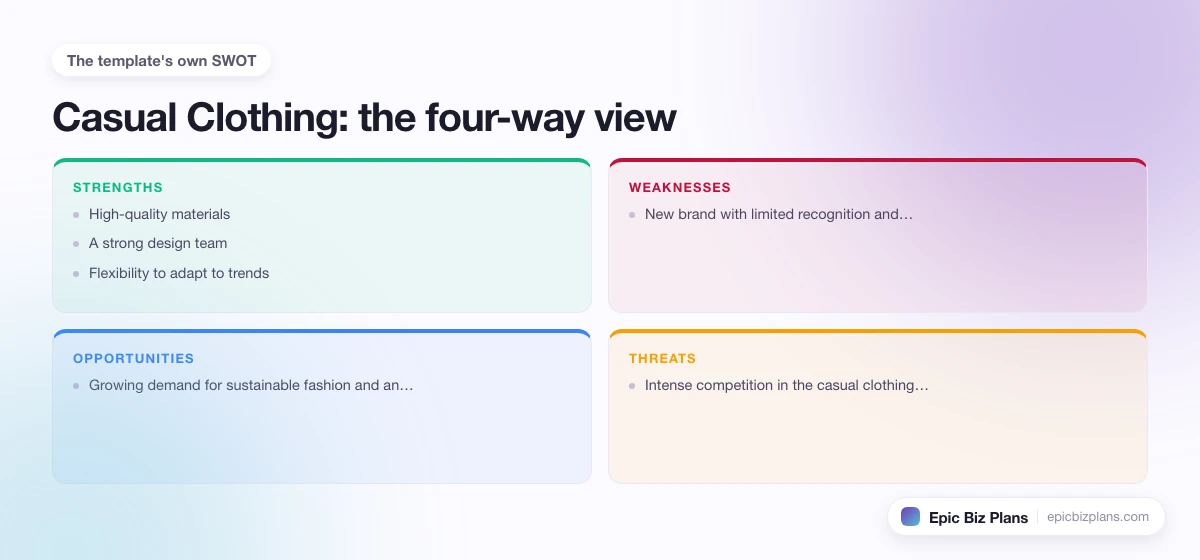
- Strengths: High-quality materials, a strong design team, and flexibility to adapt to trends.
- Weaknesses: New brand with limited recognition and initial cash flow challenges.
- Opportunities: Growing demand for sustainable fashion and an increasing shift towards online shopping.
- Threats: Intense competition in the casual clothing market and fluctuating fashion trends.
Casual Clothing Business Name Ideas
Website
Shopify is the best platform for a clothing e-commerce brand because of its apparel-specific features: size charts, variant management, inventory tracking, and integration with print-on-demand and fulfillment services. The site design should prioritize product photography showing garments on models in everyday settings, clear size guides, and a fast checkout process. Brands aiming for a more design-led, trend-driven identity can also review the stylish business plan template.
A lookbook section showcasing styled outfits helps customers see how individual pieces work together, which increases average order value. Integration with reviews platforms like Loox or Judge.me adds social proof that reduces purchase hesitation for first-time buyers.
Lines built around an assertive brand identity use the same storefront tactics to stand out.
Marketing Details
Instagram and TikTok will drive brand awareness through short-form video content showing styling ideas, behind-the-scenes production, and customer testimonials. Paid advertising on both platforms will use retargeting to convert site visitors who browsed but did not purchase. Influencer partnerships with micro-influencers (10,000 to 50,000 followers) in the lifestyle and streetwear space provide authentic brand exposure at a reasonable cost.
Email marketing will build a repeat customer base through new collection previews, early access promotions, and abandoned cart recovery sequences. SEO-optimized content on topics like capsule wardrobe building, seasonal style guides, and fabric care tips will attract organic search traffic. Brands in the custom hoodie niche have found that educational content about garment construction and materials converts particularly well. Entrepreneurs building a sustainable women's fashion brand should also see our Daniella business plan template for a DTC-focused sustainable fashion framework.
Product Development and Manufacturing
Product development begins with fabric sourcing and sample creation. We will work with contract manufacturers who specialize in knitwear and cut-and-sew apparel, starting with minimum order quantities of 200 to 500 units per style. Tech packs with detailed specifications for measurements, materials, stitching, and finishing ensure consistent quality across production runs.
Quality control includes pre-production sample approval, in-line inspections during manufacturing, and final inspection before shipment. Fit testing across a range of body types ensures our sizing runs true to the published size chart. Maintaining a 60-day production lead time allows enough buffer for quality checks without excessive inventory holding costs.
Industry Trends
The casual clothing market continues to grow as the line between workwear, activewear, and streetwear blurs. Brands building a street-led range often pair this approach with a dedicated Garms business plan to define their drop strategy. Consumers want pieces they can wear to the office, the gym, and out with friends without changing. This "trans-seasonal" and "trans-occasion" approach to dressing favors brands that deliver versatile, well-constructed basics over trend-dependent fast fashion. Brands expanding into performance fabrics or technical textiles should also review the Tex business plan for guidance on textile-focused product development and supply chain considerations. For brands building a lifestyle fashion identity rather than a pure casual-wear offer, the Starz business plan template covers brand identity strategy, limited-edition drops, and DTC channel management for young-adult lifestyle brands. For a related approach, see our trendy clothes business plan.
Sustainability is shifting from a marketing talking point to a purchasing requirement. Consumers increasingly check labels for fabric composition and production origin. Brands using vintage and secondhand clothing models are growing alongside new-production brands that use responsible materials, indicating broad consumer interest in reducing fashion waste.
-
 SemrushSemrush is a platform with literally any online tool you will need to promote your business. Spy on your competitors, get search traffic, keyword research, social info, ad copies and much more. Used by most of the top online companies in the world. Besides all its tools, Semrush also has many available integrations possible with many other tools that will make your work even better.
 -
 Surfer SEOSurfer SEO is an incredibly smart AI tool that will give you exact explanations what to do in order to make your website rank better. They use hundreds of parameters, check your competitors and decide on the best course of action. Whether it be inner links, bold text, paragraphs, headers, images and much more. Surfer is a must-have in 2026.
Competitor Information
Direct competitors include fast-fashion giants like H&M and Zara at the lower end, and premium DTC brands like Everlane and Kotn at the higher end. Smaller competitors include independent streetwear labels, denim-focused makers following a denim jeans business plan, and local boutique brands. Our positioning occupies the space between fast fashion's price point and premium DTC's quality promise, offering well-made basics at $30 to $80 per piece. Clothing brands exploring premium sustainable positioning should reference the runway sustainable fashion business plan for an in-depth look at certified sustainable materials and supply chain documentation. Clothing brands expanding into oversized styles as part of their collection should review the oversize business plan template for size inclusivity strategy, DTC marketing, and sustainable material sourcing guidance. Brands targeting youth culture and self-expression often find a brat business plan useful for understanding how to position attitude-forward fashion concepts with younger demographics.
Differentiation comes from limited-run collections that create urgency, collaborations with local artists and designers for exclusive prints, and a transparent approach to pricing that breaks down the cost of materials, production, and markup for customers. Brands considering a kids clothing line as an extension of their casual wear range will find specific guidance on age-specific sizing, safety compliance, and family-focused marketing strategies.
Financial Information
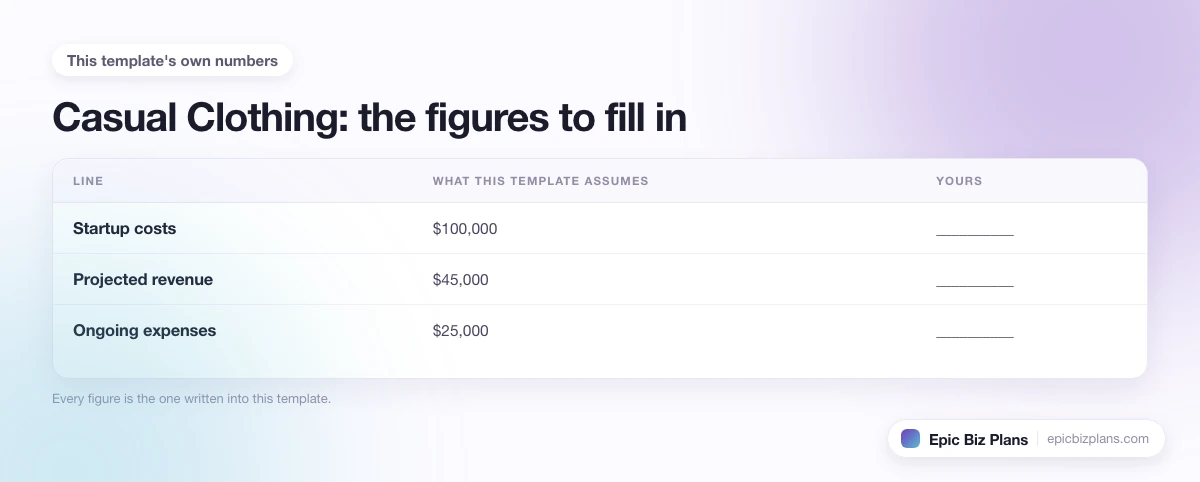
Startup costs of $100,000 cover initial inventory production ($45,000), branding and website ($20,000), marketing launch budget ($25,000), and working capital ($10,000). With an average order value of $75 and a DTC gross margin of 60%, we need approximately 556 orders per month to reach breakeven on monthly operating expenses of $25,000. Brand operators developing a broader menswear catalog can also reference this men business plan template.
Wholesale accounts will contribute additional revenue beginning in month four as we build relationships with boutique buyers. By month eight, we project combined monthly revenue of $45,000, reaching the $500,000 annual target. Cash flow management is critical in apparel because of the gap between production payment and sales revenue, so maintaining a line of credit or reserve fund is essential, similar to strategies used in fashion dropshipping businesses to manage inventory timing.
Legal and Compliance
Textile labeling laws require that all garments include fiber content, country of origin, and care instructions on a permanent label. The Federal Trade Commission enforces these requirements in the US, and non-compliance can result in fines. Business registration as an LLC, trademark protection for the brand name and logo, and product liability insurance are essential pre-launch steps. If you plan to add shoes to the range, the Happy Feet footwear plan covers the very different sizing and returns economics that come with them.
If selling internationally, customs regulations, import duties, and country-specific labeling requirements apply. Starting with domestic sales and expanding internationally once the brand and logistics are established is a lower-risk approach.
Operational Plan
Operations revolve around a seasonal production cycle: design, sample, produce, launch, and fulfill. Each collection requires a 90-day lead time from final design to delivery. A third-party logistics (3PL) provider will handle warehousing and order fulfillment, allowing the team to focus on design, marketing, and customer relationships.
Inventory management follows a just-in-time approach to minimize overstock. Best-selling styles may be restocked in subsequent seasons, while limited-run pieces create exclusivity and reduce markdown risk. Customer returns are processed through a centralized system with clear policies for exchanges, refunds, and store credit.
Contingency Planning
The primary risks are production delays and unsold inventory. Production risks are mitigated by maintaining relationships with two or three qualified manufacturers and building buffer time into the production calendar. Unsold inventory risk is managed through conservative initial order quantities, data-driven restocking decisions, and end-of-season sales that clear remaining stock without deeply discounting the brand.
A sudden shift in consumer trends could reduce demand for specific styles. Keeping collections small and launching frequently allows the brand to pivot quickly. Maintaining a core basics line that sells year-round provides stable revenue regardless of trend cycles.
-
ShopifyPut your brand on Shopify. Launch your online store with tools designed for growth and success. Ready to turn your idea into profit? Start building your e-commerce business today.
-
SquarespaceShowcase your brand with Squarespace’s sleek designs. Build a professional online presence with ease. Start with a template that already looks finished.
-
WixBring your ideas to life with Wix. Customize every aspect of your site with unmatched flexibility. Start creating your unique online space and let your creativity shine.
-
ElementorCraft captivating websites effortlessly with Elementor. Enjoy complete creative control without coding. Make your site stand out to your audience. Start turning your vision into reality now.
Embrace Your Passion
Building a casual clothing brand is a chance to express your design perspective and connect with people who share your sense of style. The fashion industry rewards brands that understand their customer deeply and deliver consistently on quality, fit, and aesthetic. Whether you are launching with a single product or a full collection, a clear plan keeps your creative vision grounded in business fundamentals. If you want a flexible starting point for a different idea, the Pp business plan template is free to copy and edit.
Adapt and Evolve
This plan is a living document. As you gather sales data, customer feedback, and market intelligence, update your product strategy, marketing mix, and financial projections. Expanding into new product categories, testing pop-up retail, or exploring international markets are all natural growth steps that the plan should accommodate.
Plan for Success
Use this plan for investor pitches, wholesale buyer meetings, production planning, and annual strategy reviews. A current, well-organized plan accelerates every business conversation and keeps your team aligned as the brand scales.
Be Bold
Retailers looking beyond casual styles should review the selling clothes business plan to understand how this model compares. Your Casual Clothing business plan is 100% free with unlimited edits, unlimited downloads, and unlimited chances to get it right.
For more guidance, see our related guides on vamp business plan.
