
Brat Business Plan Template
-
 ShopifyPut your brand on Shopify. Launch your online store with tools designed for growth and success. Ready to turn your idea into profit? Start building your e-commerce business today.
 -
 SquarespaceShowcase your brand with Squarespace’s sleek designs. Build a professional online presence with ease. Start with a template that already looks finished.
 -
 WixBring your ideas to life with Wix. Customize every aspect of your site with unmatched flexibility. Start creating your unique online space and let your creativity shine.
 -
 ElementorCraft captivating websites effortlessly with Elementor. Enjoy complete creative control without coding. Make your site stand out to your audience. Start turning your vision into reality now.
- Executive Summary
- Business Info
- Business Model Overview
- SWOT Analysis
- Brat Business Name Ideas
- Website
- Marketing Details
- Industry Trends
- Competitor Information
- Financial Information
- Legal and Compliance
- Operational Plan
- Contingency Planning
- Build the Brand You Actually Want to Run
- Keep Evolving the Plan
- Practical Uses
A "brat" brand concept plays into a specific cultural aesthetic: unapologetically confident, youth-oriented, and built around self-expression. If you're planning to launch this kind of fashion or lifestyle brand, your business plan needs to be as deliberate as the image you're projecting. That means knowing exactly who your customer is, where they shop, what they're willing to pay, and which marketing channels actually reach them.
This is the document that keeps your vision grounded in real numbers and operational decisions. Use it to map out startup costs, test your pricing model, and think through how you'll grow beyond the first 100 customers.
Executive Summary
Our mission is to build a brand that speaks directly to young adults who value self-expression through fashion. We plan to become a recognized source for streetwear-inspired clothing and accessories, with a community-focused identity that goes beyond the product. Our value is built on quality, sustainable sourcing, and strong visual identity at a price point the target demographic can actually reach.
Financial targets: $100,000 in revenue in year one, with a 60% gross margin and 20% annual growth thereafter.
Business Info
The product line covers streetwear-inspired clothing, eco-conscious apparel options, and customizable accessories for the 18-30 age group. Product design will stay current with youth culture trends while building a consistent brand aesthetic that customers recognize immediately.
Business Model Overview
We will operate direct-to-consumer through e-commerce, keeping overhead low by avoiding physical retail until the brand has enough pull to justify it. This model lets us reinvest margins into product development and marketing rather than real estate.
SWOT Analysis
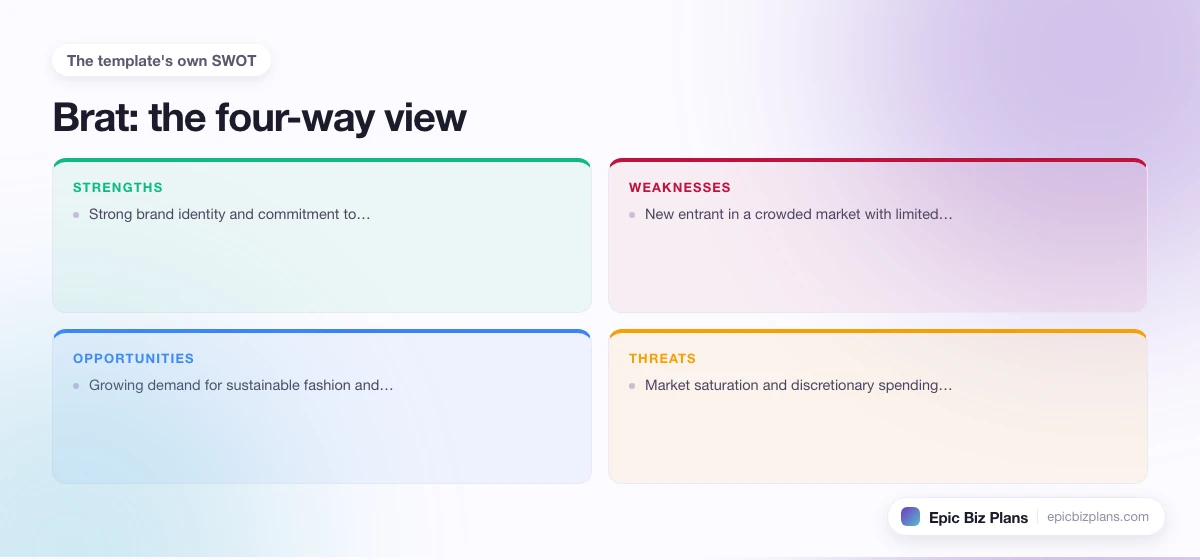
- Strengths: Strong brand identity and commitment to sustainability.
- Weaknesses: New entrant in a crowded market with limited initial recognition.
- Opportunities: Growing demand for sustainable fashion and strong influencer culture around streetwear.
- Threats: Market saturation and discretionary spending sensitivity during economic slowdowns.
Brat Business Name Ideas
Website
Shopify is the right platform for this business. It handles inventory, checkout, and integrations with marketing tools without requiring developer help. Squarespace is a reasonable alternative if the priority is visual presentation over store functionality. Either way, the site needs to reflect the brand's aesthetic immediately, since the target customer will judge it in seconds.
Marketing Details
Digital channels will lead the marketing strategy. Semrush guides SEO so product pages show up when people search for specific styles or items. HubSpot manages email flows to convert one-time buyers into repeat customers.
TikTok is the primary social channel for this demographic. Short-form content (outfit styling, behind-the-scenes production, user-generated posts) builds organic engagement that paid ads alone can't replicate. The goal is a community, not just a following. Brands working from a sustainable fashion business plan often face the same influencer-dependency challenge and use similar content frameworks to build authentic reach.
Industry Trends
Sustainable sourcing has moved from a niche preference to a standard expectation in youth-oriented fashion. Consumers aged 18-30 increasingly check brand values before making purchases, and a visible sustainability commitment helps with both conversion and loyalty. On the tech side, AR try-on tools and AI-driven product recommendations are raising customer expectations for personalization. Competing on these fronts doesn't require enterprise-level investment, but ignoring them entirely creates friction in the buying process. Businesses in adjacent markets, like those building from a casual clothing business plan, work through the same balance between trend responsiveness and operational efficiency.
Competitor Information
Direct competitors include established streetwear brands with existing communities and distribution networks. Indirect competitors are fast-fashion retailers that serve the same demographic with lower-quality, lower-priced alternatives. The differentiation strategy centers on sustainability, customization, and community engagement, giving customers a reason to choose this brand over a cheaper option.
Local artist collaborations and limited-edition drops create urgency and exclusivity that fast fashion can't replicate. For reference on how fashion brands position against resale competition, a clothing resell business plan provides useful competitive context.
Financial Information
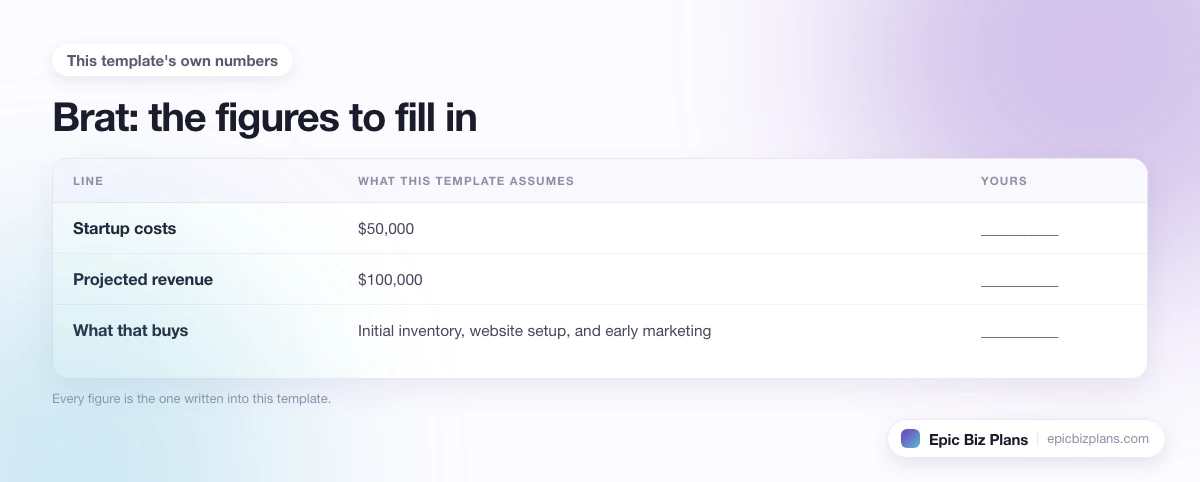
Startup costs are estimated at $50,000, covering initial inventory, website setup, and early marketing. Year-one revenue target is $100,000, with ongoing expenses (production, shipping, marketing, and maintenance) running approximately $30,000 annually.
Cash flow management is critical in the early months, particularly around inventory cycles. Building toward a detailed P&L and monthly cash flow tracking from day one prevents surprises when growth creates pressure on working capital.
Legal and Compliance
Business registration, an appropriate legal structure (LLC is standard for DTC brands at this stage), and IP protection for the brand name and designs will be handled before launch. Supplier contracts should also include quality control clauses from the start.
-
 SemrushSemrush is a platform with literally any online tool you will need to promote your business. Spy on your competitors, get search traffic, keyword research, social info, ad copies and much more. Used by most of the top online companies in the world. Besides all its tools, Semrush also has many available integrations possible with many other tools that will make your work even better.
 -
 Surfer SEOSurfer SEO is an incredibly smart AI tool that will give you exact explanations what to do in order to make your website rank better. They use hundreds of parameters, check your competitors and decide on the best course of action. Whether it be inner links, bold text, paragraphs, headers, images and much more. Surfer is a must-have in 2026.
Operational Plan
Core operations cover inventory management, order fulfillment, and customer service. Supplier and logistics partnerships need to be locked in before the first campaign goes live. A supply chain built on sustainable sources adds both cost and credibility: the tradeoff is worth it for this target market, but it needs to be priced correctly from the start.
Contingency Planning
Risks include supply chain disruptions, trend shifts, and economic downturns that reduce discretionary spending. A diversified supplier base and a cash reserve address supply-side risk. On the demand side, maintaining community engagement keeps brand loyalty strong even when consumers pull back on spending. Regular plan reviews keep the strategy aligned with what's actually happening in the market.
Build the Brand You Actually Want to Run
A brat-concept brand works when the identity is consistent and the target customer feels genuinely seen. The business plan is what ensures the operational reality keeps up with the brand vision. It is how you turn a strong aesthetic into a functioning company with real revenue and manageable costs.
Keep Evolving the Plan
As you learn more about what your customers actually buy, what messaging converts, and which channels drive real sales, update this plan to reflect it. A plan that stopped evolving on launch day stopped being useful. Use it as a live document that guides quarterly decisions, not just a one-time exercise for getting started.
Practical Uses
This plan works for investor presentations, supplier negotiations, and onboarding co-founders or early team members who need to understand the strategy quickly. Every version you complete gets you closer to a business that runs on purpose rather than guesswork.
This business plan template is completely free: edit it as many times as you need, download it in any format, and revise it as the business changes.
