
Candy Apple Business Plan Template
-
 ShopifyPut your brand on Shopify. Launch your online store with tools designed for growth and success. Ready to turn your idea into profit? Start building your e-commerce business today.
 -
 SquarespaceShowcase your brand with Squarespace’s sleek designs. Build a professional online presence with ease. Start with a template that already looks finished.
 -
 WixBring your ideas to life with Wix. Customize every aspect of your site with unmatched flexibility. Start creating your unique online space and let your creativity shine.
 -
 ElementorCraft captivating websites effortlessly with Elementor. Enjoy complete creative control without coding. Make your site stand out to your audience. Start turning your vision into reality now.
- Executive Summary
- Business Info
- SWOT Analysis
- Candy Apple Business Name Ideas
- Website
- Marketing Details
- Kitchen Setup and Equipment Costs
- Industry Trends
- Food Safety and Licensing
- Competitor Information
- Financial Information
- Legal and Compliance
- Operational Plan
- Contingency Planning
- Building Your Candy Apple Business
- Adapt and Evolve
- Practical Tools for Success
Candy apples are a nostalgic treat with year-round appeal and strong profit margins. A Candy Apple business plan helps you figure out your production process, pricing, sales channels, and growth strategy before you start spending money. Whether you plan to sell at farmers' markets, through an online store, or via event catering, a clear plan keeps your business focused and financially sound.
The confectionery market rewards businesses that combine quality ingredients with creative presentation. Sourcing fresh fruit reliably is the foundation here, and our apple business plan template covers that supply side. Your Candy Apple business plan should outline exactly how you will source apples, develop your recipe lineup, and reach customers who are willing to pay premium prices for gourmet treats. Getting these details right from the start saves time and money as you scale.
Executive Summary
Our mission is to create delicious and visually appealing candy apples that bring joy to our customers. We envision becoming a recognized brand in the confectionery space by offering creative flavors and high-quality ingredients. Our value proposition is a modern twist on traditional candy apples, combining classic favorites with seasonal and gourmet options. Financial goals include achieving revenue of $250,000 in our first year, with a growth target of 20% annually. If you are weighing related options, the Skittles Business Plan Template is worth a read.
Business Info
We will offer a range of candy apples, including classic caramel, chocolate-dipped, and seasonal flavors like pumpkin spice and peppermint. Our target market consists of families, event planners, and young adults who enjoy specialty treats. Our business model focuses on direct sales through online channels, local farmers' markets, and seasonal events.
SWOT Analysis
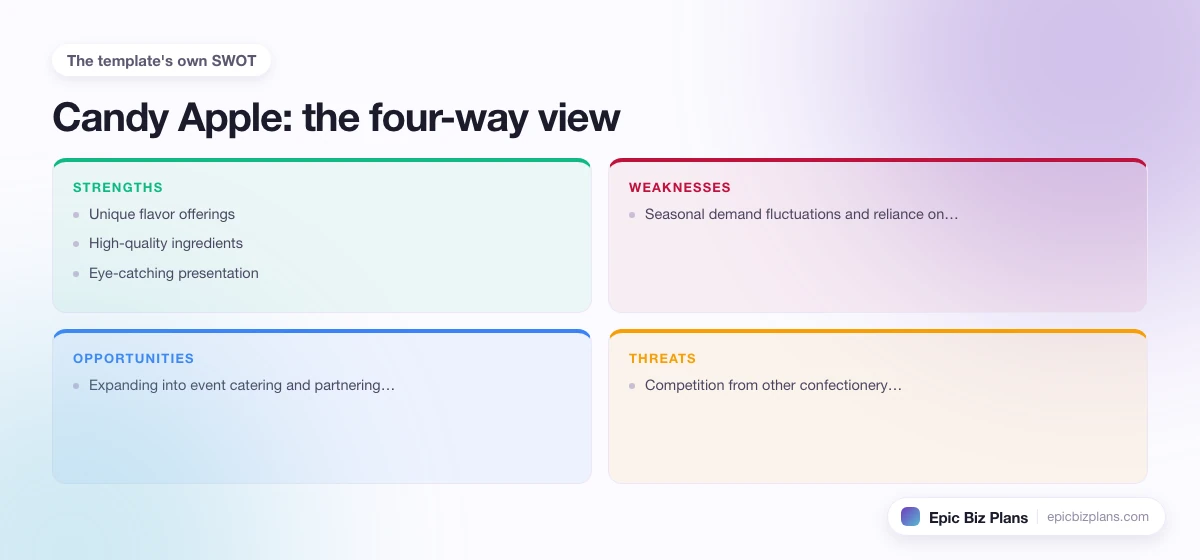
- Strengths: Unique flavor offerings, high-quality ingredients, and eye-catching presentation.
- Weaknesses: Seasonal demand fluctuations and reliance on local suppliers.
- Opportunities: Expanding into event catering and partnering with local businesses for promotions.
- Threats: Competition from other confectionery businesses and changing consumer preferences.
Candy Apple Business Name Ideas
Website
We will build our website using Shopify to handle e-commerce sales, as it offers user-friendly tools for both setup and order management. The platform allows us to create an attractive online store that showcases our candy apple varieties with professional photography. Shopify also integrates with social media for running promotions and accepting pre-orders for seasonal batches.
Marketing Details
Our marketing strategy will include SEO through Semrush to help us rank for searches like "gourmet candy apples" and "candy apple gift boxes." HubSpot will manage targeted email campaigns to engage our audience with seasonal promotions, new flavor announcements, and holiday pre-order windows. TikTok ads will generate brand awareness through recipe videos and behind-the-scenes production content that appeals to younger audiences.
Kitchen Setup and Equipment Costs
A commercial kitchen is essential for producing candy apples at scale. Renting shared commercial kitchen space costs $15-$30 per hour in most markets, while leasing your own space runs $1,000-$3,000 monthly. Essential equipment includes a commercial stove, candy thermometers, dipping stations, and refrigeration units totaling $3,000-$8,000.
Packaging materials like custom boxes, cellophane wraps, and branded stickers cost $1-$3 per unit depending on quality and order volume. Apple sourcing from local orchards runs $1-$2 per pound in bulk. Total startup costs for a small candy apple operation typically fall between $15,000-$35,000, making it one of the more accessible food businesses to launch. Similar food ventures like a confectionery business require comparable kitchen investments.
Industry Trends
Consumer interest in artisanal and gourmet food products continues to grow, and candy apples benefit from this trend. Social media has made visually striking food items highly shareable, which drives organic marketing for photogenic products like decorated candy apples. There is also a notable shift toward gift-oriented confections, with customers ordering custom candy apple boxes for holidays, weddings, and corporate events. For a related approach, see our candy bar business plan.
Food Safety and Licensing
Producing and selling food products requires specific permits and certifications. You will need a food handler's permit, a business license, and approval from your local health department to operate a commercial kitchen. If you sell across state lines, FDA registration and compliance with food labeling requirements also apply.
Cottage food laws in some states allow small-scale production from a home kitchen, but these laws typically limit your annual revenue and restrict which products you can sell. Liability insurance is essential for protecting your business against food safety claims. Having proper documentation in place also opens doors to selling through retailers and at events that require vendor permits.
Competitor Information
We will analyze our main competitors, including local candy shops and larger confectionery brands, as well as premium gifting-focused makers like those following the Sweet Heart business plan template. By focusing on our unique flavors and premium quality, we will build a distinct brand identity. Our indirect competitors include bakeries and dessert shops, and we will differentiate ourselves through our specialized focus on candy apples and custom gift packaging. For additional dessert business ideas, see our chocolate banana business plan or our chocolate bar business plan.
Financial Information
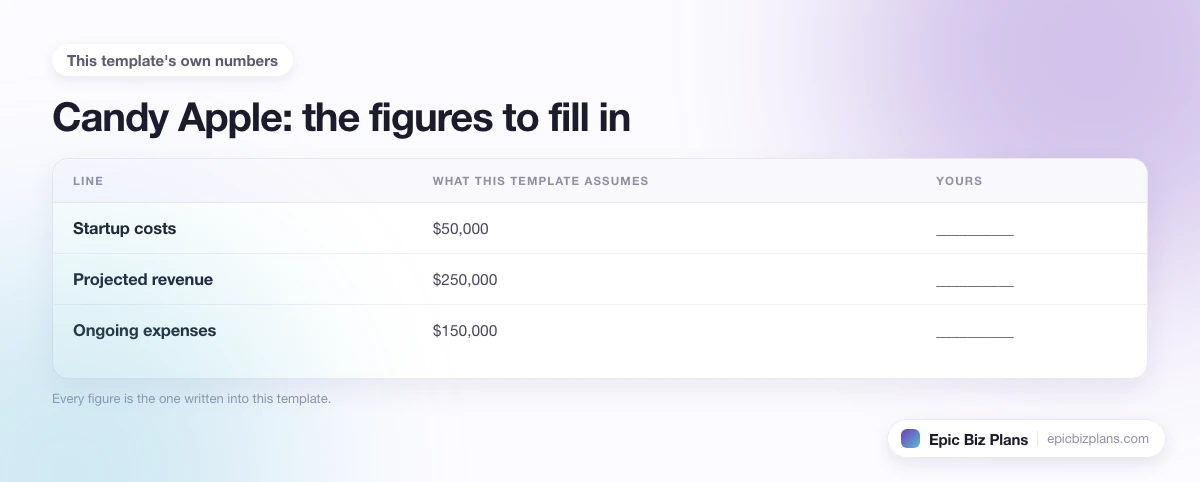
Startup costs are estimated at $50,000, covering equipment, ingredients, branding, and initial marketing efforts. We project revenues of $250,000 in the first year, with ongoing expenses of approximately $150,000. Our cash flow analysis indicates positive returns by the end of the first fiscal year. Detailed profit and loss statements will be prepared monthly during year one to track financial health closely.
Legal and Compliance
We will ensure legal compliance by registering our business in accordance with local laws. Necessary licenses will be obtained for food production and sales. Additionally, we will consider intellectual property protection for our unique recipes and branding elements, including trademarking our business name.
Operational Plan
Our operations will involve establishing partnerships with local orchards for fresh apple sourcing. We will implement a streamlined production process to maintain consistency across batches. Distribution will include e-commerce shipments, farmers' market sales, and event catering. Seasonal demand spikes around Halloween, Christmas, and Valentine's Day will require scaled-up production planning well in advance.
-
 SemrushSemrush is a platform with literally any online tool you will need to promote your business. Spy on your competitors, get search traffic, keyword research, social info, ad copies and much more. Used by most of the top online companies in the world. Besides all its tools, Semrush also has many available integrations possible with many other tools that will make your work even better.
 -
 Surfer SEOSurfer SEO is an incredibly smart AI tool that will give you exact explanations what to do in order to make your website rank better. They use hundreds of parameters, check your competitors and decide on the best course of action. Whether it be inner links, bold text, paragraphs, headers, images and much more. Surfer is a must-have in 2026.
Contingency Planning
Potential risks include supply chain disruptions during peak apple season and fluctuating demand outside of holiday periods. To mitigate these risks, we will maintain relationships with multiple apple suppliers and develop year-round marketing campaigns. Creating a financial cushion equal to two months of operating costs will help manage unexpected expenses. Diversifying into related products like bonbons and caramel sauces can smooth out seasonal revenue dips.
Building Your Candy Apple Business
A candy apple business works well at multiple scales. You can start small at weekend markets and local fairs, then grow into online sales and wholesale accounts as your brand gains traction. Some operators focus exclusively on holiday seasons, while others build year-round demand through corporate gifting and wedding favors. The right approach depends on your local market and production capacity.
Adapt and Evolve
Your Candy Apple business plan should be updated as you learn what flavors sell best and which sales channels deliver the highest margins. Test new products each season and track what generates repeat orders. Regularly revisiting your plan helps you spot opportunities and cut what is not working. Entrepreneurs running related food businesses like a farmers' market stand follow a similar iterative approach.
Practical Tools for Success
Use your Candy Apple business plan when applying for commercial kitchen leases, pitching to event coordinators, securing a small business loan, or onboarding wholesale accounts. A documented plan with financial projections shows partners and lenders that you take the business seriously.
Your Candy Apple business plan is 100% free, with unlimited edits, unlimited downloads, and unlimited chances to get it right. Start building your confectionery brand today.
