
Bonbon Business Plan Template
-
 ShopifyPut your brand on Shopify. Launch your online store with tools designed for growth and success. Ready to turn your idea into profit? Start building your e-commerce business today.
 -
 SquarespaceShowcase your brand with Squarespace’s sleek designs. Build a professional online presence with ease. Start with a template that already looks finished.
 -
 WixBring your ideas to life with Wix. Customize every aspect of your site with unmatched flexibility. Start creating your unique online space and let your creativity shine.
 -
 ElementorCraft captivating websites effortlessly with Elementor. Enjoy complete creative control without coding. Make your site stand out to your audience. Start turning your vision into reality now.
- Executive Summary
- Business Info
- SWOT Analysis
- Bonbon Business Name Ideas
- Website
- Marketing Details
- Industry Trends
- Competitor Information
- Financial Information
- Ingredient Sourcing and Quality Control
- Legal and Compliance
- Operational Plan
- Contingency Planning
- Building Your Bonbon Business
- Adapting Your Bonbon Business Plan
- Utilizing Your Plan Effectively
A bonbon business plan maps out how to enter the growing artisanal confectionery market with a product that commands premium pricing. Handcrafted bonbons sit at the intersection of culinary art and gift retail, and consumers are increasingly willing to pay more for small-batch, high-quality chocolates made with transparent sourcing. A clear plan helps you define your flavor line, price your products profitably, and reach the right buyers.
Your plan should address production capacity, ingredient sourcing, packaging design, and sales channels from the start. Whether you intend to sell through your own e-commerce store, partner with gourmet retailers, or serve the corporate gifting market, every decision flows from the foundation you set in this document. The more specific your plan, the faster you can move from kitchen prototyping to paying customers.
Executive Summary
We will establish a business focused on the production and sale of artisanal bonbons, aiming to deliver high-quality, innovative sweets to gourmet markets and individual consumers. Our mission is to create unique confections that celebrate creativity and flavor, ensuring an exceptional culinary experience. Our vision is to become a leading brand known for distinctive bonbons that appeal to both local and international audiences.
Our value proposition lies in our commitment to quality ingredients, creative flavor combinations, and attractive packaging, catering to a niche market of chocolate enthusiasts and gift seekers. Financially, we aspire to achieve break-even within the first year and achieve a revenue growth rate of 20% in year two.
Business Info
We will offer a variety of bonbons in different flavors, filled with unique ganaches, fruit purees, and spices. Our target market includes culinary enthusiasts, gift buyers, and event planners looking for exquisite options for celebrations. Our business model will revolve around direct-to-consumer sales through our online platform and partnerships with local gourmet shops. Entrepreneurs exploring related niches may also benefit from reviewing a confectionery business plan for broader category insights.
SWOT Analysis
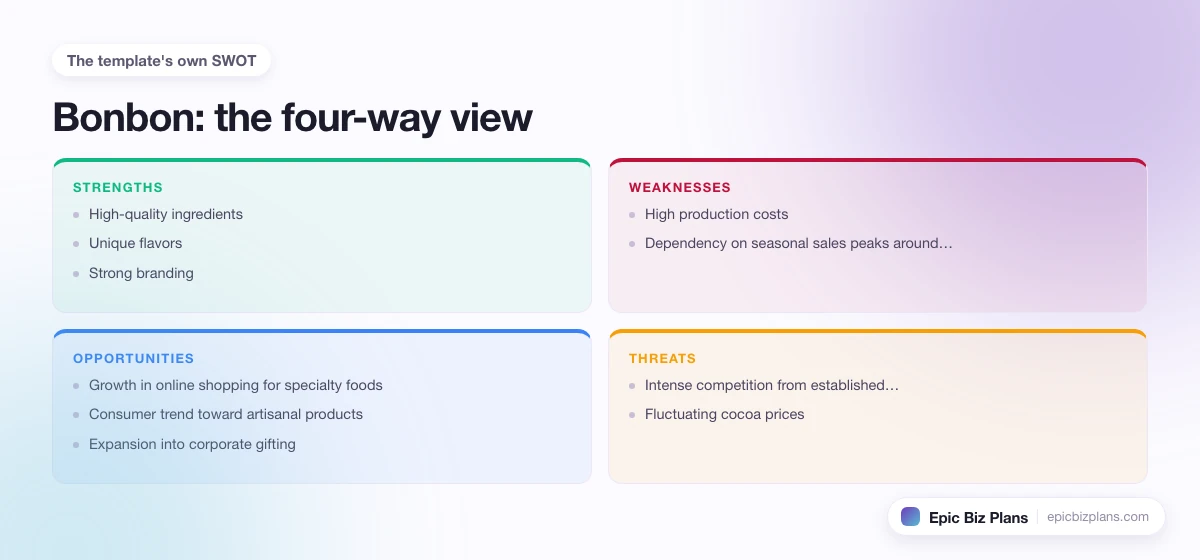
- Strengths: High-quality ingredients, unique flavors, strong branding.
- Weaknesses: High production costs, dependency on seasonal sales peaks around holidays.
- Opportunities: Growth in online shopping for specialty foods, consumer trend toward artisanal products, and expansion into corporate gifting.
- Threats: Intense competition from established chocolate brands, fluctuating cocoa prices.
Bonbon Business Name Ideas
Website
For our online presence, we will build our website using Shopify due to its user-friendly interface and eCommerce capabilities. This platform will allow us to easily manage our inventory and engage with customers efficiently. Alternatively, we may consider using Squarespace if we decide to prioritize an aesthetically appealing portfolio display for our artisan products.
Marketing Details
Our marketing strategy will incorporate a strong digital marketing approach. We will use Semrush for SEO optimization to drive organic traffic to our website. For customer relationship management and email marketing campaigns, HubSpot will be our choice, enabling us to nurture leads and enhance customer engagement effectively.
Additionally, we will run TikTok and Instagram Reels campaigns showcasing the bonbon-making process, from tempering chocolate to hand-painting each piece. Short-form video content performs well in the specialty food category and builds trust with buyers who want to see the craft behind the product. Seasonal campaigns tied to holidays like Valentine's Day, Mother's Day, and the winter gift season will drive peak revenue.
Industry Trends
The confectionery industry is witnessing a surge in demand for artisanal and gourmet products, with the premium chocolate segment growing faster than mass-market alternatives. Technological advancements such as precision tempering machines and improved cold-chain shipping have made it easier for small producers to deliver consistent quality nationwide. Consumers are also increasingly interested in single-origin cacao, ethical sourcing certifications, and reduced-sugar formulations. Those interested in a related product line can explore a chocolate bar business plan for complementary strategies.
Competitor Information
Our primary competitors will include established artisanal chocolate brands and local confectionery shops. We will distinguish ourselves by offering a wider range of unique flavor combinations, customizable gift boxes, and exceptional customer service. Additionally, our commitment to using locally sourced ingredients will appeal to the growing market of eco-conscious consumers. Studying how premium brands like luxury chocolate businesses position themselves can inform our pricing and branding strategy.
Financial Information
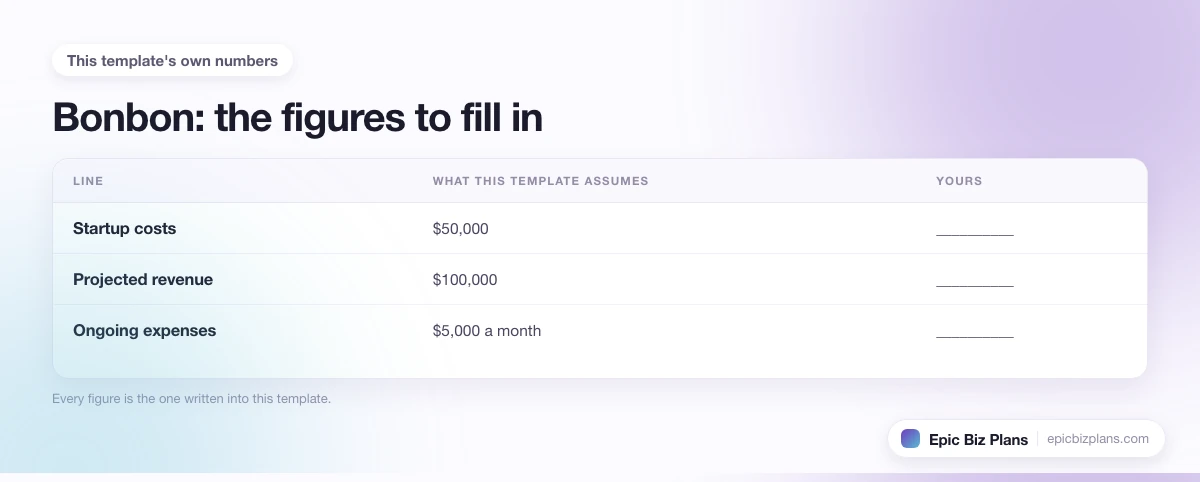
We estimate our startup costs to be approximately $50,000, which will cover tempering equipment, molds, initial ingredient stock, branding, and marketing expenses. Our projected revenue for the first year is $100,000, with ongoing monthly expenses around $5,000, which includes commercial kitchen rent, utilities, and ingredient replenishment.
We will maintain a healthy cash flow by implementing a rigorous budgeting process and closely monitoring sales performance. Profit and Loss statements will be generated quarterly to track financial health, and we will target a gross margin of 60 to 70 percent on each box of bonbons.
Ingredient Sourcing and Quality Control
Ingredient quality determines the final product, so sourcing decisions deserve their own section in the plan. Couverture chocolate should be purchased from reputable suppliers who provide certificates of origin and batch testing. Fresh ingredients like fruit purees and dairy cream require reliable cold-chain logistics, especially during warmer months.
Establishing relationships with two or three backup suppliers for each key ingredient protects against disruptions. A formal quality control checklist covering temper consistency, shell thickness, and shelf-life testing will ensure every batch meets the standard your customers expect.
Legal and Compliance
To ensure compliance, we will register our business as a limited liability company (LLC). Additionally, we will research food safety regulations specific to our region, including FDA labeling requirements for allergens and nutritional information, and obtain necessary permits for food production and sales. A candy apple business plan faces similar food safety considerations and can serve as a useful reference. Protecting our intellectual property through trademarks for our brand name and logo will also be a priority.
-
 SemrushSemrush is a platform with literally any online tool you will need to promote your business. Spy on your competitors, get search traffic, keyword research, social info, ad copies and much more. Used by most of the top online companies in the world. Besides all its tools, Semrush also has many available integrations possible with many other tools that will make your work even better.
 -
 Surfer SEOSurfer SEO is an incredibly smart AI tool that will give you exact explanations what to do in order to make your website rank better. They use hundreds of parameters, check your competitors and decide on the best course of action. Whether it be inner links, bold text, paragraphs, headers, images and much more. Surfer is a must-have in 2026.
Operational Plan
Key operations will include ingredient procurement, production scheduling, packaging, and distribution. We will establish relationships with local suppliers for fresh and organic ingredients to maintain product quality. Production will follow a weekly batch cycle aligned with order volume and shelf-life constraints. Our logistics will involve direct shipping to customers in insulated packaging and partnerships with local gourmet shops for retail distribution.
Contingency Planning
We will identify potential risks, such as supply chain disruptions, fluctuating cocoa and sugar prices, and seasonal demand swings. To mitigate these risks, we will develop alternative sourcing strategies, maintain a three-month ingredient reserve, and diversify revenue across multiple sales channels. Regular reviews of the business strategy will be conducted to adapt to changing market conditions and consumer preferences.
Building Your Bonbon Business
A bonbon business lets you turn culinary skill into a brand that customers associate with quality and celebration. Whether you envision a local shop filled with artisanal sweets, an e-commerce platform delivering gourmet delights nationally, or a pop-up presence at farmers markets and food festivals, the confectionery market has room for producers who prioritize craft over volume.
Adapting Your Bonbon Business Plan
As you grow, keep refining your strategy to target different audiences, test new flavor collections, and explore corporate gifting partnerships. Seasonal product lines and limited-edition releases can create urgency and repeat purchases. Updating your plan ensures you stay aligned with your goals and responsive to shifts in consumer taste.
Utilizing Your Plan Effectively
Think of your bonbon business plan as a working document. Use it to present to potential partners, lay the groundwork for your launch, secure an SBA loan or investor funding, or clarify your overall strategy. This structured approach will keep you focused and committed to your vision while providing a clear roadmap to profitability.
Your bonbon business plan is 100% free - with unlimited edits, unlimited downloads, and unlimited chances to get it right. Take the first step and start shaping the brand your customers will remember.
