
Apple Business Plan Template
-
 ShopifyPut your brand on Shopify. Launch your online store with tools designed for growth and success. Ready to turn your idea into profit? Start building your e-commerce business today.
 -
 SquarespaceShowcase your brand with Squarespace’s sleek designs. Build a professional online presence with ease. Start with a template that already looks finished.
 -
 WixBring your ideas to life with Wix. Customize every aspect of your site with unmatched flexibility. Start creating your unique online space and let your creativity shine.
 -
 ElementorCraft captivating websites effortlessly with Elementor. Enjoy complete creative control without coding. Make your site stand out to your audience. Start turning your vision into reality now.
- Executive Summary
- Business Info
- Business Model Overview
- SWOT Analysis
- Apple Business Name Ideas
- Website
- Marketing Details
- Industry Trends
- Competitor Information
- Seasonality and Inventory Planning
- Financial Information
- Legal and Compliance
- Operational Plan
- Contingency Planning
- Building Your Apple Business
- Expanding Your Vision
- Practical Applications
A clear Apple business plan gives your apple products venture a practical roadmap to follow. This plan is a blueprint built to present your brand and reach the customers you want to serve. Putting it together means matching your offering to real demand, whether that is fresh fruit, cider, or apple snacks. Treat the plan as a working reference you return to as the business grows.
Your Apple business plan should set out your strategy and explain how the business actually runs day to day. The market for fresh, local produce has real opportunity, and a focused plan helps you act on it. The aim is a clear, concrete document that holds up against competitors. The sections below cover each part of the plan in detail.
Executive Summary
We will establish a business that specializes in selling high-quality apple products, including fresh apples, apple cider, and apple-based snacks. Our mission is to provide healthy, well-made apple products while supporting sustainable farming practices. Our vision is to become a leading provider of apple goods in our region.
Our value proposition rests on quality, sustainability, and customer satisfaction. We aim to reach $500,000 in revenue within the first three years, with a profit margin of 20%.
Business Info
We will offer a variety of apple-based products such as fresh apples, juices, cider, and treats like pies and dried apples. Our target market includes health-conscious consumers, families, and local businesses like farmers' markets and grocery stores. Founders comparing produce-focused models can also review the fruit business plan template.
Business Model Overview
Our business model focuses on direct-to-consumer sales through online platforms and local markets, alongside partnerships with retailers. This hybrid model lets us reach a wider audience and build our brand presence.
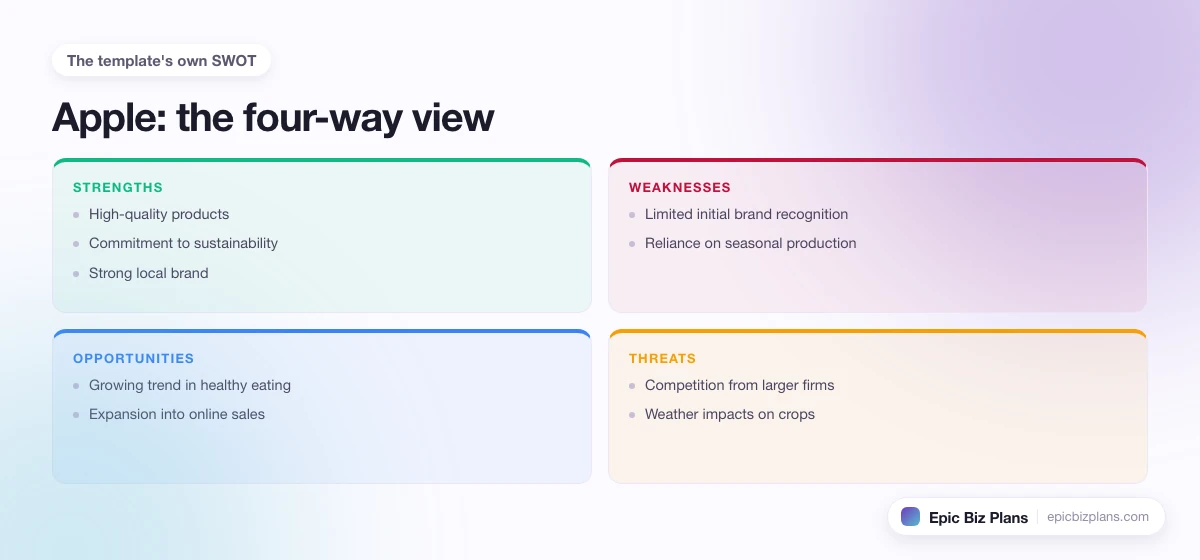
SWOT Analysis
- Strengths: High-quality products, commitment to sustainability, strong local brand.
- Weaknesses: Limited initial brand recognition, reliance on seasonal production.
- Opportunities: Growing trend in healthy eating, expansion into online sales.
- Threats: Competition from larger firms, weather impacts on crops.
Apple Business Name Ideas
Website
We will build our online presence using Shopify or Squarespace, both well suited to eCommerce businesses. Each offers a clear interface and solid features for selling products online. Shopify supports a full shopping experience, and Squarespace offers clean designs that present products well.
Marketing Details
Our marketing strategy will cover digital marketing and social media campaigns. We will use Semrush for search engine optimization to improve our website rankings. For email marketing, we will use HubSpot to build targeted campaigns that keep customers engaged.
On social media, we will run TikTok ads to reach younger buyers, showing our apples and products through short video content. This helps build brand awareness and attract a varied customer base.
Industry Trends
We will track trends that include rising demand for organic and locally sourced products. Technology in agriculture, such as drones for crop monitoring and improvements in apple breeding, will help raise production efficiency. Owners interested in the growing side can review the orchard business plan template for cultivation-focused planning.
Competitor Information
We will analyze main competitors like local orchards and grocery store chains. Indirect competitors include snack brands that sell apple-flavored products, and seasonal treat makers like those in our candy apple business plan template. To set ourselves apart, we will focus on sustainability, a distinct product range, and community engagement to build a loyal customer base.
Seasonality and Inventory Planning
Apples are a seasonal crop, so an apple business has to plan around harvest cycles. Fresh apple supply peaks in autumn, while demand for cider and baked goods often rises into the holiday season. A solid plan maps expected supply and demand month by month so you can buy, store, and price accordingly.
Cold storage extends the selling window for fresh fruit, but it adds cost and should be budgeted carefully. Value-added products such as juice, cider, and dried apples help smooth revenue across slower months because they store longer than fresh fruit. Build relationships with more than one orchard so a poor harvest at one supplier does not stop your production. Owners selling at weekend markets can also review the farmers market business plan template for seasonal sales planning.
Financial Information
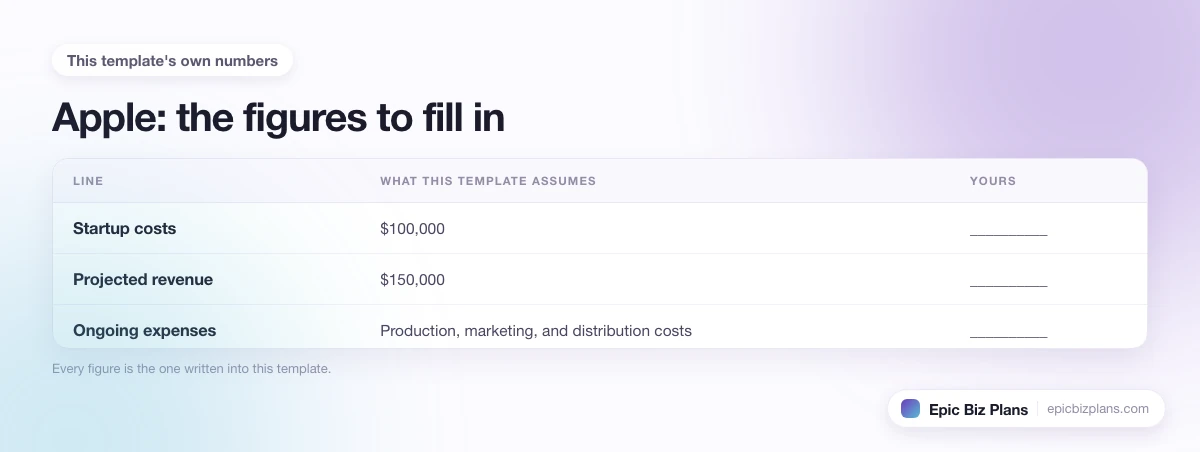
Initial startup costs are estimated at $100,000, covering equipment, marketing, and operations. Within the first year, we project revenue of $150,000, rising to $500,000 by year three. Ongoing expenses will include production, marketing, and distribution costs.
We will run regular cash flow analysis to keep enough liquidity and prepare a profit and loss statement to monitor financial performance.
-
 SemrushSemrush is a platform with literally any online tool you will need to promote your business. Spy on your competitors, get search traffic, keyword research, social info, ad copies and much more. Used by most of the top online companies in the world. Besides all its tools, Semrush also has many available integrations possible with many other tools that will make your work even better.
 -
 Surfer SEOSurfer SEO is an incredibly smart AI tool that will give you exact explanations what to do in order to make your website rank better. They use hundreds of parameters, check your competitors and decide on the best course of action. Whether it be inner links, bold text, paragraphs, headers, images and much more. Surfer is a must-have in 2026.
Legal and Compliance
We will meet local agricultural regulations and business registration requirements. We will also protect our intellectual property by trademarking our brand name and products, and make sure food safety certifications are in place.
Operational Plan
Key operations will involve sourcing apples from local farms, production at our facility, and distribution logistics. We will build an efficient supply chain to reduce waste while keeping products fresh. Logistics will include partnerships with local delivery services for reliable transportation. Founders comparing juice-led models can also review the fruit juice business plan template.
Contingency Planning
Potential risks include poor weather affecting apple harvests and shifts in market competition. To manage these risks, we will build a diversified supplier network and keep a flexible production schedule. Regular risk assessments will help us adjust our strategies as needed.
Building Your Apple Business
Turning an interest in apples into a working business is a real opportunity. From a local orchard stand to an eCommerce store selling cider and dried apples, there are several viable routes. The Apple business plan is more than a document; it is a roadmap that helps you act on those ideas with a clear sense of direction.
Expanding Your Vision
As your business grows, your Apple business plan should grow with it. Whether you target different audiences, adjust pricing, add new products, or move into fresh regions and sales channels, each update is a chance to refine your strategy. Keep the plan current so it reflects your actual operation.
Practical Applications
Your Apple business plan is a working tool. It helps when presenting to potential partners, planning a launch, securing funding, or clarifying your overall strategy. Each time you use it, you move closer to your business goals. Owners weighing a broader produce focus can also look at the farm produce business plan template.
Your Apple business plan is 100% free, with unlimited edits, unlimited downloads, and unlimited chances to get it right. Use it, refine it, and take a clear step toward building your apple products business.
