
Brickwork Business Plan Template
-
 ShopifyPut your brand on Shopify. Launch your online store with tools designed for growth and success. Ready to turn your idea into profit? Start building your e-commerce business today.
 -
 SquarespaceShowcase your brand with Squarespace’s sleek designs. Build a professional online presence with ease. Start with a template that already looks finished.
 -
 WixBring your ideas to life with Wix. Customize every aspect of your site with unmatched flexibility. Start creating your unique online space and let your creativity shine.
 -
 ElementorCraft captivating websites effortlessly with Elementor. Enjoy complete creative control without coding. Make your site stand out to your audience. Start turning your vision into reality now.
- Executive Summary
- Business Info
- Business Model Overview
- SWOT Analysis
- Brickwork Business Name Ideas
- Website
- Marketing Details
- Industry Trends
- Competitor Information
- Financial Information
- Legal and Compliance
- Operational Plan
- Contingency Planning
- Building Your Brickwork Business Plan
- Adapting Your Plan Over Time
- Practical Uses for Your Business Plan
A brickwork business operates in a trade where skill and reputation drive revenue more than any marketing campaign. Clients hiring for brick laying, restoration, or custom masonry work are making long-term decisions about their properties - they need to trust the contractor they choose. Your Brickwork business plan defines how you position that expertise, how you price your services, and how you build the kind of track record that generates steady referrals.
The construction and renovation market has seen consistent demand for quality masonry work, driven by both new residential builds and the growing preference for restoration over replacement on older properties. A clear business plan helps you enter this market with realistic financial targets and an operational framework that supports quality at scale.
Executive Summary
We are building a brickwork business focused on residential and commercial masonry - brick laying, restoration, and custom design work. Our mission is to deliver craftsmanship that holds up structurally and looks exactly as the client intended. We aim to break even within the first year and achieve a 20% net profit margin by the end of year two. Our value proposition rests on quality of finish, project timeline reliability, and the kind of clear communication that property owners and general contractors rarely get from masonry subcontractors.
Business Info
Our services cover new brick construction, restoration of existing brickwork, tuck-pointing, retaining walls, fireplaces, and decorative masonry features. Our target clients are homeowners undertaking renovations, residential builders needing reliable masonry subcontractors, and commercial property owners managing building upgrades. Revenue will come through direct service contracts and ongoing relationships with general contractors who need dependable masonry work on multiple projects per year. Operators offering general brick services can also use our bricklaying business plan.
Business Model Overview
We operate on a project-fee model with clear scope-of-work agreements before any work begins. Repeat contractor relationships are the primary source of revenue stability. As we build a reputation for on-time, on-budget delivery, referral volume from both contractors and direct homeowner clients should grow without proportional increases in marketing spend.
SWOT Analysis
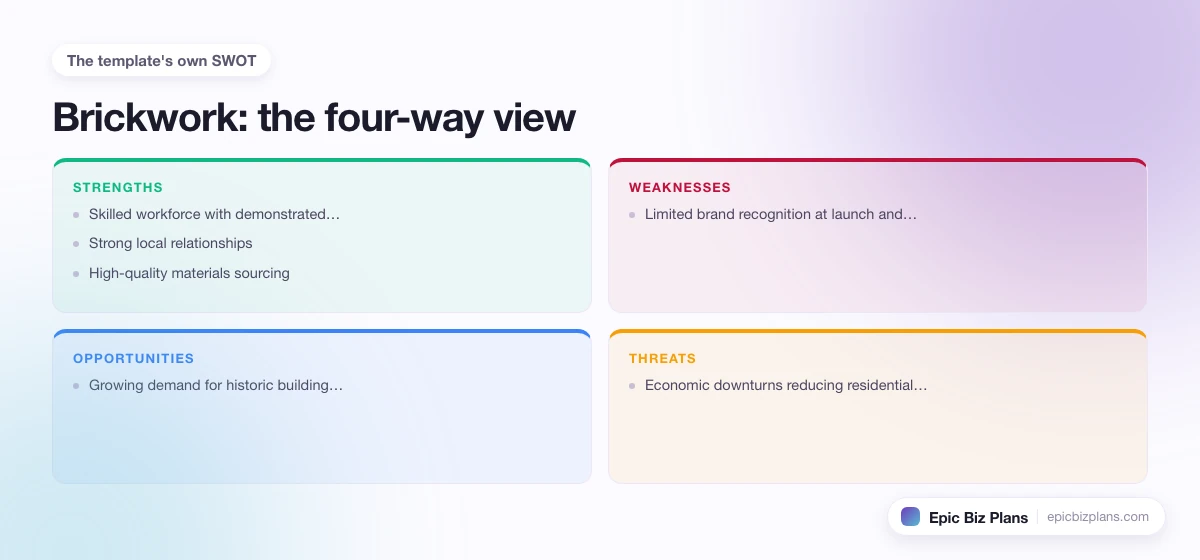
- Strengths: Skilled workforce with demonstrated craftsmanship, strong local relationships, and high-quality materials sourcing.
- Weaknesses: Limited brand recognition at launch and dependence on local market construction volume.
- Opportunities: Growing demand for historic building restoration and sustainable building material alternatives to poured concrete.
- Threats: Economic downturns reducing residential renovation budgets and competition from established masonry firms with longer client histories.
Brickwork Business Name Ideas
Website
We will build our website on WordPress with a portfolio-first design. Project photos - before and after, with detail shots of finished work - are the primary conversion tool for masonry clients. The site will include a clear service list, a project inquiry form, and a client testimonials section. Local SEO will target searches like "brickwork contractor [your city]" and "brick restoration [your city]" since virtually all clients search locally. For businesses looking to expand into adjacent construction trades, reviewing a plastering business plan illustrates how closely related trades structure their operations and pricing.
Marketing Details
Our primary marketing channel is local SEO, supported by a Google Business Profile with project photos and regular review requests to clients after project completion. Semrush will guide keyword targeting for service-specific pages. HubSpot will manage follow-up sequences for project inquiries and post-project communication that encourages referrals. General contractors who see our work on shared job sites are among the highest-converting referral sources - maintaining those relationships is a marketing priority.
For social media, Instagram and Facebook work better than TikTok for the masonry audience - project photos and before-and-after content generate strong organic engagement among homeowners planning renovations. Operators in adjacent masonry trades may find it useful to compare their approach against a bricklayer business plan or a mason business plan to benchmark positioning and pricing.
Industry Trends
Demand for historic brick restoration has grown as more property owners prioritize preservation over replacement. Traditional masonry skills are increasingly valued as an alternative to concrete block and precast panel construction for residential and boutique commercial projects where aesthetics matter. Eco-friendly brick alternatives - reclaimed brick, low-carbon-fired options - are gaining interest among sustainable construction advocates. Advanced diamond cutting and laser-guided layout tools have improved precision and reduced rework on complex decorative projects, creating a quality benchmark that differentiates skilled operators from low-cost competitors.
Competitor Information
Direct competitors are other masonry and brickwork contractors in the local market. Indirect competition comes from concrete specialists and general contractors who take on masonry work with subcontracted labor. Our differentiation comes from specialization - we do brickwork specifically and do it well - and from the documentation and communication we provide clients at each project stage. For broader context on how construction specialty businesses compete, reviewing a concrete construction business plan is useful.
Financial Information
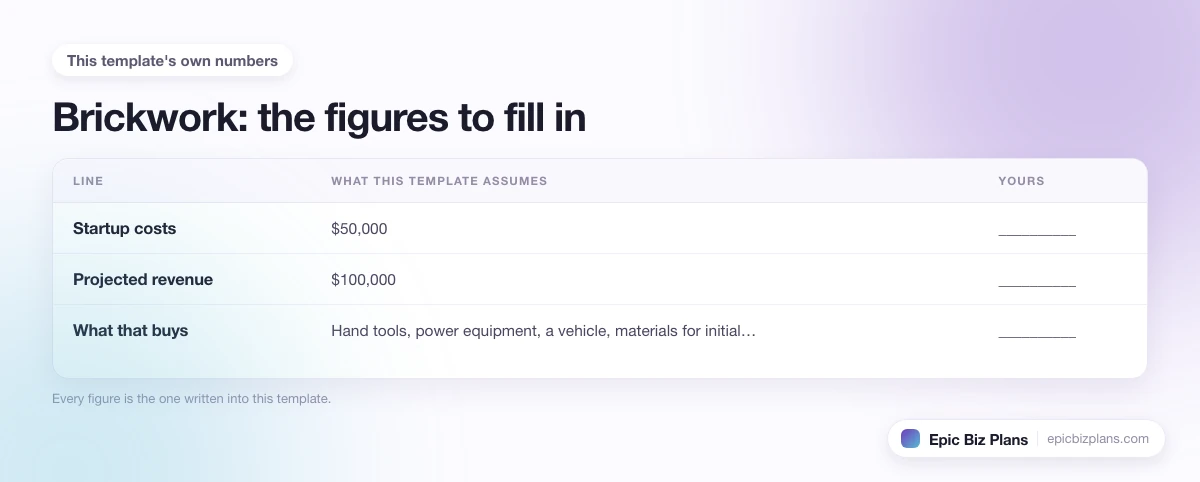
Startup costs are estimated at $50,000, covering hand tools, power equipment, a vehicle, materials for initial projects, licensing, insurance, and initial marketing. First-year revenue is projected at $100,000, growing 15% annually as contractor relationships deepen and referral volume increases. Labor is the largest ongoing expense and will be managed through a mix of core employees and licensed subcontractors on peak-volume projects. Monthly cash flow monitoring will track receivables closely, since payment timing on contractor jobs can affect short-term liquidity.
Legal and Compliance
We will obtain the state contractor license required for masonry work in our jurisdiction, register the business entity, and secure both general liability and workers' compensation insurance before starting any work. Some municipalities require specific permits for structural masonry work - we will pull permits on every project that requires them and document that process for clients. Trademark protection for our business name and logo will be pursued in the first six months.
Operational Plan
Daily operations involve project scheduling, materials procurement and staging, on-site execution, and quality inspection at key milestones. We will establish supply agreements with two or three brick and mortar suppliers to ensure material availability during busy periods. Project management software will track each job's scope, timeline, and budget against actuals. Every project will include a post-completion walkthrough with the client to confirm quality and address any concerns before final invoicing.
Contingency Planning
Primary risks include weather delays, material supply disruptions, and economic contraction that reduces renovation budgets. We will maintain a two-month operating expense reserve, diversify our project mix between new construction and restoration work, and build alternative supplier relationships before we need them. If local market conditions tighten, we will expand our geographic service radius and increase direct homeowner marketing to reduce dependence on contractor referrals from a single client base.
Building Your Brickwork Business Plan
A brickwork business is built on visible results and word-of-mouth reputation. Every project you complete is a portfolio piece and a potential source of future referrals - which means the quality of your work is the most durable marketing investment you can make. Your business plan helps you structure the operation so that quality is repeatable, not just occasional.
-
 SemrushSemrush is a platform with literally any online tool you will need to promote your business. Spy on your competitors, get search traffic, keyword research, social info, ad copies and much more. Used by most of the top online companies in the world. Besides all its tools, Semrush also has many available integrations possible with many other tools that will make your work even better.
 -
 Surfer SEOSurfer SEO is an incredibly smart AI tool that will give you exact explanations what to do in order to make your website rank better. They use hundreds of parameters, check your competitors and decide on the best course of action. Whether it be inner links, bold text, paragraphs, headers, images and much more. Surfer is a must-have in 2026.
Adapting Your Plan Over Time
Revisit your brickwork business plan at least once a year. As you accumulate completed projects, your portfolio strengthens and your ability to target higher-margin work increases. Update your financial targets to reflect actual labor costs, material price changes, and the revenue mix between contractor and direct client work. A plan that reflects reality is a plan you will actually use.
Practical Uses for Your Business Plan
Use your brickwork business plan when applying for a contractor line of credit, approaching general contractors as a preferred subcontractor, or hiring your first employee. It signals that you run a professional operation and that the people working with you can count on consistent, organized project management.
Your Brickwork business plan is 100% free - with unlimited edits, unlimited downloads, and unlimited chances to refine it as your business grows.
