
Bricklaying Business Plan Template
-
 ShopifyPut your brand on Shopify. Launch your online store with tools designed for growth and success. Ready to turn your idea into profit? Start building your e-commerce business today.
 -
 SquarespaceShowcase your brand with Squarespace’s sleek designs. Build a professional online presence with ease. Start with a template that already looks finished.
 -
 WixBring your ideas to life with Wix. Customize every aspect of your site with unmatched flexibility. Start creating your unique online space and let your creativity shine.
 -
 ElementorCraft captivating websites effortlessly with Elementor. Enjoy complete creative control without coding. Make your site stand out to your audience. Start turning your vision into reality now.
- Executive Summary
- Business Info
- Products and Services
- Business Model Overview
- SWOT Analysis
- Bricklaying Business Name Ideas
- Website
- Marketing Details
- Industry Trends
- Competitor Information
- Financial Information
- Legal and Compliance
- Operational Plan
- Estimating and Bidding Process
- Contingency Planning
- Building Your Future with a Bricklaying Business Plan
- Explore the Many Facets of Bricklaying
- Adapting Your Strategy
- Practical Applications of Your Plan
A bricklaying business plan is the foundation for turning your trade skills into a profitable construction company. Demand for skilled masons stays strong across residential, commercial, and industrial projects. A clear plan helps you win contracts, price jobs correctly, and grow at a steady pace. Use it to define your services, your clients, and the standards your crew works to.
Construction clients expect quality, reliable timelines, and fair pricing. Your bricklaying business plan should show how you deliver all three. Spell out your specialties, your service area, and what sets your work apart from larger firms. Treat the plan as a roadmap that keeps the business on track as you take on bigger projects.
Executive Summary
Our mission is to provide high-quality bricklaying services that meet the diverse needs of clients in the construction industry. We aim to become a trusted name in bricklaying, known for craftsmanship and reliability. Our value proposition is our commitment to excellence, attention to detail, and customer satisfaction. Financially, we target steady growth of 15% annually, which lets us expand our service offerings and invest in advanced tools and training for our workforce.
Business Info
Products and Services
We offer a full range of bricklaying services including residential, commercial, and industrial construction. Our services cover masonry repair, new builds, and custom designs for patios, walkways, and other outdoor structures. Our target market includes homeowners, contractors, and commercial businesses seeking reliable, professional bricklaying. Crews that also pour and finish slabs can review a concrete business plan to add a complementary service line.
Business Model Overview
We will operate on a service-based model, relying on both direct client engagements and partnerships with construction companies. Our revenue will come from project-based contracts and ongoing maintenance services.
SWOT Analysis
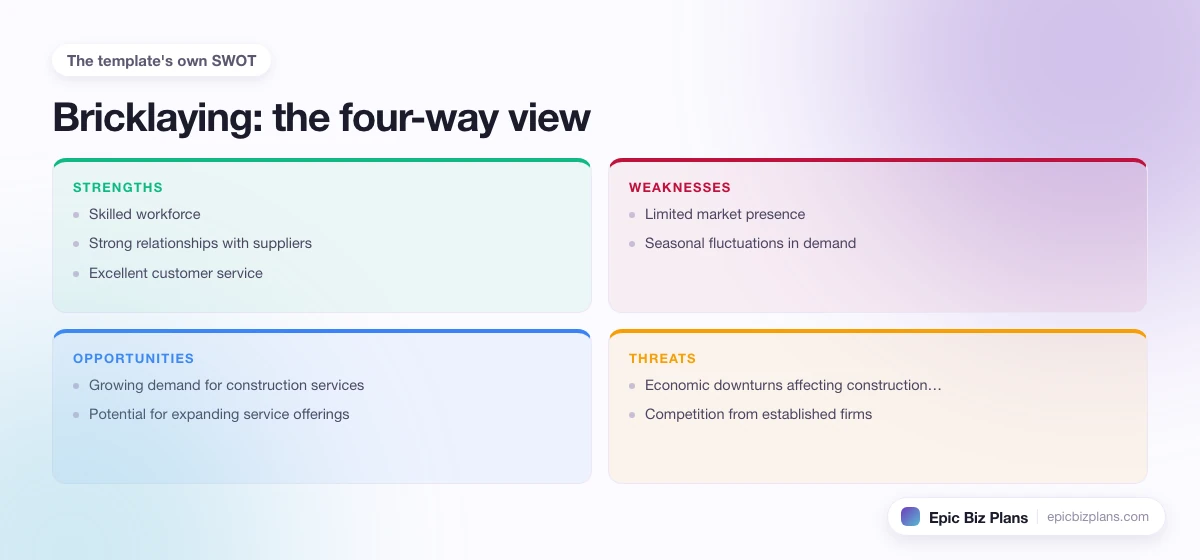
- Strengths: Skilled workforce, strong relationships with suppliers, excellent customer service.
- Weaknesses: Limited market presence, seasonal fluctuations in demand.
- Opportunities: Growing demand for construction services, potential for expanding service offerings.
- Threats: Economic downturns affecting construction budgets, competition from established firms.
Bricklaying Business Name Ideas
Website
We will build our website using Wix, since it provides an easy-to-use platform for non-technical owners and the features needed to showcase our services. We will make sure the site works well on mobile and includes a portfolio of completed projects to attract potential clients.
Marketing Details
Our marketing strategy will combine digital and traditional methods. We will use Semrush for SEO to improve our visibility and drive website traffic. For client engagement, we will run email campaigns through HubSpot to nurture leads and stay in touch with existing clients. We will also use TikTok ads to reach younger audiences and show our work in an engaging format.
Industry Trends
The construction industry is seeing rising demand for sustainable, eco-friendly building materials, which drives new masonry techniques. Technological advancements such as 3D printing in construction are starting to affect traditional bricklaying methods. These shifts bring both challenges and chances to adapt. Owners running a broader building construction business face the same trends across larger projects.
Competitor Information
Our main competitors include established bricklaying services and larger construction companies that offer masonry as part of broader packages. To stand apart, we will focus on personalized customer service, competitive pricing, and our specialized skills in custom bricklaying. Bricklaying operators who offer a broader range of masonry services including stonework and concrete should also review the masonry business plan for a framework covering multi-service trade operations.
Financial Information
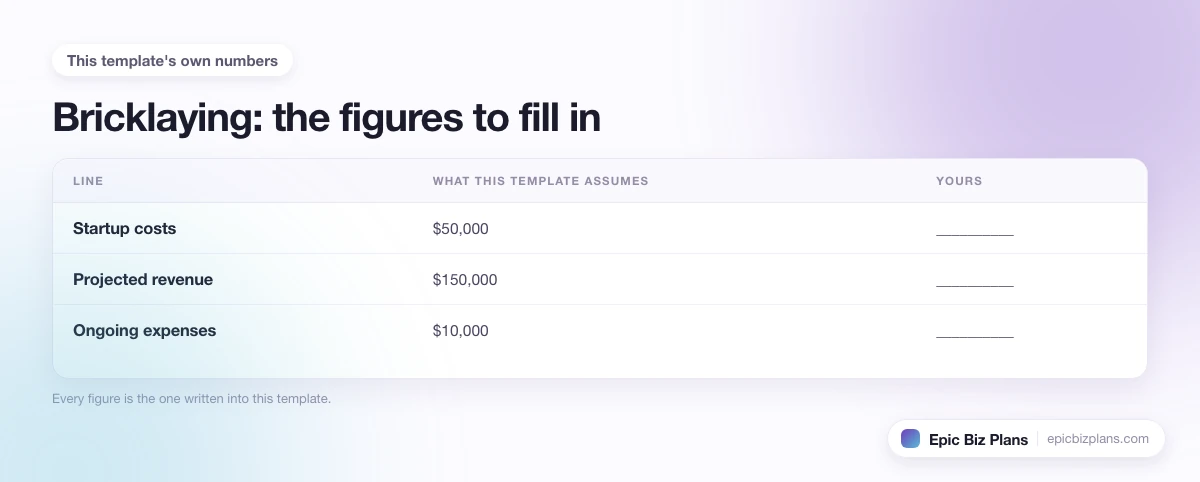
Start-up costs are estimated at roughly $50,000, including equipment, licensing, and initial marketing. Projected revenue within the first year is about $150,000, with ongoing expenses near $10,000 monthly for labor, materials, and overhead. We will monitor cash flow closely and aim for a positive P&L statement within the first 18 months of operation.
Legal and Compliance
We will meet all legal requirements, including business registration, the licenses and permits needed for bricklaying, and appropriate insurance coverage. We will also protect our intellectual property by securing trademarks for our business name and logos.
Operational Plan
Key operations include procuring materials, managing a skilled labor force, and meeting project timelines. We will build relationships with reliable suppliers and keep an efficient supply chain to support our projects. Logistics will be planned around project locations and timelines to use resources well. General contractors who subcontract trades can compare workflows in a contractor business plan.
Estimating and Bidding Process
Accurate estimates separate profitable bricklaying firms from the ones that lose money on every job. We will price each project by measuring material quantities, labor hours, equipment, and a fair margin before submitting a bid. Detailed written quotes protect both sides and reduce disputes over scope. Tracking actual costs against estimates after each job sharpens our pricing over time.
Contingency Planning
Potential risks include economic swings that affect construction demand and supply chain disruptions. We will reduce these risks by diversifying our client base, keeping financial reserves, and setting up contingency agreements with multiple suppliers to keep materials available.
Building Your Future with a Bricklaying Business Plan
Starting a bricklaying business is more than a way to earn money; it is a path to independence and pride in your craft. You build a real connection with your community through work that stands for years. You might pursue local construction contracts, artisan masonry services, or even an online course teaching the trade. Each route draws on genuine skill and craftsmanship.
-
 SemrushSemrush is a platform with literally any online tool you will need to promote your business. Spy on your competitors, get search traffic, keyword research, social info, ad copies and much more. Used by most of the top online companies in the world. Besides all its tools, Semrush also has many available integrations possible with many other tools that will make your work even better.
 -
 Surfer SEOSurfer SEO is an incredibly smart AI tool that will give you exact explanations what to do in order to make your website rank better. They use hundreds of parameters, check your competitors and decide on the best course of action. Whether it be inner links, bold text, paragraphs, headers, images and much more. Surfer is a must-have in 2026.
Explore the Many Facets of Bricklaying
In this niche, businesses range from small, custom operations focused on high-end residential work to larger firms taking on commercial projects. E-commerce platforms that sell bricklaying tools and training resources show the variety of options in this field. Solo tradespeople starting out can also follow a bricklayer business plan built around one-person operations. Each model has its own strengths, so pick the one that fits your goals.
Adapting Your Strategy
As you grow, revisit and revise your bricklaying business plan. Adapt it for new audiences, pricing models, regions, and service channels. Regular updates keep you flexible in a changing market and set the business up for long-term success.
Practical Applications of Your Plan
Your business plan is a powerful tool. Use it to present to partners, guide your launch, or secure funding. Most of all, it clarifies your strategy and direction. This living document grows with you as you build your bricklaying business.
Your bricklaying business plan is 100% free, with unlimited edits, unlimited downloads, and unlimited chances to get it right. Do not wait for the perfect moment; start building today.
