
Bricklayer Business Plan Template
-
 ShopifyPut your brand on Shopify. Launch your online store with tools designed for growth and success. Ready to turn your idea into profit? Start building your e-commerce business today.
 -
 SquarespaceShowcase your brand with Squarespace’s sleek designs. Build a professional online presence with ease. Start with a template that already looks finished.
 -
 WixBring your ideas to life with Wix. Customize every aspect of your site with unmatched flexibility. Start creating your unique online space and let your creativity shine.
 -
 ElementorCraft captivating websites effortlessly with Elementor. Enjoy complete creative control without coding. Make your site stand out to your audience. Start turning your vision into reality now.
- Executive Summary
- Business Info
- Business Model Overview
- SWOT Analysis
- Bricklayer Business Name Ideas
- Website
- Marketing Details
- Industry Trends
- Competitor Information
- Financial Information
- Legal and Compliance
- Operational Plan
- Contingency Planning
- Build Your Future With a Bricklaying Business
- Types of Bricklayer Businesses
- Adapt and Thrive
- Practical Uses for Your Plan
- Your Future Awaits
Your bricklayer business plan is more than a roadmap; it sets out how you will win work, price jobs, and grow a reliable trade business. Whether you lay bricks for homes, commercial sites, or detailed artistic projects, the plan defines your services and the clients you serve. Every section you complete makes the business easier to run and easier to fund. Treat it as the document that turns skilled work into a profitable operation.
As you build the plan, keep it grounded in how the construction market actually works in your area. Matching your services to local demand, from new builds to repairs, makes a real difference to your pipeline. This is about more than bricks and mortar; it is about steady scheduling, fair pricing, and a reputation that brings repeat referrals. A clear plan helps you stand out from competitors who work without one.
Executive Summary
Our mission is to provide reliable bricklaying services that meet customer expectations through quality craftsmanship and attention to detail. We aim to become a leading bricklaying business in our region, recognized for reliability and skill.
Our value proposition rests on quality materials and competitive pricing. We aim for target revenue of $500,000 in our first year, with a growth rate of at least 20% per year after that. Tradespeople comparing service models often review our mason business plan for additional structure.
Business Info
We offer a range of bricklaying services, including residential and commercial construction, repairs, and restorations. Our target market includes homeowners, contractors, and architects looking for dependable bricklaying. Knowing how each of these buyers awards work lets us tailor our quotes and scheduling to win more of it.
Business Model Overview
Our business model is based on direct service to clients and partnerships with construction companies. We focus on delivering quality work and building long-term client relationships. Firms taking on larger structural jobs can compare notes with our concrete construction business plan.
SWOT Analysis
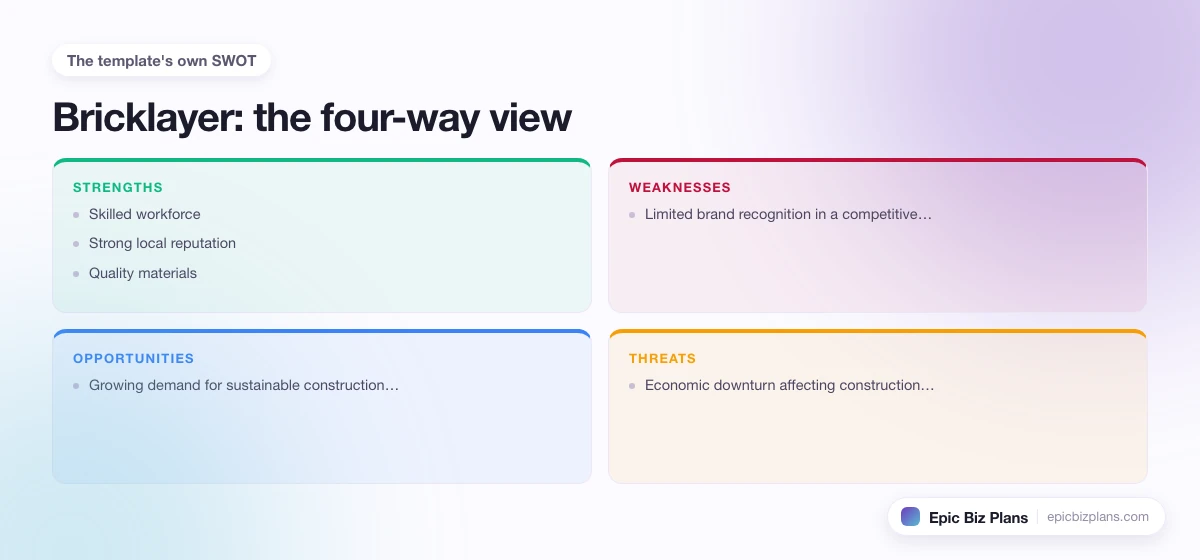
- Strengths: Skilled workforce, strong local reputation, and quality materials.
- Weaknesses: Limited brand recognition in a competitive market.
- Opportunities: Growing demand for sustainable construction and renovation projects.
- Threats: Economic downturn affecting construction budgets.
Bricklayer Business Name Ideas
Website
We will build our website using Wix for ease of use and maintenance, which suits owners who are not developers. Wix offers practical templates for showcasing completed projects with strong photography. For e-commerce options, we will also consider Shopify or Squarespace to manage orders and keep the customer experience simple.
Marketing Details
Our marketing strategy will focus on digital channels, using Semrush for SEO to improve our search visibility. We will run HubSpot email campaigns to keep clients informed and engaged between projects. Before-and-after photos of real jobs are some of our strongest marketing assets.
We will also use TikTok ads to reach younger audiences with short, visually clear content that shows our work and process. Trade videos build trust quickly because the quality of the work speaks for itself. We will track which platforms bring the best-fit enquiries and focus spend there.
Industry Trends
We will track trends in the construction industry, including 3D modeling for design and planning. As sustainability becomes a bigger priority, we will adopt eco-friendly materials and methods where they fit the job. Specialist finishing trades are in demand too, and our plastering business plan covers a complementary service line.
Competitor Information
We will identify our main competitors in the bricklaying market and study their strengths and weaknesses. Our differentiation will come from better customer service, transparent pricing, and a strong online presence. Clear, written quotes alone set us apart from many tradespeople who still work on vague verbal estimates.
Financial Information
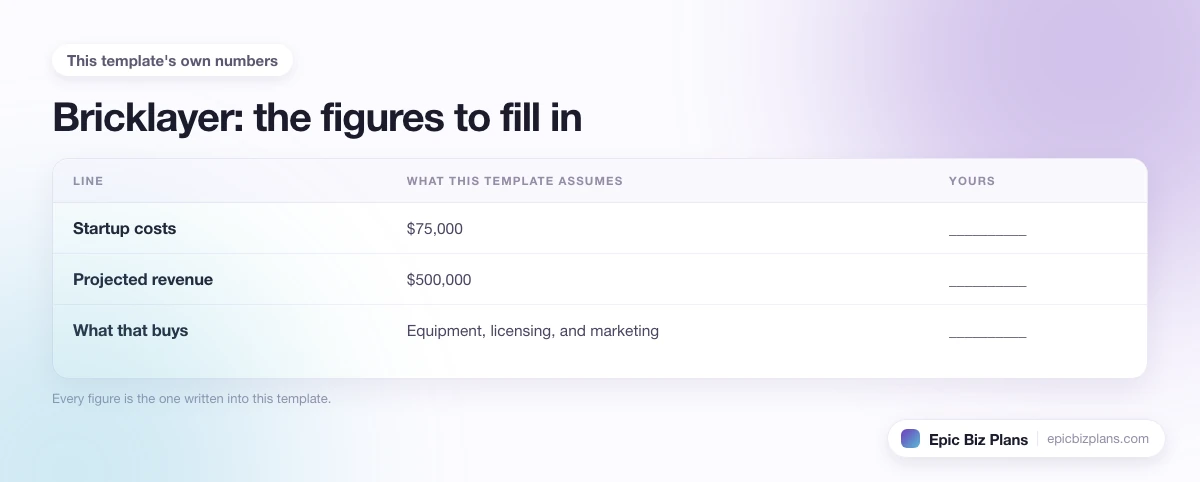
Our startup costs are estimated at roughly $75,000, covering equipment, licensing, and marketing. We anticipate projected revenue of $500,000 within the first year, with ongoing costs such as materials and labor near $300,000. Builders planning larger residential projects can reference our home building business plan for cost benchmarks.
We will build cash flow forecasts and Profit & Loss statements to track financial health and adjust as needed. Watching cash closely matters in trades, where payment timing on big jobs can strain a young business.
Legal and Compliance
We will comply with all local regulations, including the licenses and permits our work requires. We will also consider protecting our brand identity and any distinctive methods. Proper insurance and safety documentation will be in place before we take on client sites.
Operational Plan
Key operations will include project management, workforce training, and quality control. We will set up reliable material sourcing and dependable logistics for timely project completion. Bricklayers who expand into full-service masonry contracting should review a detailed brickwork business plan to understand how to structure multi-service operations and contractor relationships.
-
 SemrushSemrush is a platform with literally any online tool you will need to promote your business. Spy on your competitors, get search traffic, keyword research, social info, ad copies and much more. Used by most of the top online companies in the world. Besides all its tools, Semrush also has many available integrations possible with many other tools that will make your work even better.
 -
 Surfer SEOSurfer SEO is an incredibly smart AI tool that will give you exact explanations what to do in order to make your website rank better. They use hundreds of parameters, check your competitors and decide on the best course of action. Whether it be inner links, bold text, paragraphs, headers, images and much more. Surfer is a must-have in 2026.
Contingency Planning
We will address risks such as economic swings and labor shortages by diversifying our services and keeping a financial buffer. Mitigation will include strong supplier relationships and customer loyalty built through consistent, quality service. A simple review of these risks each quarter keeps the plan current as the business grows.
Build Your Future With a Bricklaying Business
Starting a bricklayer business is about more than laying bricks; it is a way to build something tangible in your community. It gives you control over your work, your schedule, and the standard of every job you complete. Whether you run a local masonry outfit, sell masonry products online, or offer a boutique artisan service, the options are wide. A clear plan helps you choose the path that fits your skills best.
Types of Bricklayer Businesses
Your bricklayer business plan can cover a range of directions. These include small local contractor services for family homes, larger commercial projects, sustainable building work, and custom masonry art. Each model suits different strengths and markets. A written plan helps you weigh which one to lead with and which to add later.
Adapt and Thrive
As your business grows, revisit and refine your bricklayer business plan on a regular schedule. Be ready to adjust your services for different clients, test new pricing, and expand into new areas. The plan does not end with the first draft; it evolves as the business does. Frequent updates keep it accurate and useful.
Practical Uses for Your Plan
Use your plan to present to potential partners, prepare your launch, secure funding, or clarify your direction. The clearer your vision, the easier it is to rally support and resources. It also keeps your pricing and scheduling decisions consistent as you take on more work.
Your Future Awaits
Your bricklayer business plan is 100% free, with unlimited edits, unlimited downloads, and unlimited chances to get it right. Take the opportunity and lay the foundation for the business you want.
