
Building Construction Business Plan Template
-
 ShopifyPut your brand on Shopify. Launch your online store with tools designed for growth and success. Ready to turn your idea into profit? Start building your e-commerce business today.
 -
 SquarespaceShowcase your brand with Squarespace’s sleek designs. Build a professional online presence with ease. Start with a template that already looks finished.
 -
 WixBring your ideas to life with Wix. Customize every aspect of your site with unmatched flexibility. Start creating your unique online space and let your creativity shine.
 -
 ElementorCraft captivating websites effortlessly with Elementor. Enjoy complete creative control without coding. Make your site stand out to your audience. Start turning your vision into reality now.
- Executive Summary
- Business Info
- Business Model Overview
- SWOT Analysis
- Building Construction Business Name Ideas
- Website
- Marketing Details
- Industry Trends
- Competitor Information
- Licensing, Bonding, and Startup Cost Breakdown
- Financial Information
- Legal and Compliance
- Operational Plan
- Contingency Planning
- Build a Construction Business on Execution and Reputation
- Embrace Flexibility
- Step Into the Future
A building construction business plan establishes the foundation for a company operating in one of the economy's most essential and capital-intensive sectors. Construction companies face specific challenges that general business planning frameworks don't fully address: project-based revenue with long collection cycles, complex subcontractor relationships, bonding and insurance requirements, and labor market dynamics that affect every job margin. This plan is built around those realities, not around them. Operators researching nearby niches may also find our countertop installation business plan useful for benchmarking financials and operational planning.
Whether you're launching a residential general contracting firm, a commercial construction company, or a specialty trade contractor (such as those covered in a glass installation business plan), the planning requirements are significant. This template covers all of the core areas and gives you a starting point that reflects how construction businesses actually operate. For site work and excavation, pair it with our earthmoving business plan template.
Executive Summary
Our mission is to deliver high-quality building construction services that meet the diverse needs of residential and commercial clients. Firms that source aggregate or minerals on site may also study a mining business plan template for extraction and compliance detail. We will build our operation around sustainable practices, careful project management, and a skilled workforce that consistently delivers on schedule and within budget. Our vision is to become a recognized construction company in our region, known for honest communication with clients, quality workmanship, and the ability to execute complex projects reliably. Construction firms requiring external engineering oversight will partner with qualified civil engineering consultants to handle structural analysis and regulatory compliance, as referenced in the civil engineering business plan. We target a 15% net profit margin within three years through controlled overhead and efficient project execution. For a related angle, see the Design And Construction business plan template. Related reading: Permits business plan.
Business Info
We specialize in residential and commercial building construction, offering new construction, renovations, additions, and full project management services. Our target market includes homeowners undertaking significant renovation or build projects, real estate developers requiring reliable construction partners, and commercial enterprises building or expanding facilities in our service area, many of whom also engage a firm following a quantity surveying business plan to control costs.
Business Model Overview
Revenue is project-based, with contracts specifying scope, timeline, and payment milestones. We use a combination of fixed-price contracts for well-defined residential projects and cost-plus arrangements for commercial work where scope has inherent variability. Subcontractor relationships are central to our operational model - we maintain qualified trade partners for electrical, plumbing, HVAC, and specialty work, coordinated by our own project management team.
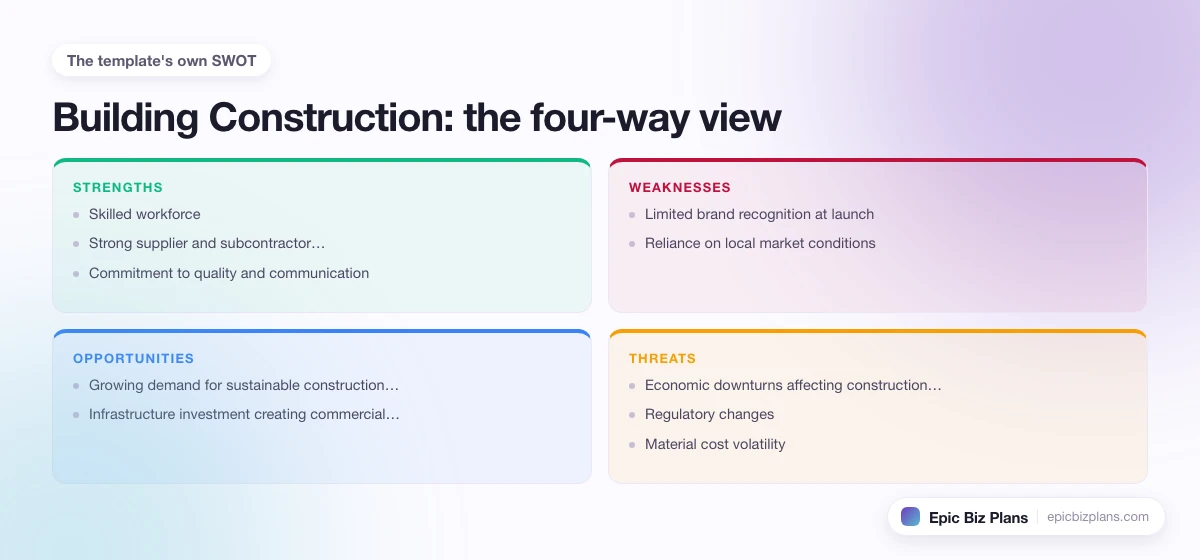
SWOT Analysis
- Strengths: Skilled workforce, strong supplier and subcontractor relationships, commitment to quality and communication.
- Weaknesses: Limited brand recognition at launch, reliance on local market conditions.
- Opportunities: Growing demand for sustainable construction and urban infill development, infrastructure investment creating commercial opportunity.
- Threats: Economic downturns affecting construction activity, regulatory changes, material cost volatility, and labor market tightness.
Building Construction Business Name Ideas
Website
We will build our website on WordPress, which provides the flexibility and content management capabilities appropriate for a project-based business. The excavating business plan will showcase our portfolio with detailed project photography, client testimonials, and case studies that demonstrate our execution capability. A clear contact and quote request flow is essential - construction clients researching online want to reach a real person quickly. We will optimize the site for local search terms relevant to our service area and specialization using Semrush keyword data.
Marketing Details
Construction business development is relationship-driven. Our primary channels are referrals from satisfied clients, relationships with architects and engineers who recommend contractors to their clients, and relationships with real estate developers who need reliable construction partners for multiple projects. These channels take time to develop but generate high-quality leads with genuine project budgets.
Digital marketing plays a supporting role - we will use Semrush to build local SEO presence for high-intent search terms in our area, and HubSpot to manage follow-up with prospects who have requested quotes. Targeted social media content featuring completed projects builds credibility with homeowners who are in early research mode. Related construction business models covered in the home builder business plan and contractor business plan offer useful benchmarks for marketing approach and sales cycle management.
Industry Trends
The construction industry is being reshaped by Building Information Modeling (BIM) technology, which improves coordination between design and construction phases and reduces costly field conflicts. Sustainable building practices - including LEED certification, energy efficiency requirements, and low-carbon material selection - are moving from optional to required on an increasing proportion of commercial projects. Prefabrication and modular construction are gaining adoption for their cost efficiency and schedule predictability advantages. Labor market tightness remains a persistent challenge, making investment in workforce training and subcontractor relationship management a competitive differentiator.
Competitor Information
Direct competitors include established local general contractors and specialty construction firms. That specialty group includes moisture-focused crews working from a water proofing business plan, whose services we sometimes subcontract on larger builds. Indirect competition comes from owner-managed construction operations and regional or national contractors who occasionally compete in our local market. Our differentiation focuses on project management quality - consistent communication with clients, accurate scheduling, and margin discipline that allows us to price fairly without sacrificing profitability. We track competitor activity through project permit databases, local developer networks, and industry association membership. The concrete construction business plan covers a specialist trade category that frequently acts as a key subcontractor partner for general contractors like us. Builders offering interior finishing often attach a wood flooring business plan template to cover flooring scope on residential jobs. Construction firms coordinating complex builds increasingly bring in modeling support, often guided by a BIM business plan template.
Licensing, Bonding, and Startup Cost Breakdown
Construction businesses face more regulatory startup requirements than most industries. Licensing requirements vary significantly by state and project type - general contractor licenses, specialty trade licenses, and home improvement registrations each have different examination, insurance, and bonding requirements. Budget $2,000–$5,000 for initial licensing and bonding setup, and allocate ongoing budget for annual license renewals and bond premium payments.
Additional startup costs include general liability insurance ($5,000–$12,000 annually for a new contractor), workers' compensation insurance (varies by payroll, typically 5–15% of labor costs), initial equipment and tool inventory ($20,000–$80,000 depending on project type), a work vehicle or fleet ($15,000–$40,000), website and marketing materials ($3,000–$6,000), and 3–6 months of operating capital to bridge project payment cycles ($50,000–$100,000). Total estimated startup investment ranges from $95,000 to $243,000 for a properly capitalized entry into general contracting. Specialty trade contractors launching with more focused scope can start for $40,000–$80,000.
Financial Information
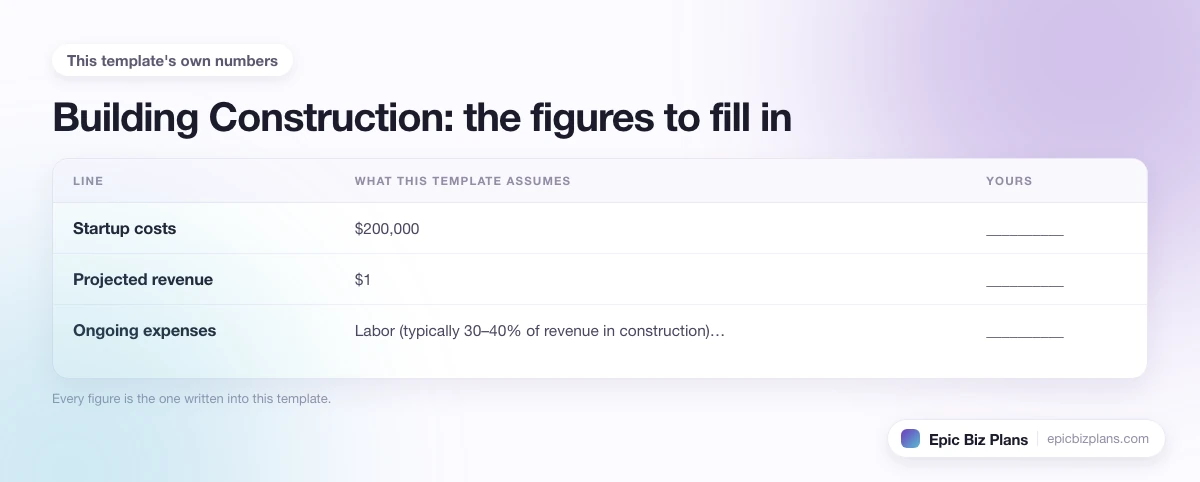
Startup costs are estimated at $200,000, covering equipment, initial materials, licensing, insurance, and operating capital. We project $500,000 in first-year revenue from an initial project pipeline, increasing to $1 million by year three as our referral network and client base expand. Ongoing expenses include labor (typically 30–40% of revenue in construction), materials, subcontractor costs, insurance, equipment maintenance, and overhead. Cash flow is tightly managed given the gap between project milestones and payment collection - we use draw schedules and payment terms designed to keep cash flow positive throughout each project. P&L statements are reviewed monthly, not quarterly, given the margin sensitivity of project-based work. Contractors working out how many units a site has to have should read the sanitation section of the toilet business plan. For how to confirm which code edition an authority enforces before quoting, see the tiny home business plan.
Legal and Compliance
We will obtain all required state and local contractor licenses, maintain appropriate general liability and workers' compensation coverage, and ensure compliance with OSHA safety regulations at every job site. Contract documentation - including signed contracts, change order procedures, lien rights management, and project closeout protocols - is critical to protecting our business legally and financially. Intellectual property protection covers any proprietary project management methodologies or estimating tools we develop. We will retain a construction attorney to review our standard contract forms before use.
Operational Plan
Operations center on four functions: estimating and bidding, project management, subcontractor coordination, and quality control. Each project begins with a detailed preconstruction phase - scope review, subcontractor bidding, material procurement planning, and permit acquisition - before breaking ground. Project managers maintain weekly schedule reviews and budget-to-actual cost tracking for every active job. Quality control inspections occur at defined milestones, with documentation maintained for both client confidence and warranty management. Our supply chain prioritizes established supplier relationships with negotiated pricing and delivery reliability. The remodeling business plan provides a useful operational reference for the renovation and retrofit side of our project portfolio.
-
 SemrushSemrush is a platform with literally any online tool you will need to promote your business. Spy on your competitors, get search traffic, keyword research, social info, ad copies and much more. Used by most of the top online companies in the world. Besides all its tools, Semrush also has many available integrations possible with many other tools that will make your work even better.
 -
 Surfer SEOSurfer SEO is an incredibly smart AI tool that will give you exact explanations what to do in order to make your website rank better. They use hundreds of parameters, check your competitors and decide on the best course of action. Whether it be inner links, bold text, paragraphs, headers, images and much more. Surfer is a must-have in 2026.
Contingency Planning
Construction companies face multiple risk categories that require specific mitigation strategies. Project delay risk is managed through realistic scheduling with built-in float, early subcontractor commitment, and detailed preconstruction planning. Material cost volatility is addressed through supplier price locks on major material orders and contract escalation clauses for projects with extended timelines. Labor shortages are mitigated by maintaining relationships with multiple subcontractor trades in each category and by building in realistic production rates rather than optimistic assumptions. A contingency reserve of 5–10% is included in all project budgets to cover unforeseen conditions. At the company level, we maintain 3 months of operating expense coverage in reserve at all times. Contractors who specialize in exterior cladding and architectural finishes should also review a facade business plan template as a useful reference for specialty scope management.
Build a Construction Business on Execution and Reputation
In construction, your reputation is built job by job. Every project delivered on time and on budget strengthens your referral network and makes the next project easier to win. Every schedule slip or cost overrun erodes the trust you've built. The business plan you build now is about setting up the operational discipline - the estimating processes, project management protocols, subcontractor relationships, and financial controls - that make consistent execution possible.
For operators expanding into adjacent construction and trade categories, the electrical contractor business plan and plumbing and heating business plan cover the key trade categories that interface most frequently with general construction operations.
Embrace Flexibility
Review and update this plan each year. As your project portfolio diversifies, your estimating capabilities improve, and your client base broadens, update your plan to reflect your actual business rather than your launch-day assumptions. A plan that stays current with your real operation is far more useful than one that sits unchanged from the day you wrote it.
Step Into the Future
Your building construction business plan is 100% free - with unlimited edits, unlimited downloads, and unlimited chances to get it right. The construction industry needs well-run companies. Build yours on a solid operational and financial foundation.
