
Brewpub Business Plan Template
-
 ShopifyPut your brand on Shopify. Launch your online store with tools designed for growth and success. Ready to turn your idea into profit? Start building your e-commerce business today.
 -
 SquarespaceShowcase your brand with Squarespace’s sleek designs. Build a professional online presence with ease. Start with a template that already looks finished.
 -
 WixBring your ideas to life with Wix. Customize every aspect of your site with unmatched flexibility. Start creating your unique online space and let your creativity shine.
 -
 ElementorCraft captivating websites effortlessly with Elementor. Enjoy complete creative control without coding. Make your site stand out to your audience. Start turning your vision into reality now.
- Executive Summary
- Business Info
- Products and Services
- Target Market
- Business Model Overview
- SWOT Analysis
- Brewpub Business Name Ideas
- Website
- Marketing Details
- Industry Trends
- Competitor Information
- Financial Information
- Startup Cost Breakdown
- Legal and Compliance
- Operational Plan
- Contingency Planning
- Your Passion, Your Brewpub
- Your Evolving Brewpub Business Plan
- Practical Uses for Your Plan
A brewpub combines two distinct businesses - a craft brewery and a full-service restaurant - under one roof. That combination creates operational complexity and high startup costs, but it also produces a customer experience and margin profile that neither a standalone bar nor a production brewery can match. Getting your brewpub business plan right from the start means understanding both sides of that equation.
This plan template gives you a realistic foundation: startup costs grounded in actual brewpub economics, a marketing approach that works for a location-based hospitality business, and an operational structure that accounts for the challenges of running food service and beer production simultaneously. Owners weighing a house soda or cola line alongside the taps can plan it with a cola business plan.
Executive Summary
We will open a neighborhood brewpub focused on handcrafted beers paired with a kitchen menu designed to complement - not compete with - the brewing program. Our mission is to become the preferred gathering spot for craft beer enthusiasts and food-conscious diners in our community, built on a foundation of local sourcing, consistent quality, and genuine hospitality. We project positive cash flow within 18 months and first-year revenue of $500,000, supported by dine-in sales, weekend events, and a merchandise program. Our taproom will seat 80 guests with an additional 30-seat patio, and the brewery will have a 5-barrel production capacity suitable for both on-premises consumption and limited distribution.
Business Info
Products and Services
Our beer program will launch with six year-round house beers covering the main style categories - a pale ale, an IPA, a stout, a wheat beer, a lager, and a seasonal rotation slot. The kitchen menu will be focused and deliberate: 8–10 items designed specifically to pair with beer, with rotating specials tied to seasonal tap releases. We will sell merchandise (glassware, apparel, branded merchandise) and offer a Mug Club membership for our most loyal regulars. Brewpubs that also want to offer retail bottle sales should review a craft beer business plan for how retail and taproom revenue streams are typically structured.
Target Market
Our core customer is a local resident aged 25–50 who drinks craft beer at least occasionally, dines out 2–3 times per week, and values a comfortable, authentic atmosphere over a trendy nightclub environment. Secondary customers include tourists seeking a local experience, event planners booking private events in our space, and local businesses looking for a venue for team outings. Understanding how pub-style operations serve community needs is also relevant - a British pub business plan covers the community-centered hospitality model in useful detail, as does our Irish pub business plan template for operators leaning into that traditional, community-focused theme.
Business Model Overview
Revenue will come from four streams: on-premises food and beverage sales (estimated 75% of revenue), private event bookings (10%), merchandise sales (5%), and Mug Club memberships and beer-to-go crowlers (10%). The food-and-beverage focus keeps our license requirements and operational complexity manageable, while events and memberships create revenue predictability that pure bar operations lack.
SWOT Analysis
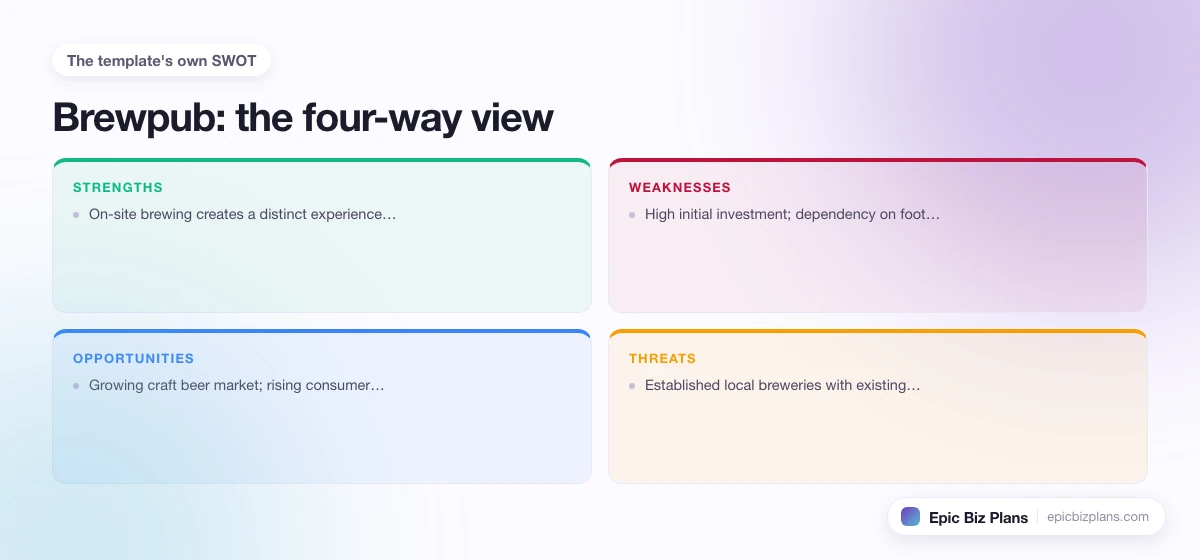
- Strengths: On-site brewing creates a distinct experience and margin advantage vs. bars buying wholesale.
- Weaknesses: High initial investment; dependency on foot traffic and local market conditions.
- Opportunities: Growing craft beer market; rising consumer interest in local sourcing and community-centered venues.
- Threats: Established local breweries with existing customer loyalty; restaurant industry labor challenges.
Brewpub Business Name Ideas
Website
A brewpub website needs three things: a clear location and hours, an up-to-date tap list, and an event calendar. Wix handles this well for a non-technical operator and is fast to maintain. If you plan to sell merchandise or Mug Club memberships online, adding Shopify as a secondary store or integrating Shopify's buy button into your Wix site works cleanly. Keep the website mobile-optimized - the majority of brewpub website visitors arrive via a phone search, often in the same hour they decide to visit.
Marketing Details
Google Business Profile is the highest-ROI marketing tool for a brewpub. Claiming and actively maintaining your listing - with updated photos, current hours, and regular posts about new tap releases - drives local search traffic at zero cost. Instagram is the primary social media platform for craft beer businesses, where tap list photos, behind-the-scenes brewing content, and event announcements build a community of regulars. Semrush will support our organic SEO strategy for longer-tail searches like "craft beer pub near [your neighborhood]." HubSpot will manage our email list for promoting events and new tap releases to subscribers.
TikTok is increasingly relevant for breweries targeting the 21–35 demographic - short videos of the brewing process, staff personality content, and event highlights generate organic reach that paid ads cannot always replicate at the same efficiency. For venue-focused hospitality businesses, a wine bar business plan provides useful context on how comparable beverage-forward venues approach event programming and customer loyalty.
Industry Trends
The craft brewing industry has matured - the explosive growth phase is over, and the businesses thriving now are those with genuine community integration and consistent quality. Non-alcoholic craft beer is growing fast, with major beer drinker survey data showing 30%+ of craft beer customers regularly seek NA options. Adding a quality non-alcoholic tap option is increasingly a table-stakes expectation rather than a niche accommodation. Food quality now matters more than it did five years ago for brewpubs - customers who might have tolerated average pub food in 2015 now expect a thoughtful, well-executed menu.
Competitor Information
We will map every bar, restaurant, and brewery within a 3-mile radius before opening. Direct competitors are other brewpubs with similar price points and atmospheres. Indirect competitors are any establishment that competes for the same Friday night spend - restaurants, bars, entertainment venues. Our differentiation is the brewing program itself: watching your beer being made 20 feet from your table is an experience no bar can replicate. We will lean into that through brewery tours, brewing education events, and transparent communication about our ingredients and process. Operators weighing a production-focused model instead of a brewpub can compare the economics with a brewery business plan template. A related hospitality operation worth reviewing for pricing and operational comparison is a pub business plan. Entrepreneurs building a craft beer brand alongside their brewing operation should review the craft beer business plan template for taproom design guidance, membership program strategy, and community marketing approaches.
Financial Information
Estimated startup costs are $300,000. This covers brewing equipment for a 5-barrel system ($80,000), leasehold improvements and buildout ($120,000), liquor license and permits ($15,000–$25,000 depending on state), initial ingredient and supply inventory ($20,000), working capital for the first 90 days of operation ($50,000), and marketing/branding launch costs ($15,000). First-year revenue target is $500,000, with a food-beverage cost of goods at 28–32% and labor at 30–35% of revenue - industry benchmarks for a well-run brewpub operation.
Startup Cost Breakdown
A detailed view of brewpub startup costs helps prevent the most common failure mode in this industry: running out of cash before the business reaches steady-state operations.
- 5-barrel brewing system and fermentation tanks: $70,000–$100,000
- Leasehold improvements (kitchen, bar, taproom buildout): $100,000–$150,000
- Furniture, fixtures, and equipment: $30,000–$50,000
- Liquor license and health permits: $15,000–$30,000
- Initial inventory (ingredients, food, supplies): $15,000–$25,000
- Branding, website, and opening marketing: $10,000–$20,000
- Operating reserve (3 months): $40,000–$60,000
Total estimated startup range: $280,000–$435,000. Most successful brewpub operators recommend having at least 6 months of operating expenses in reserve, not 3.
Legal and Compliance
A brewpub requires a brewer's notice from the TTB (Alcohol and Tobacco Tax and Trade Bureau), a state liquor license for on-premises sales, and food service permits from the local health department. These take time - budget 3–6 months for licensing before opening. We will also protect our original beer recipe names and brand as trademarks, and our brewing recipes as trade secrets through appropriate employee confidentiality agreements.
-
 SemrushSemrush is a platform with literally any online tool you will need to promote your business. Spy on your competitors, get search traffic, keyword research, social info, ad copies and much more. Used by most of the top online companies in the world. Besides all its tools, Semrush also has many available integrations possible with many other tools that will make your work even better.
 -
 Surfer SEOSurfer SEO is an incredibly smart AI tool that will give you exact explanations what to do in order to make your website rank better. They use hundreds of parameters, check your competitors and decide on the best course of action. Whether it be inner links, bold text, paragraphs, headers, images and much more. Surfer is a must-have in 2026.
Operational Plan
The head brewer will be responsible for production scheduling, quality control, and recipe development. The kitchen will operate under a head chef with specific experience in high-volume pub kitchens - restaurant skills do not automatically transfer to the pace and volume of a busy taproom. Front-of-house staffing will maintain a 1:20 server-to-table ratio during peak hours. Inventory for both brewery ingredients and food supplies will be managed through weekly ordering cycles with 30-day cost tracking to identify variance from projected food and beverage costs.
Contingency Planning
Key risks include equipment failure, liquor license delays, a key staff departure during the launch phase, and slower-than-projected ramp-up in customer traffic. Mitigation strategies include a preventive maintenance schedule for all brewing equipment, dual sourcing relationships for key ingredients, cross-training staff across kitchen and bar functions, and a 90-day cash reserve explicitly reserved for below-projection scenarios. Monthly P&L reviews will identify underperforming areas before they become critical problems.
Your Passion, Your Brewpub
Running a successful brewpub requires genuine passion for both the craft and the hospitality side of the business. The owners who burn out are usually those who loved brewing but underestimated how much of the job is managing staff, handling vendor relationships, and dealing with the unglamorous side of running a restaurant. Go in clear-eyed about both parts of the business, and you will be better equipped for the challenges that come.
Your Evolving Brewpub Business Plan
Update your plan annually, and revisit your financial assumptions after each quarter in the first year. Revenue ramp in hospitality is rarely linear - you will likely see strong opening weeks, a slower middle period, and then steady growth as regulars develop. Build that curve into your projections rather than assuming a straight-line growth trajectory from day one.
Practical Uses for Your Plan
Banks and SBA lenders require a detailed business plan for any loan application. Investors in a brewpub deal will want to see realistic financial projections with clearly stated assumptions. Landlords increasingly ask for business plans before signing a lease with a hospitality tenant. A thorough plan builds credibility in all of these conversations.
Your brewpub business plan is 100% free - with unlimited edits, unlimited downloads, and unlimited chances to get it right. Build it carefully, update it often, and let it serve as the operating document that guides your decisions as the business grows.
