
Brewery Business Plan Template
-
 ShopifyPut your brand on Shopify. Launch your online store with tools designed for growth and success. Ready to turn your idea into profit? Start building your e-commerce business today.
 -
 SquarespaceShowcase your brand with Squarespace’s sleek designs. Build a professional online presence with ease. Start with a template that already looks finished.
 -
 WixBring your ideas to life with Wix. Customize every aspect of your site with unmatched flexibility. Start creating your unique online space and let your creativity shine.
 -
 ElementorCraft captivating websites effortlessly with Elementor. Enjoy complete creative control without coding. Make your site stand out to your audience. Start turning your vision into reality now.
- Executive Summary
- Business Info
- Business Model Overview
- SWOT Analysis
- Brewery Business Name Ideas
- Website
- Marketing Details
- Industry Trends
- Competitor Information
- Financial Information
- Legal and Compliance
- Operational Plan
- Contingency Planning
- Concluding Your Brewery Business Plan
- Types of Businesses in the Brewery Niche
- Adapting Your Plan
- Practical Uses for Your Plan
Your brewery business plan sets the direction for a business that combines craft, community, and steady profitability. It is more than a document. It is the working blueprint for how your brewery will source ingredients, build a taproom audience, and reach a target revenue. Whether you are brewing hops or building a distinct brand, your plan should reflect your specific vision and the customers you want to reach.
Use this stage to define your place in a competitive market. Start with what makes your brewery different, from your flavors to the atmosphere of your taproom. Let the plan document the brand you want to build, the connections you want to form, and the financial targets you expect to hit. For a closely related angle, see the Wine Bar business plan template.
Executive Summary
Our mission is to create exceptional beers that bring people together and celebrate the rich flavors of our region. We envision a brewery that stands out for its commitment to quality, sustainability, and community involvement. Our value proposition lies in offering unique, high-quality brews tailored to the tastes of our customers while emphasizing locally sourced ingredients. We aim to achieve financial goals that ensure sustainable growth, including reaching a revenue target of $1 million in our first three years of operation.
Business Info
We will produce a variety of create beers, focusing on artisanal brewing methods and local ingredients. Our target market includes create beer enthusiasts aged 25-45, millennials, and environmentally conscious consumers who value local sourcing. For a non-alcoholic small-batch option, the ginger beer business plan template is a useful reference.
Business Model Overview
Our business model will center around direct-to-consumer sales through a taproom, online orders for local deliveries, and distribution partnerships with local bars and restaurants. Casual venues such as a dive bar are ideal accounts for a rotating keg program. We will also explore hosting events and brewery tours to enhance customer engagement. Partnering with a local wine tour business can bring a ready audience of drinks tourists to those events.
SWOT Analysis
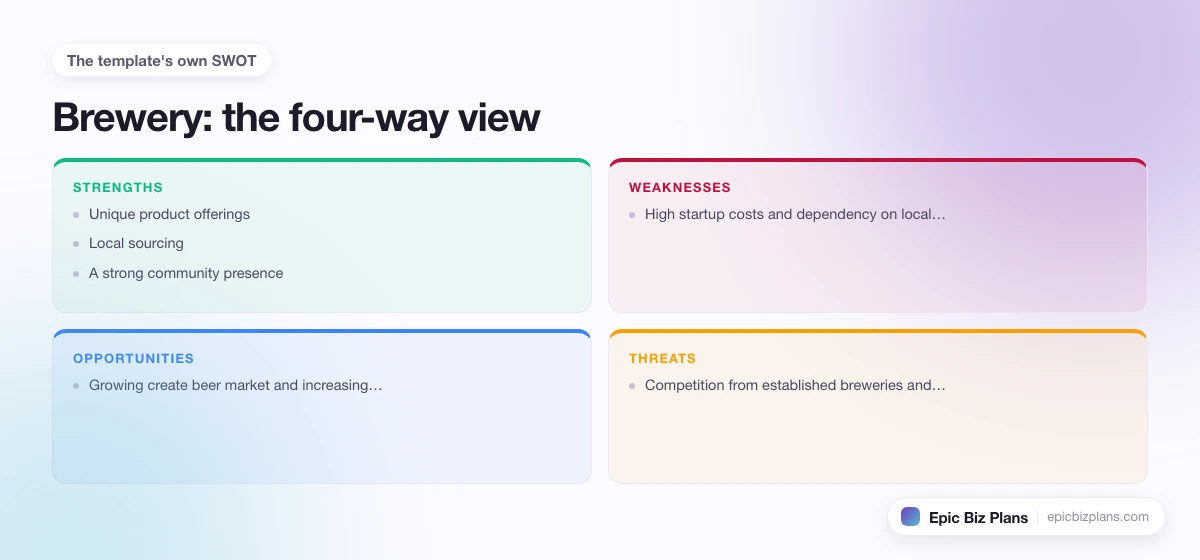
- Strengths: Unique product offerings, local sourcing, and a strong community presence.
- Weaknesses: High startup costs and dependency on local market demand.
- Opportunities: Growing create beer market and increasing consumer interest in sustainable practices.
- Threats: Competition from established breweries and changing regulatory environments.
Brewery Business Name Ideas
Website
We will build our website using Shopify to help e-commerce functionality, allowing customers to purchase our products directly online. This option is ideal for capturing the growing interest in beer delivery and online sales. Additionally, Shopify offers user-friendly design tools that can help us establish a strong online presence.
Marketing Details
Our marketing strategy will include digital marketing initiatives through platforms like Semrush for search engine optimization, enhancing our online visibility. We will implement email campaigns through HubSpot targeting existing and potential customers, providing information on new releases and events.
For social media marketing, we will use TikTok ads to reach younger demographics excited about create beer. Engaging content showcasing brewing processes, events, and community involvement will strengthen our brand presence and attract a loyal customer base.
Industry Trends
The create beer industry is experiencing significant growth attributed to consumer preference for unique flavors and local products. Advancements in brewing technology and sustainability practices are becoming increasingly prominent, with consumers valuing environmentally friendly production methods and transparent sourcing. Breweries considering adding a seltzer product line should reference the hard seltzer business plan for the TTB licensing and distribution specifics of that category.
Competitor Information
Identifying our main competitors will allow us to position our brewery effectively. Our analysis will focus on local create breweries and larger beer brands that may encroach on our market. We plan to differentiate ourselves through unique product offerings, exceptional customer service, and a strong commitment to the community. Brewery owners considering adding a distilled spirits program should consult a distillery business plan for the federal permitting and capital requirements involved. Entrepreneurs building a craft beer brand alongside their brewing operation should review the craft beer business plan template for taproom design guidance, membership program strategy, and community marketing approaches.
Financial Information
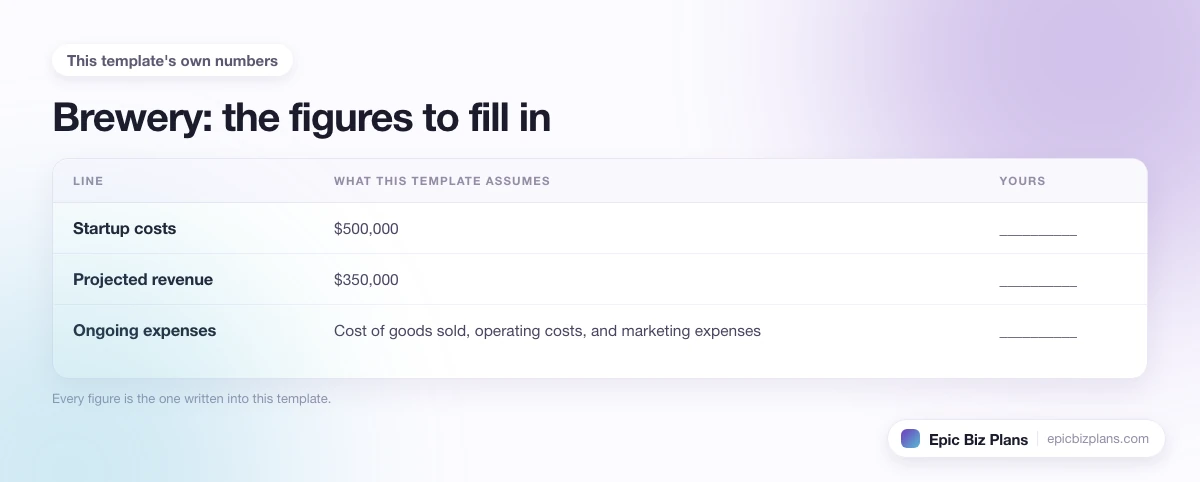
Our startup costs are projected at approximately $500,000, covering equipment, licenses, and initial inventory. We anticipate generating revenues of $350,000 in our first year, with growth potential as we expand our distribution channels and product lines. Ongoing expenses will include cost of goods sold, operating costs, and marketing expenses.
We will maintain a detailed cash flow statement and Profit & Loss (P&L) statements to track our financial health and ensure sustainable growth.
Legal and Compliance
We will ensure compliance with all local and state regulations governing the brewing industry, including obtaining the necessary licenses and permits. Additionally, we will implement measures for intellectual property protection, including trademarking our brand name and logos.
Operational Plan
Our operational plan includes sourcing high-quality ingredients from local suppliers, establishing an efficient production schedule, and creating a strong supply chain for distribution. We will focus on optimizing logistics to ensure timely delivery of our products to consumers and partners.
Contingency Planning
We will address potential risks, including fluctuations in ingredient prices, regulatory changes, and market competition. Our mitigation strategies will involve maintaining a diverse supplier base, establishing a reserve fund for unexpected costs, and regularly reviewing market conditions to adapt our business strategies accordingly.
-
 SemrushSemrush is a platform with literally any online tool you will need to promote your business. Spy on your competitors, get search traffic, keyword research, social info, ad copies and much more. Used by most of the top online companies in the world. Besides all its tools, Semrush also has many available integrations possible with many other tools that will make your work even better.
 -
 Surfer SEOSurfer SEO is an incredibly smart AI tool that will give you exact explanations what to do in order to make your website rank better. They use hundreds of parameters, check your competitors and decide on the best course of action. Whether it be inner links, bold text, paragraphs, headers, images and much more. Surfer is a must-have in 2026.
Concluding Your Brewery Business Plan
Starting a brewery is about more than brewing beer. It involves building a brand, shaping a customer experience, and serving a community. Whether you are launching a small local microbrewery, testing creative recipes in a brewpub business plan template, or moving into eCommerce by shipping beer nationwide, each model carries its own costs and operating needs. Your plan should reflect the path you choose.
Types of Businesses in the Brewery Niche
Your brewery business plan can serve as a foundation for various types of ventures: expansive create breweries aiming for regional distribution, brewpubs combining food and drink, brands built around a British pub business plan template style taproom, or niche brands focusing on gluten-free or organic options. Operators who want to compare the craft beverage model with a winery format can reference a vin business plan for how organic wine production and direct-to-consumer sales are structured. Each of these models can inspire creativity and fuel a passion for bringing people together through create beer.
Adapting Your Plan
As you expand and learn, don’t hesitate to update your brewery business plan. Whether it’s refining your target audience, adjusting pricing models, introducing new products, or exploring different sales channels, your plan should evolve with your business. This flexibility ensures that your business remains relevant and competitive in a fast-changing market.
Practical Uses for Your Plan
Your brewery business plan can be an invaluable tool. Use it to present to potential partners, outline strategies for a successful launch, secure funding, or simply clarify your vision and strategy for the future. Whatever your goals, a strong plan aligns your ideas and actions with clear objectives.
As you step into this exciting process of entrepreneurship, remember that your brewery business plan is 100% free. With unlimited edits, unlimited downloads, and unlimited chances to get it right, you have what you need to turn your idea into a working brewery.
