
British Pub Business Plan Template
-
 ShopifyPut your brand on Shopify. Launch your online store with tools designed for growth and success. Ready to turn your idea into profit? Start building your e-commerce business today.
 -
 SquarespaceShowcase your brand with Squarespace’s sleek designs. Build a professional online presence with ease. Start with a template that already looks finished.
 -
 WixBring your ideas to life with Wix. Customize every aspect of your site with unmatched flexibility. Start creating your unique online space and let your creativity shine.
 -
 ElementorCraft captivating websites effortlessly with Elementor. Enjoy complete creative control without coding. Make your site stand out to your audience. Start turning your vision into reality now.
- Executive Summary
- Business Info
- Products and Services
- Target Market
- Business Model Overview
- SWOT Analysis
- Business Name Ideas
- Website
- Marketing Details
- Industry Trends
- Competitor Information
- Financial Information
- Legal and Compliance
- Operational Plan
- Contingency Planning
- Key Success Metrics
- Why Start a British Pub Business?
- Flexibility For Growth
- Practical Applications of Your Plan
- Take the Next Step
A British Pub business plan helps you build an authentic UK-style hospitality concept that attracts regulars and tourists in equal measure. The format works well in U.S. markets with strong expat communities or college towns, and in U.K. neighborhoods looking for an alternative to gastropub fine dining. Your plan should define the pub style (traditional public house, gastropub with elevated food, or sports-focused alehouse), the food and beer programs, and how you balance local-resident weeknight trade against weekend and event revenue.
A working plan moves past charm and into operations: food cost percentage (target 28-32%), beverage cost percentage (target 20-25%), labor (target 28-32%), rent (target under 8% of revenue), and the cover counts you need to break even. Map your first six months of pre-opening including licensing, build-out, hiring British-trained kitchen and front-of-house staff, supplier relationships for imported beers and traditional ingredients, and a soft launch that gets neighborhood word of mouth started. For an adjacent concept, see the pub business plan template.
Executive Summary
We open a British pub focused on warm hospitality, traditional food, and a well-stocked bar of British and craft ales. Our mission is to be the neighborhood's go-to spot for fish and chips, Sunday roast, and a proper pint with friends. Vision: become the most-loved British pub within our metro area by year three, recognized by locals and visiting Brits alike. Financial target: profitability within 12 months and revenue of $850,000 by year two. For a related angle, our brewing walk-through goes deeper.
Business Info
Products and Services
Our menu covers traditional favorites: fish and chips, shepherd's pie, bangers and mash, Sunday roast with all the trimmings, ploughman's lunch, and a rotating selection of seasonal British dishes. The bar carries 8-10 British ales (cask if local regulations allow), 6-8 craft beers on tap, a focused wine list, classic British cocktails, and non-alcoholic options including ginger beer and elderflower cordial. We host weekly quiz nights, monthly live music, and seasonal events like Burns Night and the Six Nations rugby tournament that drive weekday traffic and build community.
Target Market
Target customers are local residents ages 25-60 who appreciate quality pub food, British expats and Anglophiles looking for authentic atmosphere, sports fans for football and rugby matches, and tourists in walking distance. The household income range is $60,000-150,000, with a mix of families during weekend lunch and Sunday roast services, young professionals on weekday evenings, and group bookings for events. Operators can compare similar models in our Irish pub business plan template if available, or the cocktail bar business plan template for hybrid concepts.
Business Model Overview
Revenue comes from food sales (45-50%), beverages (40-45%), and private events plus merchandise (5-10%). Food gross margin runs 68-72%, beer 75-80%, and wine 65-70%. We operate as a full-service kitchen and bar with table service throughout, supported by a small team of skilled staff. A loyalty program for regulars and email club for event invitations drive repeat visits and predictable bookings.
SWOT Analysis
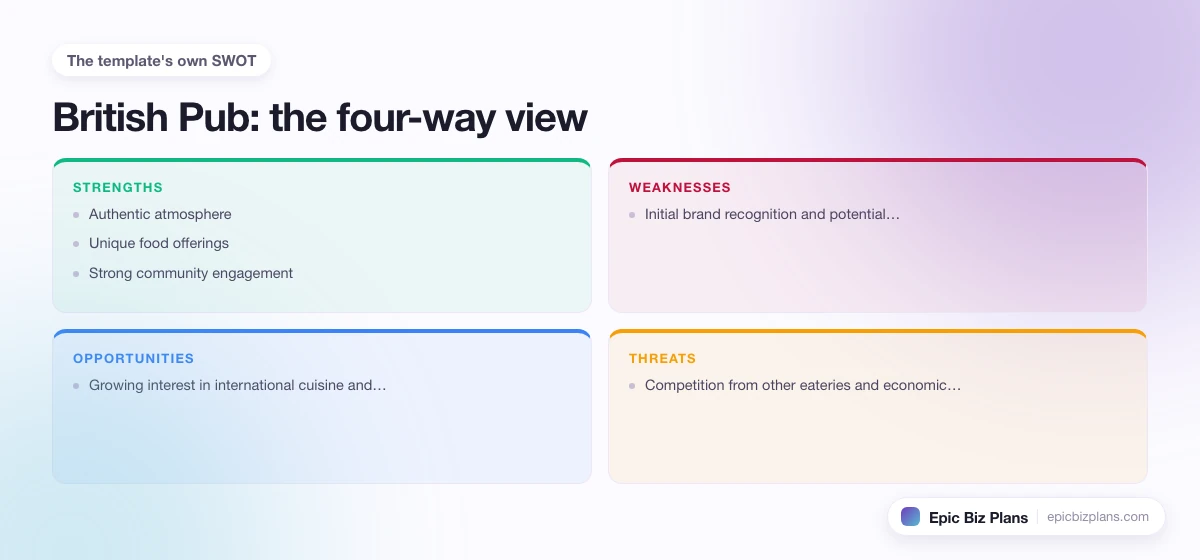
- Strengths: Authentic atmosphere, unique food offerings, and strong community engagement.
- Weaknesses: Initial brand recognition and potential operational challenges.
- Opportunities: Growing interest in international cuisine and local tourism.
- Threats: Competition from other eateries and economic downturns affecting discretionary spending.
Business Name Ideas
Website
We build the website on Squarespace or WordPress for a brand-focused site with menu, hours, event calendar, and online reservations via OpenTable or Resy. Mobile-friendly design is essential because most customers check the menu or book a table on their phones. SEO targets local searches like "British pub [your city]" and "Sunday roast near me," with Google Business Profile optimized for review collection and local pack visibility.
Marketing Details
Marketing centers on local SEO, social media, and community presence. Semrush guides keyword strategy for local food and event terms. HubSpot manages email lists segmented by event interests (pub quiz, rugby, music nights) so we can send targeted invitations rather than generic newsletters. Budget split: 30% local digital ads on Google and Meta, 25% events and sponsorships in the neighborhood, 20% PR and food blogger outreach for opening and seasonal menu launches, 15% influencer partnerships with local lifestyle creators, 10% in-store signage and printed event flyers.
Instagram and TikTok carry most of our social presence, with content showing fresh pints being pulled, kitchen scenes preparing roast dinners, and event recap reels. We work with neighborhood food and lifestyle creators on event invites rather than paid posts, which builds organic word of mouth more effectively than one-off sponsored content.
Industry Trends
Key trends in the pub industry include the rise of create beverages and a focus on local sourcing. There is also an increasing demand for unique dining experiences, which we aim to fulfill through our themed events and community-centered activities. Additionally, the integration of technology for online ordering and reservations is becoming essential in keeping pace with consumer expectations.
British pub operators considering whether to develop a signature house beer program can reference a brewpub business plan for the regulatory and capital requirements that come with adding on-site brewing capability to an existing hospitality operation.
Competitor Information
Direct competitors are other pubs and gastropubs within a 1-2 mile radius, plus restaurants offering similar elevated comfort food. Indirect competitors include sports bars, neighborhood bars without food, and casual restaurants. We differentiate through authentic British food prepared with quality ingredients, a properly-curated cask and craft ale program, and consistent weekly events that create predictable reasons to visit. Studying the craft beer business plan template helps refine our beverage program economics.
Financial Information
Startup costs of approximately $400,000-550,000 break down as: lease deposit and tenant build-out ($200,000-275,000), kitchen and bar equipment ($75,000), initial food and beverage inventory ($25,000), liquor and food service licensing ($30,000-50,000 depending on state), brand identity and website ($12,000), marketing launch including grand opening ($25,000), and working capital ($50,000-75,000). Year one revenue projection $600,000-700,000 (70-90 covers per night average at $35 check), year two $850,000-950,000 as repeat business builds. Monitor weekly: food cost percentage, beverage cost percentage, labor cost percentage, and average check per cover.
Legal and Compliance
Legal setup includes business entity formation, state liquor license (often the longest lead-time item, 60-180 days depending on jurisdiction), local food service license and health department inspection, OSHA-compliant kitchen safety program, ASCAP and BMI music licensing for any live or recorded music, and food handler certifications for kitchen staff. Insurance coverage includes general liability, liquor liability, workers comp, commercial property, and food contamination coverage. Plan licensing on the critical path because opening delays from missing permits are expensive.
Operational Plan
Operations cover daily prep and service, weekly inventory counts (food and beverage cost tracked weekly, not monthly), staff scheduling matched to forecast covers, vendor relationships with British food importers, beer wholesalers for cask and keg deliveries, and produce suppliers for fresh menu ingredients. Service quality depends on consistent staff training, so we invest 40 hours of paid training for each new hire and monthly skill-building sessions for existing team members. POS reconciliation happens nightly with a manager.
-
 SemrushSemrush is a platform with literally any online tool you will need to promote your business. Spy on your competitors, get search traffic, keyword research, social info, ad copies and much more. Used by most of the top online companies in the world. Besides all its tools, Semrush also has many available integrations possible with many other tools that will make your work even better.
 -
 Surfer SEOSurfer SEO is an incredibly smart AI tool that will give you exact explanations what to do in order to make your website rank better. They use hundreds of parameters, check your competitors and decide on the best course of action. Whether it be inner links, bold text, paragraphs, headers, images and much more. Surfer is a must-have in 2026.
Contingency Planning
Risks include slow ramp-up of opening sales, seasonal foot traffic dips, key staff turnover, supply chain issues on imported British products, and macro shocks like recession or extended weather closures. Mitigation: maintain 90 days of operating expense reserves after opening, cross-train staff so any role can be covered if someone leaves, source critical imports from at least two distributors, and build a strong private event sales channel that smooths revenue when walk-in trade is slower. For a related angle, see our Liverpool business plan template.
Key Success Metrics
Track these weekly: food cost percentage (target 28-32%), beverage cost percentage (target 20-25%), labor cost percentage (target 28-32%), average check per cover, table turn time during peak service, Google review average (maintain 4.5+ stars), and repeat customer rate via loyalty program. Sunday roast and event night metrics matter most because they tell you whether neighborhood word of mouth is working. A pub that fills its Sunday lunch service by month six is on track; one that doesn't needs a menu or marketing reset.
Why Start a British Pub Business?
Imagine a space where culture, creativity, and community converge. A British pub business isn’t just about serving pints; it’s about crafting an identity, fueling passion, and embracing a lifestyle that values connection and freedom. This venture can take many forms, from charming neighborhood establishments and innovative pop-ups to thriving e-commerce platforms that highlight British delicacies. Whether small or large, each concept has the power to enchant and draw patrons into a joyful experience.
Flexibility For Growth
Your British pub business plan is not just a static document; it's a living roadmap. As you refine your vision, don’t hesitate to update it to reflect new audiences, pricing models, or regional tastes. This adaptability will keep your plan aligned with your goals, ensuring you’re prepared to make the most of every opportunity that comes your way.
Practical Applications of Your Plan
Think of all the ways your British pub business plan can serve you. Use it to present to potential partners who share your vision, lay the groundwork for a successful launch, secure essential funding, or clarify your strategic approach. Each moment you invest in refining this plan is a step toward realizing your dream.
Take the Next Step
Your British pub business plan is 100% free - with unlimited edits, unlimited downloads, and unlimited chances to get it right. Start with confidence. The community is waiting for your unique contribution.
