
Black Business Plan Template
-
 ShopifyPut your brand on Shopify. Launch your online store with tools designed for growth and success. Ready to turn your idea into profit? Start building your e-commerce business today.
 -
 SquarespaceShowcase your brand with Squarespace’s sleek designs. Build a professional online presence with ease. Start with a template that already looks finished.
 -
 WixBring your ideas to life with Wix. Customize every aspect of your site with unmatched flexibility. Start creating your unique online space and let your creativity shine.
 -
 ElementorCraft captivating websites effortlessly with Elementor. Enjoy complete creative control without coding. Make your site stand out to your audience. Start turning your vision into reality now.
- Executive Summary
- Business Info
- Target Market
- Business Model Overview
- SWOT Analysis
- Black Business Name Ideas
- Website
- Marketing Details
- Industry Trends
- Competitor Information
- Financial Information
- Sourcing From Local Artisans
- Legal and Compliance
- Operational Plan
- Contingency Planning
- Build Your Path With a Black Business Plan
- Variety in Niche Business Types
- Grow and Adapt With Your Black Business Plan
- Practical Uses for Your Plan
Your path to a successful business begins with a solid Black business plan. In a growing market with real demand for culturally relevant products, a well-built strategy gives you a clear advantage. This is not just about numbers on a page; it is about turning your vision into a plan that reflects your brand and connects with the customers you want to serve.
Strong, well-defined ideas carry more weight than vague ambition when you outline your Black business plan. You have a genuine opportunity to build a presence in a market that values authentic, community-focused brands. Your business plan should work as a roadmap, guiding your decisions while showing exactly what makes your brand distinct.
Executive Summary
We are committed to building a business that celebrates and supports the Black community through our products and services. Our mission is to support local artisans and entrepreneurs while providing quality offerings to our target market. Our vision is to establish a trusted brand that values both profit and social impact. Our value proposition is our direct connection to the community, offering products that reflect our customers' identity.
Our financial goals include reaching a break-even point within the first year and a 20% profit margin by the end of the second year. We will actively look for growth, both by expanding our product line and increasing our customer base.
Business Info
We are establishing a retail business focused on culturally relevant products for the Black community. Our offerings will include handcrafted items, traditional clothing, and beauty products sourced from local Black entrepreneurs. A dedicated handcrafted business plan covers the sourcing and pricing details that artisan products involve.
Target Market
Our target market consists of young to middle-aged Black consumers who want to support local businesses and buy culturally significant products. We aim to build a loyal customer base through community engagement and a shared commitment to supporting Black voices and artisans.
Business Model Overview
Our business model will center on e-commerce sales, supported by pop-up events and local market participation. This dual approach lets us reach a wider audience while building real community connections.
SWOT Analysis
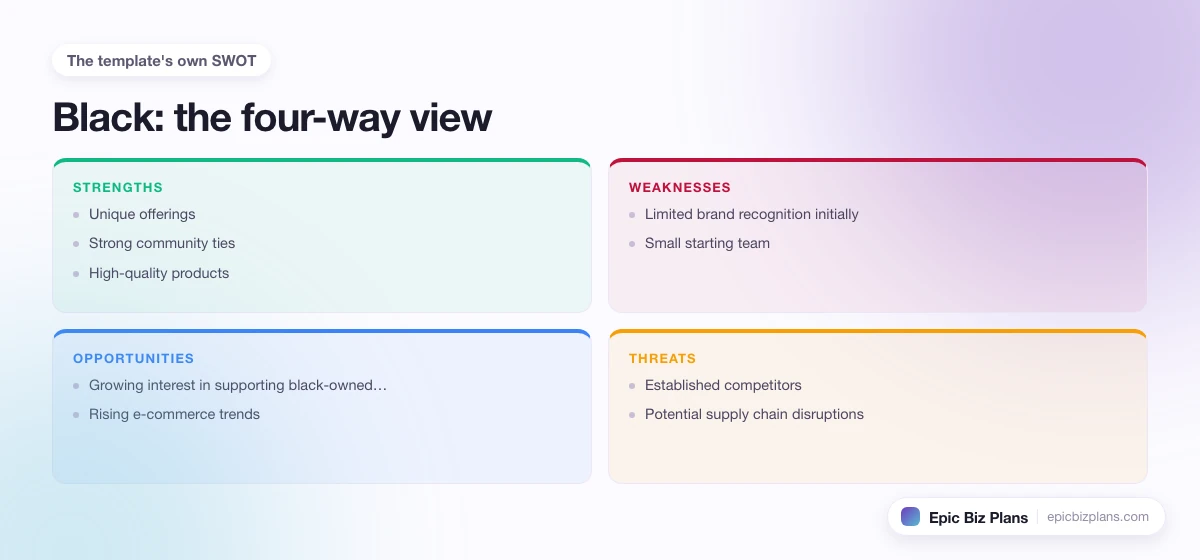
- Strengths: Unique offerings, strong community ties, high-quality products.
- Weaknesses: Limited brand recognition initially, small starting team.
- Opportunities: Growing interest in supporting Black-owned businesses, rising e-commerce trends.
- Threats: Established competitors, potential supply chain disruptions.
Black Business Name Ideas
Website
We will build our e-commerce platform using Shopify to take advantage of its strong ecommerce features. This choice lets us create a straightforward, easy-to-use shopping experience for our customers. For general business visibility, we will also consider Wix, since it makes website creation simpler for those who are less technical.
Marketing Details
Our marketing strategy will combine digital marketing and social media outreach. We will use Semrush to optimize our website and improve our SEO. Email campaigns will be managed with HubSpot to keep our customers informed and engaged.
To reach younger audiences, we will focus on TikTok ads, presenting our products in creative ways that fit this demographic. This lets us connect with our audience on the platforms they already use. Many of the same channels work well for an ecommerce retail business, so the tactics here can be adapted as our store grows.
Industry Trends
We see clear trends in increased support for Black-owned businesses and rising demand for authentic cultural products. Advances in e-commerce let small businesses like ours compete more effectively against larger retailers, with personalized shopping experiences that big chains struggle to match.
Competitor Information
We will analyze both direct competitors, such as other Black-owned retail businesses, and indirect ones, such as larger retail chains. Our differentiation will focus on our distinct product range, community engagement, and the stories behind each product, which together build a brand customers remember.
Financial Information
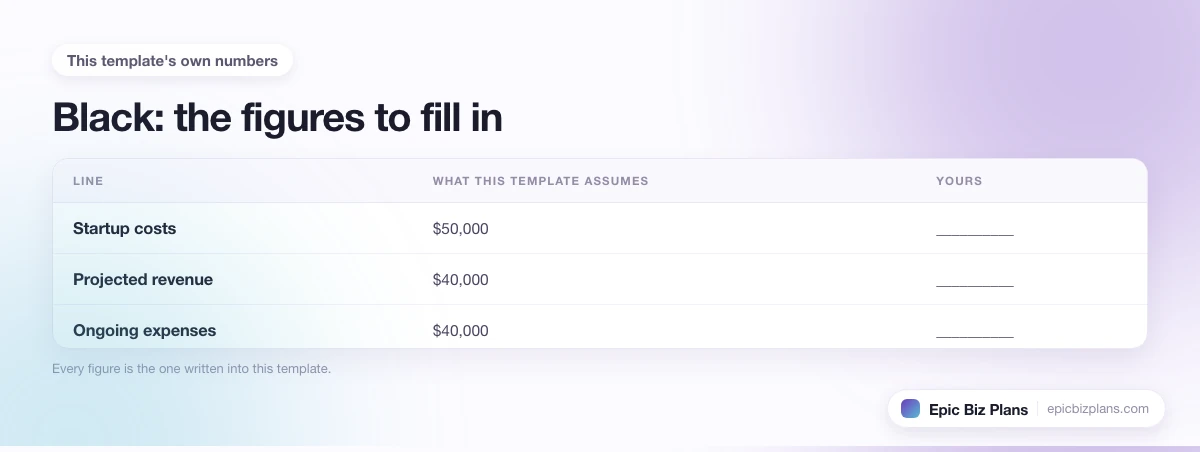
Our startup costs are projected at roughly $50,000, including inventory, website development, and marketing. We expect to generate $100,000 in revenue within the first year, with ongoing expenses around $40,000 annually.
Our cash flow projections show we can maintain positive cash flow within six months of operation, with profit and loss statements showing a gradual rise in profitability as we expand.
Sourcing From Local Artisans
The strength of a community-focused retail business comes from the artisans behind your products. Build clear agreements with each maker covering pricing, lead times, exclusivity, and how restocks are handled. Consistent quality matters as much as the story, so set simple standards for materials and finishing that every supplier understands.
-
 SemrushSemrush is a platform with literally any online tool you will need to promote your business. Spy on your competitors, get search traffic, keyword research, social info, ad copies and much more. Used by most of the top online companies in the world. Besides all its tools, Semrush also has many available integrations possible with many other tools that will make your work even better.
 -
 Surfer SEOSurfer SEO is an incredibly smart AI tool that will give you exact explanations what to do in order to make your website rank better. They use hundreds of parameters, check your competitors and decide on the best course of action. Whether it be inner links, bold text, paragraphs, headers, images and much more. Surfer is a must-have in 2026.
Pay artisans fairly and promptly, since reliable payment is what keeps the best makers working with you. As your store grows, consider featuring maker profiles on your product pages, which gives customers a reason to choose your shop over a generic retailer. Makers who work in a specific medium, such as those behind a beaded jewelry business, often have stories that sell as well as the product itself. A diverse supplier base, drawn from several makers per category, protects you if one artisan cannot meet demand.
Legal and Compliance
We will keep our business legally compliant by registering with the appropriate local and state authorities. We will also look into intellectual property protection for our distinct products and brand identity.
Operational Plan
Our operational plan includes building partnerships with local artisans for product sourcing and managing logistics for an efficient supply chain. We will hire a small team to handle day-to-day operations, including customer service, inventory management, and marketing.
Contingency Planning
We recognize potential risks, such as supply chain disruptions and market competition. To reduce these risks, we will establish alternative supplier relationships and assess market trends regularly to stay ahead of competitors. We will also keep a flexible budget to handle unexpected challenges.
Build Your Path With a Black Business Plan
Starting a business is more than a way to generate income; it is about building your identity, expressing your creativity, and working on your own terms. Your Black business plan is a chance to turn your interests into something concrete, whether that is a local cafe that celebrates cultural heritage, an online shop for unique handmade goods, or a consultancy focused on fair workplace practices. The direction is yours to set, and every step reflects your values.
Variety in Niche Business Types
As you build your business, consider the range of models available in this niche. From larger brands with national reach to small, community-focused enterprises, or online stores serving specific markets, there are many viable paths. A gift shops business plan shows one storefront-led route that suits curated cultural products. A focused beauty products business is one example of a category that fits well within a culturally rooted retail brand.
Grow and Adapt With Your Black Business Plan
As your business changes, your Black business plan should change with it. Update it regularly to reflect new audiences, different pricing models, expanded product lines, or fresh sales channels. This flexibility keeps your strategy aligned with your vision and strengthens your position in a competitive market.
Practical Uses for Your Plan
Your plan is not just a document; it is a working tool for presenting to potential partners, planning a launch, securing funding, or clarifying your strategy. Keep it close and put it to use at every stage of building your business. If selling artisan goods is central to your model, a handmade products business plan covers the inventory and fulfillment side in more detail.
Your Black business plan is 100% free, with unlimited edits, unlimited downloads, and unlimited chances to get it right. You have what it takes to build something worth running. Now, put your plan into action.
