
Beaded Jewelry Business Plan Template
-
 ShopifyPut your brand on Shopify. Launch your online store with tools designed for growth and success. Ready to turn your idea into profit? Start building your e-commerce business today.
 -
 SquarespaceShowcase your brand with Squarespace’s sleek designs. Build a professional online presence with ease. Start with a template that already looks finished.
 -
 WixBring your ideas to life with Wix. Customize every aspect of your site with unmatched flexibility. Start creating your unique online space and let your creativity shine.
 -
 ElementorCraft captivating websites effortlessly with Elementor. Enjoy complete creative control without coding. Make your site stand out to your audience. Start turning your vision into reality now.
- Executive Summary
- Business Info
- Products and Services
- Target Market
- Business Model Overview
- SWOT Analysis
- Beaded Jewelry Business Name Ideas
- Website
- Marketing Details
- Industry Trends
- Competitor Information
- Financial Information
- Legal and Compliance
- Operational Plan
- Contingency Planning
- Putting Your Beaded Jewelry Business Plan to Work
- Embrace Growth
- Make It Work for You
- Take the Leap
A beaded jewelry business plan covers the practical requirements of launching a handmade jewelry company, from material sourcing and production workflow through pricing strategy and online sales. The handmade jewelry market has grown significantly as consumers seek unique, artisan-crafted pieces over mass-produced alternatives. A structured plan helps you estimate material costs per piece, set prices that cover labor and overhead while remaining competitive, and identify the sales channels most likely to reach your target buyers. Makers in the broader bead crafting space can also reference the Perler beads business plan for a complementary direct-to-consumer model.
This template addresses each section of a beaded jewelry business plan. Use it to define your product line, establish production capacity, project revenue based on realistic sales volumes, and build a marketing strategy that showcases your craftsmanship to the right audience.
Executive Summary
This beaded jewelry business will produce handcrafted necklaces, bracelets, earrings, and custom pieces using high-quality beads, gemstones, and eco-friendly materials. The value proposition centers on customization, unique design, and sustainable sourcing that differentiates these pieces from mass-produced jewelry. The first-year revenue target is $100,000, driven by e-commerce sales, craft fair presence, and workshop revenue. Entrepreneurs exploring the broader handmade market should also review the handmade jewelry business plan for additional production and pricing strategies.A related angle on sentimental pieces is in our charm necklace business plan template. For a related approach, see the jewel business plan template.
Sustainability is a core brand attribute. All materials will be sourced from suppliers who meet ethical and environmental standards. Makers selling to community-focused buyers often pair this with a broader Black business plan to reach culturally minded shoppers. This positioning resonates with the growing segment of consumers who factor production ethics into their purchasing decisions.
Business Info
Products and Services
The product line includes beaded necklaces, bracelets, earrings, anklets, and custom-designed pieces for special occasions. Service offerings include jewelry-making workshops where customers learn beading techniques, which serve as both a revenue stream and a customer acquisition channel. Custom orders for weddings, bridesmaids gifts, and corporate events provide higher-margin opportunities.
Target Market
The primary target market is women aged 25 to 45 who value handmade, unique accessories and are willing to pay a premium over mass-market jewelry. Secondary markets include event planners sourcing custom favors, gift buyers during holiday seasons, and craft enthusiasts who attend workshops. Businesses focused on specific jewelry formats may find the jewelry bracelets business plan useful for product-specific strategies.
Business Model Overview
The business operates primarily through e-commerce (Shopify or Etsy), supplemented by pop-up shops at craft fairs, local markets, and community events. Workshop revenue adds a service component that builds brand loyalty and creates repeat customers. For entrepreneurs who prefer a lower-inventory model, a dropshipping jewelry business offers an alternative that eliminates the need to hold stock while still selling fashion accessories online.
SWOT Analysis
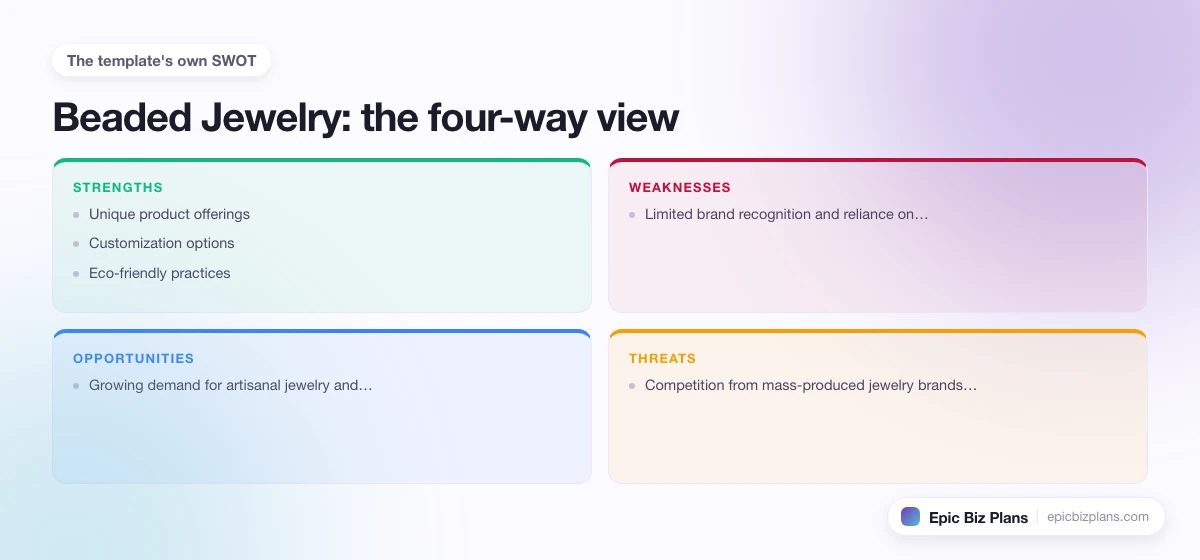
- Strengths: Unique product offerings, customization options, and eco-friendly practices.
- Weaknesses: Limited brand recognition and reliance on online sales.
- Opportunities: Growing demand for artisanal jewelry and online shopping.
- Threats: Competition from mass-produced jewelry brands and economic fluctuations.
Beaded Jewelry Business Name Ideas
Website
Shopify is the recommended e-commerce platform for a beaded jewelry business, offering product variant management (sizes, materials, colors), integrated payment processing, and a wide selection of jewelry-specific themes. High-quality product photography is essential, as customers need to see bead detail, color accuracy, and scale. Lifestyle photos showing jewelry being worn drive higher conversion rates than product-only images. Etsy serves as a valuable secondary sales channel given its built-in audience of handmade jewelry buyers.
Marketing Details
Instagram and Pinterest are the primary marketing channels for handmade jewelry, as both platforms cater to visually oriented shoppers seeking unique accessories. SEO through Semrush should target specific product queries like "handmade beaded necklace" and "custom beaded bracelet" along with gift-related searches. Email marketing through HubSpot drives repeat purchases through new collection announcements, workshop invitations, and exclusive subscriber discounts.
Content showing the making process (material selection, beading techniques, finished piece reveals) performs well across social platforms and positions you as a skilled artisan rather than just another seller. Craft fair and market appearances provide direct customer interaction and immediate sales, while also building a local customer base. Entrepreneurs interested in expanding into other handmade categories should explore the jewelry design business plan for scaling production beyond beadwork.
Industry Trends
The handmade jewelry market is influenced by several current trends. Personalization and customization have become baseline expectations rather than premium features. Sustainable and ethically sourced materials are increasingly important to buyers, particularly younger demographics. Online marketplaces continue to grow as the primary discovery channel for artisan jewelry. The rise of jewelry-making content on social media has both increased competition and expanded the overall market by introducing more consumers to handmade alternatives. The broader leather craft business shares similar production and marketing dynamics for entrepreneurs considering material diversification. Sellers specializing in earrings should also review a tassel earrings business plan for a focused template covering earring-specific design, pricing, and social commerce execution. For a closely related approach, see our Melty Beads business plan template.
Competitor Information
Direct competitors include other handmade jewelry sellers on Etsy, Instagram shops, and local artisans at craft fairs. Indirect competitors range from fast-fashion jewelry retailers to fine jewelry brands, with cute jewelry labels sitting in the affordable trendy middle of that market. Entrepreneurs building a broader accessories brand that includes handbags and sunglasses alongside jewelry should also review our Steele accessories business plan for a multi-category accessories strategy. Differentiation depends on design originality, customization depth, material quality, brand story, and the personal connection that small-batch makers can offer. Pricing should position above mass-market alternatives but remain accessible to the target demographic.
Financial Information
Startup costs of approximately $20,000 cover initial bead and material inventory, tools and equipment (pliers, wire, stringing materials, storage), website development, product photography, and marketing launch. Material cost per piece typically ranges from $5 to $30 depending on bead quality and design complexity, with retail prices set at 3x to 5x material cost to cover labor, overhead, and profit.
Ongoing expenses include material replenishment, platform fees (Shopify subscription, Etsy listing fees), packaging and shipping supplies, marketing spend, and craft fair booth fees. Cash flow can be seasonal, with holiday periods (November through February for gift-giving) generating significantly higher revenue. Workshop income provides a steadier monthly revenue stream.
Legal and Compliance
Requirements include business registration, sales tax collection, and compliance with product safety standards for jewelry (particularly regarding lead content and allergen disclosures for nickel-containing components). Trademark protection for the business name and logo prevents brand confusion. If selling children's jewelry, additional safety testing and CPSIA compliance may be required.
-
 SemrushSemrush is a platform with literally any online tool you will need to promote your business. Spy on your competitors, get search traffic, keyword research, social info, ad copies and much more. Used by most of the top online companies in the world. Besides all its tools, Semrush also has many available integrations possible with many other tools that will make your work even better.
 -
 Surfer SEOSurfer SEO is an incredibly smart AI tool that will give you exact explanations what to do in order to make your website rank better. They use hundreds of parameters, check your competitors and decide on the best course of action. Whether it be inner links, bold text, paragraphs, headers, images and much more. Surfer is a must-have in 2026.
Operational Plan
Core operations include material sourcing, design development, production, quality control, photography, listing management, order fulfillment, and customer service. Production workflow should balance batch production of popular designs with capacity for custom orders. Material inventory management prevents both stockouts of popular beads and overinvestment in slow-moving supplies. Shipping logistics require jewelry-appropriate packaging that protects pieces during transit while presenting an attractive unboxing experience.
Contingency Planning
Primary risks include material supply disruptions (particularly for specialty or imported beads), seasonal demand fluctuations, and competitive pressure from new sellers entering the handmade marketplace. Mitigation strategies include maintaining relationships with multiple bead suppliers, building a financial reserve covering three months of expenses, and diversifying revenue across e-commerce, craft fairs, workshops, and wholesale accounts.
Putting Your Beaded Jewelry Business Plan to Work
A beaded jewelry business plan supports decision-making at every stage. Use it when negotiating with suppliers, applying for craft fair booth space, evaluating wholesale opportunities, or deciding whether to hire production help. The financial projections section helps set realistic pricing, while the marketing strategy keeps promotional efforts focused on channels that actually reach your target buyers.
Embrace Growth
Update your business plan as you add new product lines, expand into new sales channels, or adjust your target market. Track which designs sell best, which price points generate the highest margins, and which marketing channels deliver the lowest customer acquisition costs. Use this data to refine your strategy quarterly. If your line spans rings, necklaces, and custom pieces, the broader Jew business plan covers positioning across a full jewelry range.
Make It Work for You
Present this plan to potential wholesale accounts, use it to structure craft fair season planning, and reference it when evaluating whether to invest in new tools or materials. A documented strategy prevents reactive decision-making and ensures each business choice aligns with your growth goals.
Take the Leap
This beaded jewelry business plan template is free to use with unlimited edits and downloads. Customize each section for your specific designs, materials, and market, then start building your jewelry business with a clear plan in hand.
