
Beauty Products Business Plan Template
-
 ShopifyPut your brand on Shopify. Launch your online store with tools designed for growth and success. Ready to turn your idea into profit? Start building your e-commerce business today.
 -
 SquarespaceShowcase your brand with Squarespace’s sleek designs. Build a professional online presence with ease. Start with a template that already looks finished.
 -
 WixBring your ideas to life with Wix. Customize every aspect of your site with unmatched flexibility. Start creating your unique online space and let your creativity shine.
 -
 ElementorCraft captivating websites effortlessly with Elementor. Enjoy complete creative control without coding. Make your site stand out to your audience. Start turning your vision into reality now.
- Executive Summary
- Business Info
- SWOT Analysis
- Beauty Products Business Name Ideas
- Website
- Marketing Details
- Industry Trends
- Competitor Information
- Startup Cost Breakdown
- Financial Information
- Legal and Compliance
- Operational Plan
- Key Metrics to Track
- Contingency Planning
- Build a Beauty Brand Worth Recommending
- Keep Evolving
- Practical Applications
- Get Started
The beauty brand business plan products market rewards brands that combine genuine product quality with clear, authentic positioning. For a complementary angle, see our hair and beauty business plan. Brands focused on clean, natural formulations can also reference our natural cosmetics business plan template. This business plan template gives you a structured framework for launching a beauty product line - covering everything from product development and safety compliance to marketing strategy and financial projections. Work through each section with your specific products and target customer in mind. For a plan focused specifically on clean, organic formulas, see the natural beauty business plan template. Brands leaning into rose-based and botanical formulas may find the Rose Beauty business plan a useful companion.
Whether you are building a skincare brand, a color cosmetics line, or a specialty beauty tool, the planning fundamentals are the same. For a worked example, the Western Beauty Co business plan applies these same fundamentals. The sections below will help you define your market position, map your path to profitability, and identify the operational requirements before you commit capital to inventory and marketing.
Executive Summary
We will launch a beauty products brand focused on eco-friendly skincare and cosmetics for consumers aged 18 to 35 who prioritize natural, cruelty-free formulations. Founders pairing clean skincare with herbal wellness lines can also review our Juju wellness business plan. Our mission is to deliver effective, clean beauty products without the pricing premium that most sustainable beauty brands carry - making the category accessible to a wider customer base. For wellness brands that go beyond beauty into supplements and aromatherapy, the Lena business plan template covers that broader product mix.
First-year revenue target is ,000, scaling to ,000 by year three through direct-to-consumer online sales, select wholesale partnerships, and a growing repeat customer base. We will prioritize gross margin above revenue growth in the first year to ensure the unit economics are sustainable before scaling marketing spend. Brands launching a focused styling-spray line within a wider catalog can pair this with our hair spray business plan template.
Business Info
Our initial product range covers skincare essentials - cleanser, moisturizer, and SPF - along with a focused selection of color cosmetics. Brands focusing on mask-led face care or transparent claims can model the catalog against a parallel unmasked business plan, and a high-energy DTC brand voice is covered in our Blazing business plan template. We will not try to compete across the full beauty spectrum at launch. A tight initial range means tighter quality control, clearer brand positioning, and faster inventory turns - all critical in year one.
Our target customer is an environmentally conscious consumer who actively researches ingredient lists, checks for cruelty-free and clean beauty certifications, and shares product recommendations within their social networks. This customer is already educated about the category and responds poorly to vague sustainability marketing.
SWOT Analysis
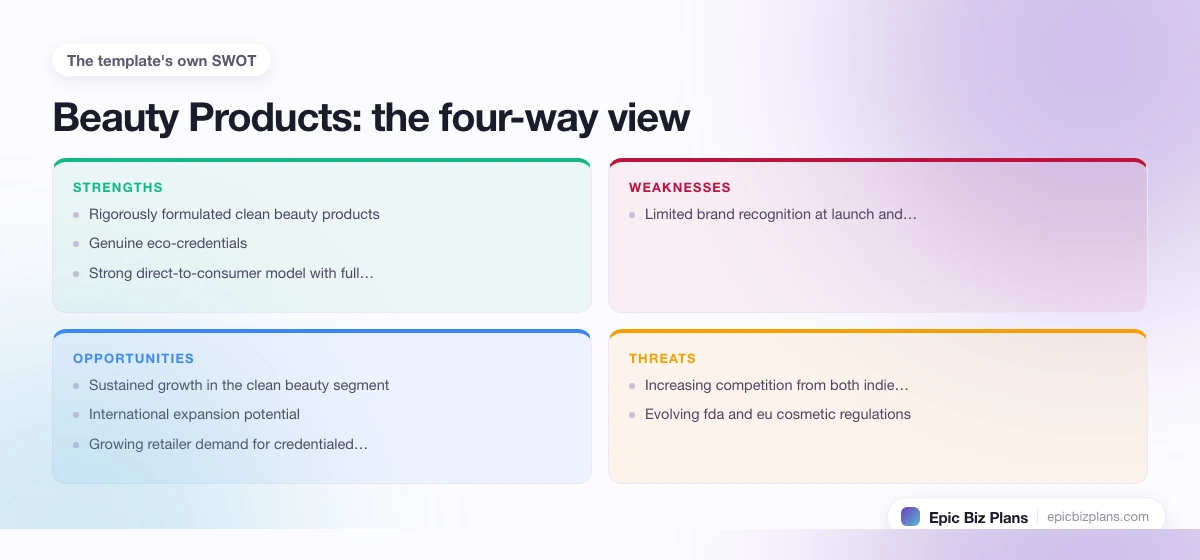
- Strengths: Rigorously formulated clean beauty products, genuine eco-credentials, and strong direct-to-consumer model with full margin control.
- Weaknesses: Limited brand recognition at launch and reliance on online sales while building retail partnerships.
- Opportunities: Sustained growth in the clean beauty segment, international expansion potential, and growing retailer demand for credentialed eco-beauty brands.
- Threats: Increasing competition from both indie startups and major brands launching clean sub-lines, and evolving FDA and EU cosmetic regulations.
Beauty Products Business Name Ideas
Website
We will build on Shopify, using a design system that communicates ingredient transparency and sustainability credentials as prominently as product benefits. Each product page will include a full ingredient list, a plain-language explanation of what each key ingredient does, and third-party certification badges. This level of transparency is a competitive differentiator and reduces customer service queries about formulation.
A blog covering skincare education, ingredient science, and clean beauty sourcing will drive organic traffic and establish the brand as a credible authority in the space - not just another product vendor.
Marketing Details
Our marketing strategy is built around three channels: organic content (SEO and social), influencer partnerships, and email. We will produce SEO-optimized content targeting high-intent beauty research queries - ingredient comparisons, skin concern guides, and product reviews - to build consistent organic traffic from customers already in the research phase. Brands selling beauty products within a community-focused retail store can reference a Black business plan for a culturally rooted approach.
Influencer marketing in the beauty space requires careful selection. Micro-influencers with audiences of 10,000 to 100,000 in the clean beauty niche consistently outperform celebrity partnerships for conversion rate and brand trust. We will prioritize long-term relationships with a small number of aligned creators over broad reach campaigns. For businesses expanding into makeup services alongside product sales, this makeup and skincare business plan covers the service-side model in detail.
Industry Trends
Clean beauty is no longer a niche - it has become the expectation for a significant portion of the beauty buying public. The challenge is now differentiation within the clean category. Brands that can demonstrate ingredient sourcing transparency, publish third-party safety testing results, and hold recognized certifications (EWG Verified, COSMOS, Leaping Bunny) are pulling ahead of brands that simply use "natural" in their marketing without substantiation.
Augmented reality try-on tools are becoming standard on major beauty platforms, reducing return rates and increasing conversion from digital browsing. Personalization - both in product recommendations and in formulation (custom skincare) - is also becoming a meaningful differentiator at the premium end of the market.
Competitor Information
Direct competitors in the clean beauty DTC space include brands like Versed, Youth to the People, and numerous emerging indie labels. Indirect competitors are the conventional beauty brands skincare glow business plan template - L'Oreal, Maybelline - that are launching clean sub-lines with the marketing budgets that indie brands cannot match. Stores stocking imported routines sometimes build a dedicated line using a Korean skincare business plan template. For a niche take on a glow-focused beauty brand, the Shimmer beauty business plan offers a useful contrast.
Our differentiation rests on three things: genuine formulation quality (not just marketing positioning), ingredient transparency that goes beyond the label, and customer relationships built on education rather than promotion. Beauty brands built on community trust consistently outperform those built on advertising in long-term retention metrics. For a complementary service-based business model, see this nails and beauty business plan.
Startup Cost Breakdown
Estimated startup costs are ,000, allocated across: product formulation, stability testing, and safety certification (,000); initial inventory production run (,000); website development and product photography (,000); launch marketing and influencer seeding (,000); business setup and legal (,000). For related ideas, see our organic soap business plan template.
-
 SemrushSemrush is a platform with literally any online tool you will need to promote your business. Spy on your competitors, get search traffic, keyword research, social info, ad copies and much more. Used by most of the top online companies in the world. Besides all its tools, Semrush also has many available integrations possible with many other tools that will make your work even better.
 -
 Surfer SEOSurfer SEO is an incredibly smart AI tool that will give you exact explanations what to do in order to make your website rank better. They use hundreds of parameters, check your competitors and decide on the best course of action. Whether it be inner links, bold text, paragraphs, headers, images and much more. Surfer is a must-have in 2026.
Safety testing is the critical non-negotiable line item. Cosmetics sold in the US must meet FDA requirements; products marketed for EU sale require a Cosmetic Product Safety Report. If you are positioning as clean or organic, third-party certification adds additional cost and timeline - budget for both before committing to a launch date.
Financial Information
First-year revenue target is ,000, growing 30% annually to reach ,000 by year three. Gross margin target is 60% - common for premium beauty brands with direct distribution. At this margin, ,000 in revenue produces ,000 in gross profit, which funds marketing and operations in early years. For additional context, see our sunscreen business plan template.
The biggest financial risk in a beauty brand is inventory write-offs from products that fail to sell. We will start with small production runs - minimum viable quantities - and only scale inventory as sales data confirms demand by SKU. Cash flow will be reviewed weekly in year one.
Legal and Compliance
All cosmetic products must comply with FDA regulations on labeling, ingredient listings, and prohibited substances. We will maintain Safety Data Sheets for all products and ensure our labeling meets both US and any export market requirements from day one. Claims made in marketing copy - "anti-aging," "SPF" - have specific regulatory implications and must be reviewed by a regulatory consultant before use. For another angle, see our let business plan template.
We will trademark the brand name and any signature product names in primary markets. Product liability insurance at a minimum of million per occurrence is required by most wholesale retail partners and is prudent regardless. For a related model, see the radiant business plan template.
Operational Plan
We will work with a contract manufacturer (CM) who specializes in clean beauty formulations, giving us access to professional production equipment and quality control systems without the capital cost of in-house manufacturing. The CM relationship is critical - we will audit facilities before signing, review quality control processes, and include production timeline commitments in our contract.
Order fulfillment will be managed through a third-party logistics provider. Customer service will be handled in-house to maintain the quality of the customer relationship, with a defined response time standard of 24 hours across all channels. For brands considering expanding into the spa and wellness space, this med spa business plan covers the service-side model in depth.
Key Metrics to Track
The most critical metrics for a beauty product business are: repeat purchase rate (the single strongest indicator of product quality and customer satisfaction), customer acquisition cost by channel, gross margin by SKU, return and refund rate, and skin reaction or complaint rate (which must be tracked for safety as well as product improvement). A repeat purchase rate of 30% or higher after 12 months indicates strong product-market fit.
Contingency Planning
The primary risks are a product safety issue and slower-than-projected customer acquisition. For safety: maintain full traceability on all batches, keep batch records for at least three years, and have a documented recall procedure before launch. For slow growth: have a pre-defined plan for shifting budget from paid acquisition to organic content and influencer seeding, both of which have lower cost and better credibility for clean beauty audiences.
Ingredient supply disruptions are also a real risk for brands relying on specialty botanical ingredients. We will identify backup ingredient sources for our three most critical formulation inputs before committing to our first production run.
-
ShopifyPut your brand on Shopify. Launch your online store with tools designed for growth and success. Ready to turn your idea into profit? Start building your e-commerce business today.
-
SquarespaceShowcase your brand with Squarespace’s sleek designs. Build a professional online presence with ease. Start with a template that already looks finished.
-
WixBring your ideas to life with Wix. Customize every aspect of your site with unmatched flexibility. Start creating your unique online space and let your creativity shine.
-
ElementorCraft captivating websites effortlessly with Elementor. Enjoy complete creative control without coding. Make your site stand out to your audience. Start turning your vision into reality now.
Build a Beauty Brand Worth Recommending
The beauty brands that endure are built on product quality and customer trust - not marketing volume alone. This plan gives you the framework to build both. Every section - from formulation investment to customer service standards - is designed to create a business that earns recommendations, not just first purchases.
Keep Evolving
The beauty market moves quickly. Revisit this plan quarterly, update your competitive analysis as new players enter your category, and adjust financial projections as you accumulate real sales data. Brands leaning into trend-driven styling can also reference a glam business plan template when planning seasonal launches. A living plan is far more valuable than a static one.
Practical Applications
Use this plan to secure funding, approach wholesale retail partners, structure your launch campaign, or set performance benchmarks for your first year. Every element you sharpen strengthens the business. For brands exploring the broader cosmetics retail space, this cosmetic accessories business plan covers complementary product line opportunities.
Get Started
This beauty products business plan template is free to use, edit, and download. Build your version today, grounded in real market research and honest financial assumptions - and use it as your operational guide from launch through your first major growth milestone.
