
Anime Art Business Plan Template
-
 ShopifyPut your brand on Shopify. Launch your online store with tools designed for growth and success. Ready to turn your idea into profit? Start building your e-commerce business today.
 -
 SquarespaceShowcase your brand with Squarespace’s sleek designs. Build a professional online presence with ease. Start with a template that already looks finished.
 -
 WixBring your ideas to life with Wix. Customize every aspect of your site with unmatched flexibility. Start creating your unique online space and let your creativity shine.
 -
 ElementorCraft captivating websites effortlessly with Elementor. Enjoy complete creative control without coding. Make your site stand out to your audience. Start turning your vision into reality now.
- Executive Summary
- Business Info
- Business Model Overview
- SWOT Analysis
- Anime Art Business Name Ideas
- Website
- Marketing Details
- Industry Trends
- Competitor Information
- Financial Information
- Legal and Compliance
- Operational Plan
- Contingency Planning
- Pricing and Product Tiers
- Community and Audience Building
- Build Your Anime Art Business
- Explore Diverse Business Models
- Adapting Your Business Plan
- Practical Use Cases
- Take the Next Step
Ready to enter the anime art market? Your Anime Art business plan is the starting point for a category that rewards distinctive style, active community engagement, and consistent output. The market is more than aesthetics - it depends on connecting with a fanbase that knows the difference between original work and generic reproductions.
Each section of your Anime Art business plan should reflect your specific brand voice and the audience you want to reach. Strong work in this space stands out because it has a clear point of view rather than chasing every trend. Build a plan that puts your creative direction, pricing model, and audience strategy in writing, and the day-to-day decisions get easier as the business grows.
Executive Summary
Our mission is to create and distribute distinctive anime art that resonates with fans and collectors worldwide. The vision is a portfolio of varied art styles that serves multiple tastes within the anime community, from classic genre work to original character-driven pieces. Our value proposition is high-quality, original artwork that celebrates well-known themes while introducing fresh designs. Financially, we aim to reach break-even within the first year of operation and grow steadily as the audience expands. Artists who want to extend into wearable fan products can reference our cosplay business plan template.
Business Info
Our business focuses on producing and selling anime-inspired artwork, including prints, digital files, and merchandise featuring both original characters and licensed-friendly fan art. The target market consists of anime fans, collectors, and enthusiasts aged 15 to 35 who are active on social media and engaged in the broader anime community. Many of these buyers also follow the cute character style covered in our Kawai business plan, and fans of specific series often shop the merchandise mapped out in our One Piece business plan template.
Business Model Overview
We will use a direct-to-consumer model, selling artwork through our own e-commerce site and using platforms such as Etsy to reach a wider audience. Revenue streams include physical prints, downloadable digital art, and branded merchandise. Brands working in adjacent product spaces may find our anime merchandise business plan template useful for thinking through complementary product lines.
SWOT Analysis
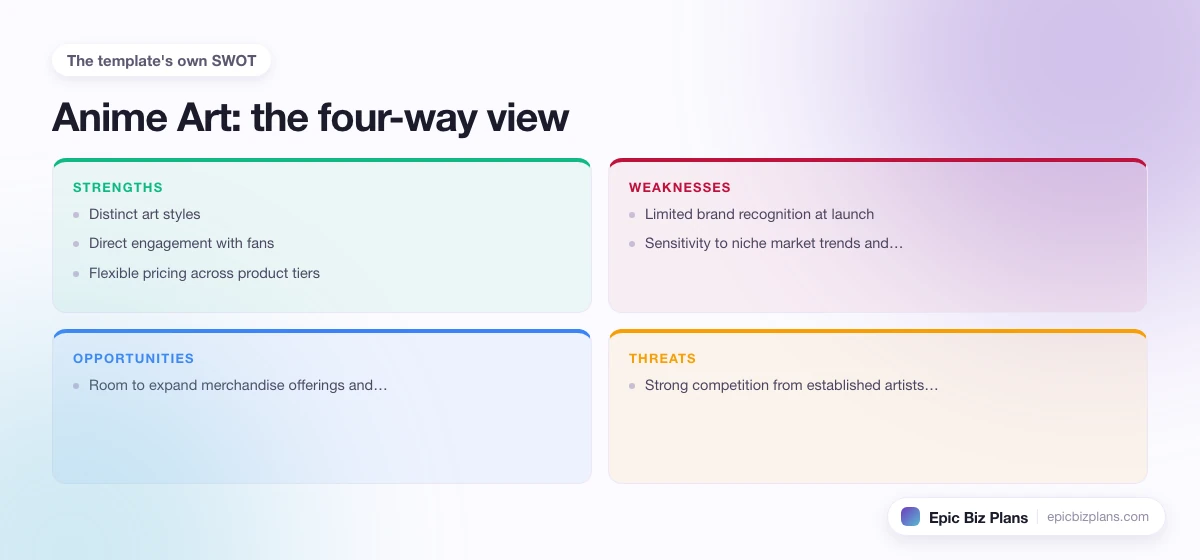
- Strengths: Distinct art styles, direct engagement with fans, flexible pricing across product tiers.
- Weaknesses: Limited brand recognition at launch, sensitivity to niche market trends and seasonal interest.
- Opportunities: Room to expand merchandise offerings and partner with established creators in the anime community.
- Threats: Strong competition from established artists and copyright concerns around licensed characters.
Anime Art Business Name Ideas
Website
We will build the website on Shopify because the platform handles product-based e-commerce well and gives buyers a quick checkout. For a more portfolio-driven site or one focused on visual storytelling, Squarespace works as an alternative or companion site. Both platforms cover the storefront management basics; the choice depends on whether the site leans more toward selling products or showcasing the artist behind them. Our art print business plan template covers platform trade-offs for art-focused stores in more detail.
Marketing Details
The marketing approach combines digital marketing, social media engagement, and targeted ads. Semrush will guide keyword research and on-page SEO so the site ranks for high-intent buying terms specific to anime art and merchandise. HubSpot will manage email marketing campaigns that keep the community updated on new releases and limited drops without flooding inboxes.
Social media is central, and TikTok ads work well for reaching younger demographics at lower CPMs than other paid channels. Content showing the art process, customer testimonials, and behind-the-scenes work tends to outperform polished promo posts in this category. For broader creator-led marketing context, our content creator business plan template covers tactics that translate well to art-led brands.
Industry Trends
The anime art industry continues to grow as streaming platforms expand global access to anime series, which lifts demand for related art and merchandise. Digital ownership formats including limited NFT drops are still being tested by some artists as an additional revenue stream, with mixed results so far. More buyers are also moving to online channels for art purchases, which favors smaller artists who can build direct relationships with their audience.
Competitor Information
Our primary competitors include established artists and art shops specializing in anime-themed work. Indirect competition comes from larger merchandise retailers selling licensed products. Our differentiation focuses on distinct art styles, personalized customer interactions, and exclusive product offerings such as customizable commissions that the larger retailers cannot match. Brands working in adjacent visual art categories may find our graphic art business plan template useful for positioning decisions.
Financial Information
Startup costs cover artwork creation, website setup, and initial marketing, totaling about $15,000. We expect average monthly revenue of $3,000 in the early months, with growth as brand awareness builds. Recurring expenses for inventory management, marketing, and operations come to roughly $1,500 monthly. Cash flow will be tracked monthly with a simple P&L statement that tells us which product tiers are pulling their weight.
Legal and Compliance
Legal requirements include business registration in our operating jurisdiction and the permits required for online sales. We will also focus on intellectual property protection for original artwork and avoid IP issues by sticking to original characters or clearly transformative fan art rather than direct reproductions of copyrighted material.
Operational Plan
The operational plan focuses on building a reliable supply chain for prints and merchandise, working with production partners who can hold consistent quality across order volumes. Logistics covers shipping that meets customer expectations on speed and tracking without eroding margin. We will review production quality on a quarterly cadence and switch partners if defect rates exceed our threshold rather than living with quality drift.
Contingency Planning
The main risks are market saturation in popular sub-genres and supply chain disruption. To address these, we will keep marketing flexible enough to shift focus across product lines and maintain relationships with at least one backup production partner per major product type. Regular financial reviews each quarter will catch problems while there is still time to adjust the approach.
Pricing and Product Tiers
Pricing will be tiered across digital downloads, standard prints, premium framed prints, and limited-edition signed pieces. The lowest tier serves discovery buyers who try the brand at a low price point, while the top tier serves collectors willing to pay for scarcity and signed work. Custom commissions will be priced per project with a deposit structure, since those orders justify the production planning required. Quarterly price reviews will tell us where there is room to raise prices without slowing conversion.
-
 SemrushSemrush is a platform with literally any online tool you will need to promote your business. Spy on your competitors, get search traffic, keyword research, social info, ad copies and much more. Used by most of the top online companies in the world. Besides all its tools, Semrush also has many available integrations possible with many other tools that will make your work even better.
 -
 Surfer SEOSurfer SEO is an incredibly smart AI tool that will give you exact explanations what to do in order to make your website rank better. They use hundreds of parameters, check your competitors and decide on the best course of action. Whether it be inner links, bold text, paragraphs, headers, images and much more. Surfer is a must-have in 2026.
Community and Audience Building
The art business in this niche depends on community more than any single launch or product. We will build a presence on Instagram, TikTok, and one anime-focused community platform such as Reddit or Discord, with consistent posting schedules each platform actually rewards. Free monthly content, including process videos and wallpapers, gives the audience a reason to follow without buying immediately, which compounds into a base of buyers who already know and trust the work when paid drops happen.
Build Your Anime Art Business
Starting an Anime Art business means turning a creative skill into a working operation that sells, ships, and serves customers consistently. This is a path toward creative independence built on real customers and recurring revenue rather than one-off commissions. Whether the goal is an active e-commerce store selling prints and merchandise or a smaller, more selective shop with custom work, both can work depending on how you want to spend your time.
Explore Diverse Business Models
From major franchise-licensed merchandise to small independent artists building audiences on social media, the anime art niche has room for several business shapes. Commissioned pieces, merchandise collaborations, and local art events or workshops all sit inside this space, and each rewards different skills and time commitments.
Adapting Your Business Plan
Your Anime Art business plan is a working document. Revisit it as the audience grows, pricing changes, or new products and channels come online. A plan that updates with the business stays useful as a decision-making tool rather than a snapshot of where you started.
Practical Use Cases
Use the plan to present ideas to partners, outline launch strategy, secure funding, or clarify your overall approach when you need to make a hard call. A well-structured plan supports both the steady periods and the harder ones, because it gives you a reference point that doesn't shift with mood or market noise.
Take the Next Step
Your Anime Art business plan is 100% free - with unlimited edits, unlimited downloads, and unlimited chances to get it right. Start writing, then refine the plan as the business shows you what it actually wants to be.
For more guidance, see our related guides on fine art business plan.
