
Anime Merchandise Business Plan Template
-
 ShopifyPut your brand on Shopify. Launch your online store with tools designed for growth and success. Ready to turn your idea into profit? Start building your e-commerce business today.
 -
 SquarespaceShowcase your brand with Squarespace’s sleek designs. Build a professional online presence with ease. Start with a template that already looks finished.
 -
 WixBring your ideas to life with Wix. Customize every aspect of your site with unmatched flexibility. Start creating your unique online space and let your creativity shine.
 -
 ElementorCraft captivating websites effortlessly with Elementor. Enjoy complete creative control without coding. Make your site stand out to your audience. Start turning your vision into reality now.
- Executive Summary
- Business Info
- SWOT Analysis
- Anime Merchandise Business Name Ideas
- Website
- Marketing Details
- Industry Trends
- Competitor Information
- Financial Information
- Legal and Compliance
- Operational Plan
- Contingency Planning
- Frequently Asked Questions
- Do I need licenses to sell anime merchandise?
- What product types sell best for a new store?
- How important are anime conventions for sales?
- Embrace Your Passion
- Adapt and Evolve Your Plan
- Practical Applications
- Seize the Opportunity
An Anime Merchandise business plan gives you a clear way to turn a fan-driven concept into a working venture. The category is more than a product line, it is a community space where shared fandoms drive repeat purchases and word-of-mouth. Your plan needs to show clearly which series, demographics, and product types you will focus on, and how you will compete against larger established retailers without burning your margins on licensing fees. For a deeper teardown, our geek business plan walks through the same kind of operational and financial detail.
Your Anime Merchandise business plan should reflect your brand and the audience you want to serve. Think carefully about which series have staying power, which audiences pay full price, and which product categories carry the best margins after import duties and platform fees. Each section below walks through one part of a complete plan you can adapt for your own store. For a related angle, see our Hello Kitty business plan template.
Executive Summary
We will build a brand that supplies anime merchandise to fans across a range of genres. Our mission is to offer high-quality products that resonate with the anime community, and our vision is to create a brand where fans can find merchandise that reflects how seriously they take their fandoms. Our value proposition is a curated catalog of officially licensed and original-design products, supported by service that respects the customer. We project break-even within year one and 20% annual revenue growth over the following five years. Entrepreneurs focused on Naruto merchandise should review the Naruto business plan for IP licensing and niche product sourcing. Operators interested in applying a similar community-first strategy to Western pop music would benefit from reviewing the pop culture fan merchandise business plan as a complementary reference.
Business Info
Our primary product range includes clothing, accessories, figurines, and collectibles tied to popular anime series. Our target market is largely young adults aged 18 to 35 who follow anime and manga closely. We will run a direct-to-consumer model with sales through our online store, plus a presence at anime conventions where we can test new designs and build email lists. The cosplay business plan template covers adjacent audience research that often applies to anime apparel buyers.
SWOT Analysis
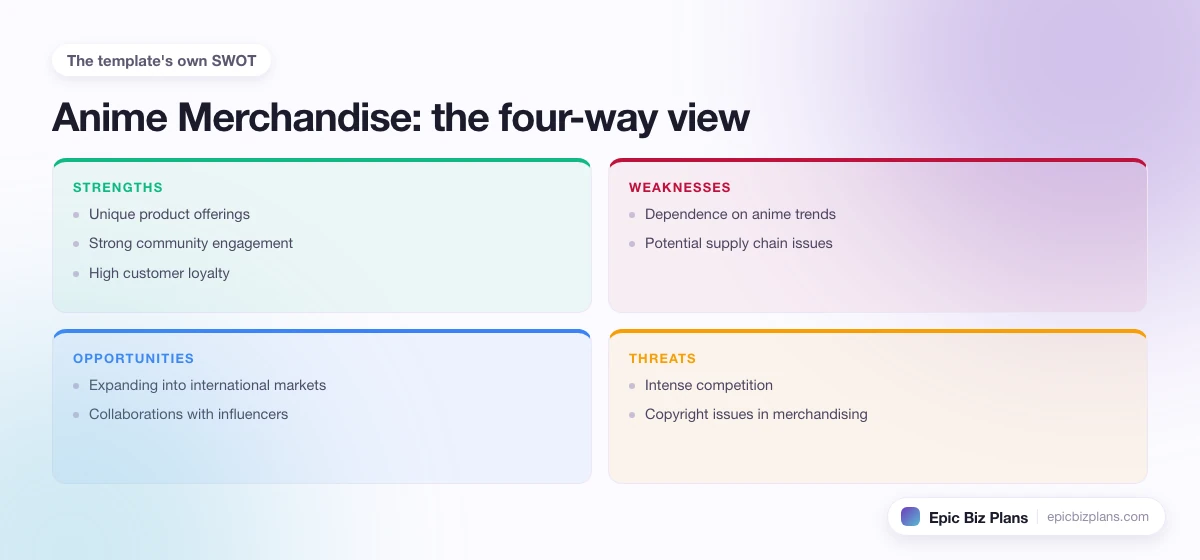
- Strengths: Unique product offerings, strong community engagement, high customer loyalty.
- Weaknesses: Dependence on anime trends, potential supply chain issues.
- Opportunities: Expanding into international markets, collaborations with influencers.
- Threats: Intense competition, copyright issues in merchandising.
Anime Merchandise Business Name Ideas
Website
We will build our ecommerce platform on Shopify because it gives us the right base for an inventory-led brand that needs payments, shipping rules, and a mature app ecosystem. The platform supports pre-orders, limited drops, and franchise-based collections without custom development. Shopify also makes it easier to add wholesale gating later as we attract retail buyers.
Marketing Details
Our marketing strategy combines SEO using Semrush, email through HubSpot, and paid social to support launches. SEO will target high-intent terms tied to specific anime series and product categories, where larger retailers tend to be less focused. Email flows will handle welcome, abandoned cart, drop alerts, and post-purchase upsells for related items.
Paid social will run on TikTok and Instagram with short videos that highlight new arrivals, fan tributes, and behind-the-scenes design work. Creator partnerships with anime-focused micro-influencers consistently outperform broad ad spend in this category, especially for first-time customers.
Industry Trends
The anime merchandise category is seeing a surge driven by streaming platforms and social media, which has shortened the time from anime release to merchandise demand. Augmented-reality try-on tools, NFC-tagged collectibles, and AI-personalized recommendations are starting to shape how fans shop. Sustainable and ethically produced merchandise is also becoming more important to younger buyers. Anime merchandise businesses that also carry licensed pop culture figures should review the Funko Pop business plan for the variant tracking, secondary market, and collector-focused operations that segment requires. Businesses expanding into gaming IP merchandise, particularly around brands like Nintendo franchises, should also study the Pokemon business plan template for licensing strategy, fan community engagement, and event-based revenue models.
Niche fan merchandise businesses operate under the same e-commerce fundamentals covered in a general merchandise business plan (including print-on-demand vs. bulk inventory decisions, platform selection, and micro-influencer marketing), adapted for the specific dynamics of fan-driven communities.
Competitor Information
Our main competitors include established online retailers that focus on anime products and the large general marketplaces where buyers default. To set ourselves apart, we will offer exclusive merchandise, collaborative collections with independent artists, and the kind of service big platforms cannot match. Building real community through social engagement, convention presence, and Discord groups is a key part of how we earn repeat business. Operators experimenting with anime-inspired apparel can also study the streetwear business plan template for design release and drop cadence ideas.
Financial Information
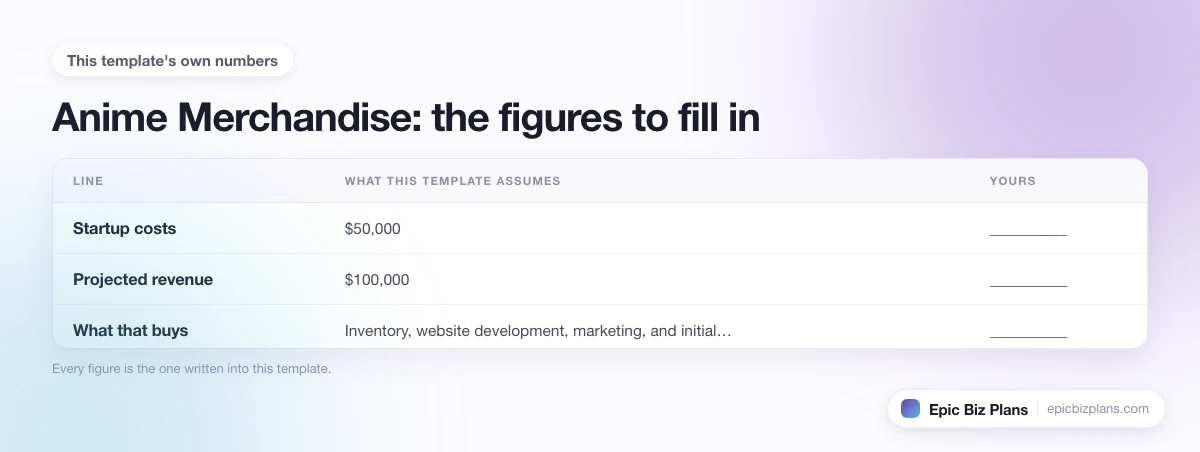
Startup costs are estimated at $50,000, covering inventory, website development, marketing, and initial operations. We project year-one revenue of $100,000, with healthy margins on apparel and accessories in particular. Ongoing costs include inventory replenishment, hosting, marketing, and fulfillment, and we will run monthly cash flow forecasts and P&L statements so we can act on warning signs early.
Legal and Compliance
Legal requirements include business registration, sales tax setup, and any permits required to sell merchandise in our state. Copyright compliance is the big one in this category, so we will only carry licensed product from reputable distributors and will keep original designs clearly distinct from any trademarked IP. We will also register our own brand assets and consult with a lawyer who handles anime and entertainment merchandise specifically.
Operational Plan
Our operational plan focuses on sourcing high-quality products from reputable suppliers and licensors. We will build a clear supply chain with two or three vetted partners per category, so we are not single-source dependent. A reliable shipping partner will keep delivery times competitive, and a clear customer service flow will handle inquiries, returns, and damaged-package cases.
Contingency Planning
We see risks in shifts in fandom popularity, shipment delays, and rising competition. To address them, we will run monthly trend reviews, hold a small safety stock of best-sellers, and keep a cash reserve equal to three months of fixed costs. We will also keep at least one backup supplier per category lined up before we need them.
Frequently Asked Questions
Do I need licenses to sell anime merchandise?
For anything that uses official anime artwork, character names, or trademarked elements, yes. You either source from a licensed distributor or work through an agency to secure rights directly with the IP holder. Fan-art and original-design products inspired by anime culture are a separate path, but it is worth getting a brief legal review before scaling that side of the catalog. For a related approach, see our Kpop albums business plan template.
-
 SemrushSemrush is a platform with literally any online tool you will need to promote your business. Spy on your competitors, get search traffic, keyword research, social info, ad copies and much more. Used by most of the top online companies in the world. Besides all its tools, Semrush also has many available integrations possible with many other tools that will make your work even better.
 -
 Surfer SEOSurfer SEO is an incredibly smart AI tool that will give you exact explanations what to do in order to make your website rank better. They use hundreds of parameters, check your competitors and decide on the best course of action. Whether it be inner links, bold text, paragraphs, headers, images and much more. Surfer is a must-have in 2026.
What product types sell best for a new store?
Apparel (tees, hoodies, hats), enamel pins, stickers, and acrylic stands tend to lead for new anime stores because they offer strong margins and low return rates. Figurines and statues are higher-ticket but require more careful sourcing and can tie up working capital if you stock the wrong releases.
How important are anime conventions for sales?
Conventions are useful for testing new designs, collecting email addresses, and building word-of-mouth, but the booth math rarely makes sense as a pure sales channel after travel and table fees. Treat them as marketing investments first and direct sales second.
Embrace Your Passion
The world of anime is more than just entertainment, it is a culture that resonates with fans seeking identity and connection. Launching an Anime Merchandise business is a way to channel that energy into a working venture. Whether you draw inspiration from streetwear brands or small creative shops on Etsy, the opportunities in this niche are wide. From local pop-ups to large e-commerce sites, every choice you make can reflect your own perspective on the art form.
Adapt and Evolve Your Plan
Your Anime Merchandise business plan is a living document that should evolve alongside the business. As you learn more about your audience, pricing, and product preferences, update your strategy without hesitation. That habit lets you reach new demographics and expand into new sales channels while staying profitable.
Practical Applications
Use your Anime Merchandise business plan as the foundation for key milestones, including presenting to partners, planning launches, securing funding, and clarifying your vision when growth pulls you in too many directions. The clarity that comes from a written plan is what supports sound decisions when the calendar is full.
Seize the Opportunity
Your Anime Merchandise business plan is 100% free, with unlimited edits, unlimited downloads, and unlimited chances to refine it. Take the first step today and turn your passion into a working business.
