
Art Print Business Plan Template
-
 ShopifyPut your brand on Shopify. Launch your online store with tools designed for growth and success. Ready to turn your idea into profit? Start building your e-commerce business today.
 -
 SquarespaceShowcase your brand with Squarespace’s sleek designs. Build a professional online presence with ease. Start with a template that already looks finished.
 -
 WixBring your ideas to life with Wix. Customize every aspect of your site with unmatched flexibility. Start creating your unique online space and let your creativity shine.
 -
 ElementorCraft captivating websites effortlessly with Elementor. Enjoy complete creative control without coding. Make your site stand out to your audience. Start turning your vision into reality now.
- Executive Summary
- Business Info
- Business Model Overview
- SWOT Analysis
- Business Name Ideas
- Website
- Marketing Details
- Industry Trends
- Competitor Information
- Financial Information
- Legal and Compliance
- Operational Plan
- Contingency Planning
- Build a Sustainable Art Print Business
- Keep It Updated
- Use It for Real Decisions
The art print business is one of the more accessible creative product categories - digital artwork can be printed and shipped on demand, keeping inventory costs low and making it possible to test dozens of designs with minimal upfront risk. Your Art Print business plan should reflect both the creative and commercial sides of the business: what makes your prints distinctive, who you're selling to, and how you're going to build a customer base that buys more than once.
This template covers every section of an Art Print business plan, from executive summary and market positioning to operations and financial projections. Customize it to your specific style, price point, and distribution model - whether you're selling through your own Shopify store, a marketplace like Society6 or Redbubble, or through gallery partnerships. For a deeper look at that path, see the Muse business plan template. Sellers exploring related creative niches can also study our coloring business plan for a low-cost printable product angle.
If you are building a wider curated brand, see our collection business plan template.
Executive Summary
Our mission is to deliver high-quality, original art prints that connect with a broad range of buyers - from interior design enthusiasts to gift shoppers seeking something more personal than a mass-market print. We promote both established and emerging artists, offering customization options so buyers can select styles and sizes that work for their space. For related planning ideas, see our printable art business plan template.
Our financial goal is 20% annual revenue growth over the first three years, built on a repeat-purchase model where customers return for new collections, seasonal releases, and custom orders.
Business Info
Our product range includes contemporary, abstract, and classic art prints, alongside canvas art, in multiple sizes, produced using sustainable materials. Our target market is art enthusiasts, home decorators, and gift buyers aged 25–45 who value originality and are willing to pay a premium for something that feels personal rather than generic. We will also sell digital downloads for buyers who print locally.
Business Model Overview
We will operate primarily through an e-commerce platform with direct online sales as the main revenue channel. Artist collaborations and gallery partnerships will supplement online sales with physical presence at key moments during the year - art fairs, local exhibitions, and seasonal pop-ups. For founders building a complementary screen-printed merchandise range alongside art prints, the screen printing business plan covers equipment, workflow, and pricing specific to that production model.
SWOT Analysis
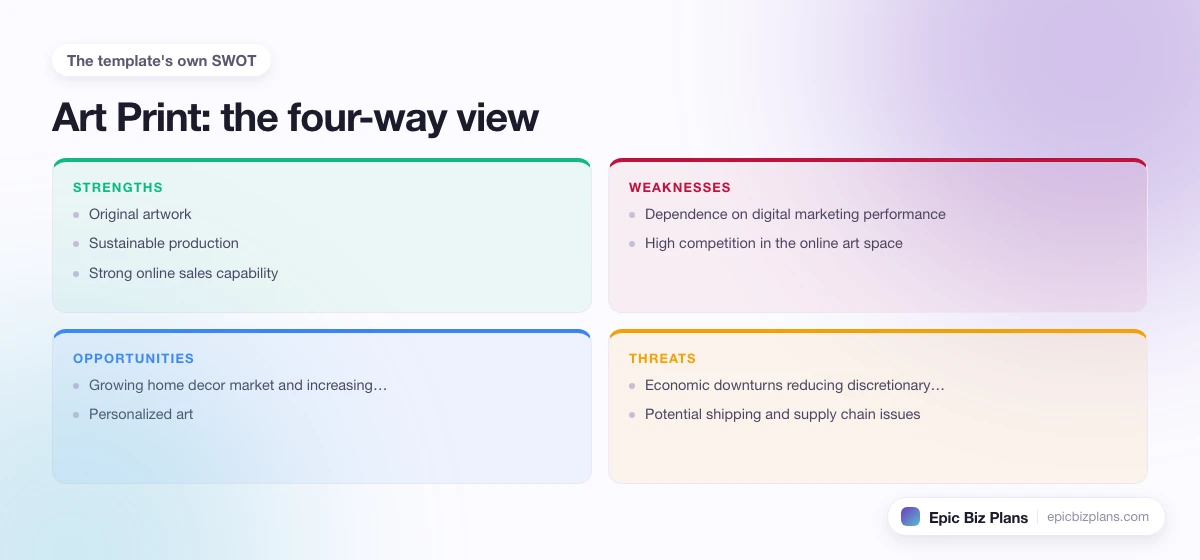
- Strengths: Original artwork, sustainable production, strong online sales capability.
- Weaknesses: Dependence on digital marketing performance, high competition in the online art space.
- Opportunities: Growing home decor market and increasing demand for original, personalized art.
- Threats: Economic downturns reducing discretionary spending, potential shipping and supply chain issues.
Business Name Ideas
Website
We will build on Shopify, which handles the product variants, inventory, and payment processing needed for a print business well. The site will be organized by style category and price range to help gift buyers and interior designers find what they need quickly. High-resolution image zoom and room mock-up visuals will reduce purchase hesitation for buyers who can't see the print in person.
Marketing Details
Our marketing strategy uses Semrush for SEO to capture organic traffic from searches like "abstract art prints for living room" and "framed art for home office." HubSpot will handle email campaigns segmented by past purchase behavior - buyers who purchased contemporary work get updates on new contemporary releases, not everything we offer at once.
TikTok ads will be the primary paid channel for visual product discovery, using short video clips showing prints in real room settings. Artists building out broader creative services alongside their print business may also find the visual design business plan template useful for structuring commission work and client services.
Industry Trends
The art print industry is seeing continued growth in online purchases, driven by print-on-demand technology that eliminates minimum order requirements and makes it practical to sell one unit at a time. Consumer interest in personalized and custom artwork is strong - buyers want art that feels chosen rather than generic. The home décor market overlap means art prints benefit from broader home improvement spending trends. For founders who want to build a combined fine art and prints business, the fine art business plan covers original works, gallery representation, and the different pricing and sales dynamics that apply to one-of-a-kind pieces.
Competitor Information
Main competitors include large online art print platforms, local art stores, and individual artists selling directly through Instagram or Etsy. Operators expanding into event and promotional poster work should also review the poster making business plan for custom commission revenue ideas. We differentiate through sustainable production, curated artist collaborations, and customizable options that the mass-market platforms don't offer at our price point. Art businesses that want to add workshops, crafting kits, and community events alongside print sales can find a useful operational model in the Scatter creative products business plan. For a related plan, see our diamond art business plan template. Artists selling moody or alternative prints can pair this with a gloomy business plan template for the broader brand.
Financial Information
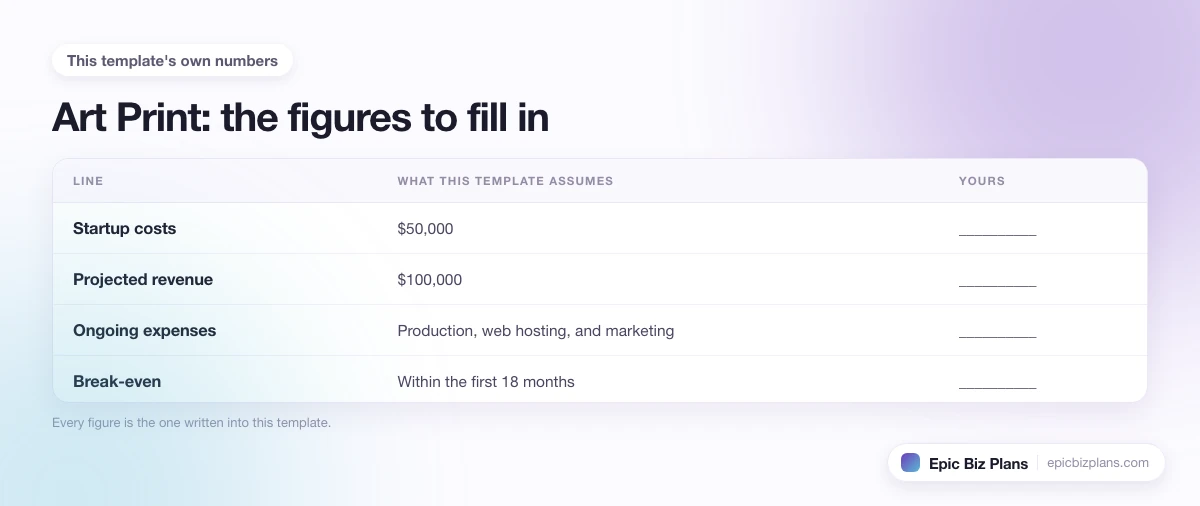
Startup costs - website setup, initial inventory, and marketing - are estimated at $50,000. Year 1 revenue is projected at $100,000, with break-even expected within the first 18 months. Ongoing expenses include production, web hosting, and marketing. Print-on-demand fulfillment keeps variable costs predictable, since we only produce when an order is placed.
Legal and Compliance
We will register the business, ensure compliance with local regulations, and protect intellectual property through licensed artist agreements and copyright documentation. All original art used in our catalog will be licensed or owned outright before going on sale - this is a non-negotiable protection for both the business and the artists we work with. For a related plan, see our posters business plan template.
Operational Plan
Operations center on sustainable material sourcing and partnerships with printing companies that maintain quality and eco-friendly production standards. Order fulfillment will be managed through our Shopify integration with a print-on-demand partner for physical prints, with digital downloads delivered automatically. We will inspect print quality regularly and maintain quality control standards with any production partner.
-
 SemrushSemrush is a platform with literally any online tool you will need to promote your business. Spy on your competitors, get search traffic, keyword research, social info, ad copies and much more. Used by most of the top online companies in the world. Besides all its tools, Semrush also has many available integrations possible with many other tools that will make your work even better.
 -
 Surfer SEOSurfer SEO is an incredibly smart AI tool that will give you exact explanations what to do in order to make your website rank better. They use hundreds of parameters, check your competitors and decide on the best course of action. Whether it be inner links, bold text, paragraphs, headers, images and much more. Surfer is a must-have in 2026.
Contingency Planning
Risks include economic downturns reducing discretionary art purchases and supply chain issues affecting print quality or delivery times. We will maintain a flexible marketing budget that can scale down quickly if revenue drops, and keep a cash reserve sufficient to cover at least three months of operations. If a specific supplier fails, we have backup print partners identified and tested.
Build a Sustainable Art Print Business
An art print business works best when the creative and commercial sides are equally well-planned. The most successful independent print brands aren't just producing beautiful work - they understand their customer, price to their margins, and build systems that let them sell consistently without starting from scratch each month. Your Art Print business plan is the foundation for that kind of business. Artists who want to explore how fine art and limited edition print models compare should also review the graphic art business plan for positioning strategies across different art product categories.
Keep It Updated
Your Art Print business plan should evolve as your collection and customer base grow. When you discover which styles convert best, which marketing channels bring in repeat buyers, and how your margins compare to projections, update the plan to reflect that reality. A static plan built on assumptions is quickly outdated - a live one that reflects what you've learned is genuinely useful.
Use It for Real Decisions
Bring your plan to partner and gallery conversations, use it to apply for funding, and refer to it when making pricing or expansion decisions. It is a practical tool, not just a document to complete once and file away.
Print artists who sell pixel art merchandise should also explore the pixel business plan to understand how digital art product models compare. Your Art Print business plan is 100% free - with unlimited edits, unlimited downloads, and unlimited chances to get it right.
