
Parking Business Plan Template
-
 ShopifyPut your brand on Shopify. Launch your online store with tools designed for growth and success. Ready to turn your idea into profit? Start building your e-commerce business today.
 -
 SquarespaceShowcase your brand with Squarespace’s sleek designs. Build a professional online presence with ease. Start with a template that already looks finished.
 -
 WixBring your ideas to life with Wix. Customize every aspect of your site with unmatched flexibility. Start creating your unique online space and let your creativity shine.
 -
 ElementorCraft captivating websites effortlessly with Elementor. Enjoy complete creative control without coding. Make your site stand out to your audience. Start turning your vision into reality now.
- Executive Summary
- Business Info
- Business Model Overview
- SWOT Analysis
- Parking Business Name Ideas
- Website
- Marketing Details
- Industry Trends
- Competitor Information
- Financial Information
- Legal and Compliance
- The accessible-space count is set for you
- Operational Plan
- Contingency Planning
- Building Your Future with a Parking Business Plan
- Types of Parking Businesses
- Adapting Your Parking Business Plan
- Practical Uses for Your Plan
- Your Time is Now
The parking industry is a quiet but consistently profitable corner of urban infrastructure. Demand is driven by predictable factors (population density, commercial activity, and vehicle ownership rates) which makes financial modeling more reliable than in many other service businesses. A Parking business plan is the document where you turn that demand into a specific operation: which sites you are targeting, which technology you are using, and how you plan to acquire customers in a market where the competition is mostly entrenched.
This plan covers the operational and financial detail a parking business actually needs to address. The right plan reflects your specific model: a single-lot operator, a multi-site network, an app-based aggregator, or an event parking specialist all have different cost structures and customer acquisition profiles. Make every section concrete to your real business.
Executive Summary
Our mission is to provide convenient, reliable, and accessible parking solutions that improve the urban driving experience for individual drivers and the businesses that depend on convenient parking for their customers. We aim to be a recognized name in our regional market by combining technology (real-time availability, easy reservations, and frictionless payment) with operational reliability that customers can trust. Our value proposition is straightforward: drivers find available parking faster, and lot owners earn more from their existing real estate. The financial goal is profitability within the first two years while reinvesting steadily in technology and customer acquisition. For a closely related approach, see our Valet Parking business plan.
Business Info
Our service mix includes hourly and monthly parking rentals in urban areas, supported by an app that lets users find, reserve, and pay for parking without the friction of a physical ticket or kiosk. The target market includes daily commuters, business travelers, tourists, and local businesses that need predictable parking for their staff and customers. For founders who want to integrate parking with vehicle care services, the car detailing business plan template covers an adjacent service category that customers often book together with parking.
Business Model Overview
The core model is a transaction-fee structure, we earn a percentage of each parking session booked through our platform. We will also pursue partnerships with local businesses for integrated parking validation and offer monthly subscription plans for daily users who want predictable pricing and guaranteed availability.
SWOT Analysis
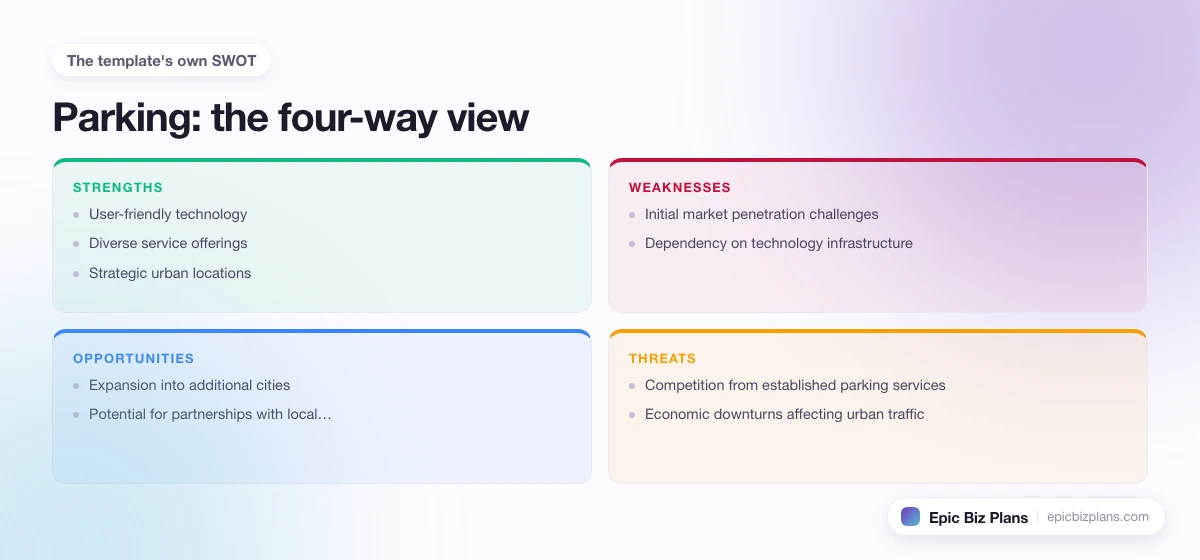
- Strengths: User-friendly technology, diverse service offerings, strategic urban locations.
- Weaknesses: Initial market penetration challenges, dependency on technology infrastructure.
- Opportunities: Expansion into additional cities, potential for partnerships with local businesses.
- Threats: Competition from established parking services, economic downturns affecting urban traffic.
Parking Business Name Ideas
Website
The customer-facing site will be built on Wix for the initial launch. It gets the marketing site online quickly without engineering overhead, while the actual reservation and payment flow runs through a dedicated app. Once usage volume justifies it, we will move to a platform with stronger eCommerce and integration capabilities, such as Shopify or a custom build, to support gift cards, corporate accounts, and the operational complexity of a multi-site service.
Marketing Details
The marketing plan combines digital advertising, SEO, and local partnerships. Semrush will support keyword research and on-page optimization so we capture intent-driven searches like "parking near me" and city-specific queries. HubSpot will run email and SMS campaigns, including reservation confirmations, expiry reminders, and re-engagement flows for lapsed users. TikTok ads will target the under-35 commuter demographic where short-form video performs well, and we will pursue partnerships with local restaurants, venues, and event organizers for cross-promotion. Auto businesses targeting a similar customer base should also review the car business plan template for more detail on customer acquisition in adjacent automotive categories.
Industry Trends
The parking industry is moving toward digital-first user experiences. Mobile payments, real-time availability data, and app-based reservations are becoming customer expectations rather than premium features. Sustainability is also a growing factor, with EV charging integration, partnerships with shared-mobility services, and reduced-footprint operations all increasingly important to municipal partners and corporate customers. The operators who win in this space combine reliable physical operations with software customers actually want to use.
Competitor Information
Competitors include established parking app operators, traditional parking lot owners, and city-run parking authorities. We differentiate on customer experience (faster booking, clearer pricing, and reliable availability) and on the depth of partnerships we build with local lot owners. Premium venues may prefer a staffed option, so a valet business plan covers the attended-parking model that complements self-park lots. For founders building businesses around vehicle accessories or car-adjacent retail, the car accessories business plan covers complementary categories that share customer demographics with parking services.
Financial Information
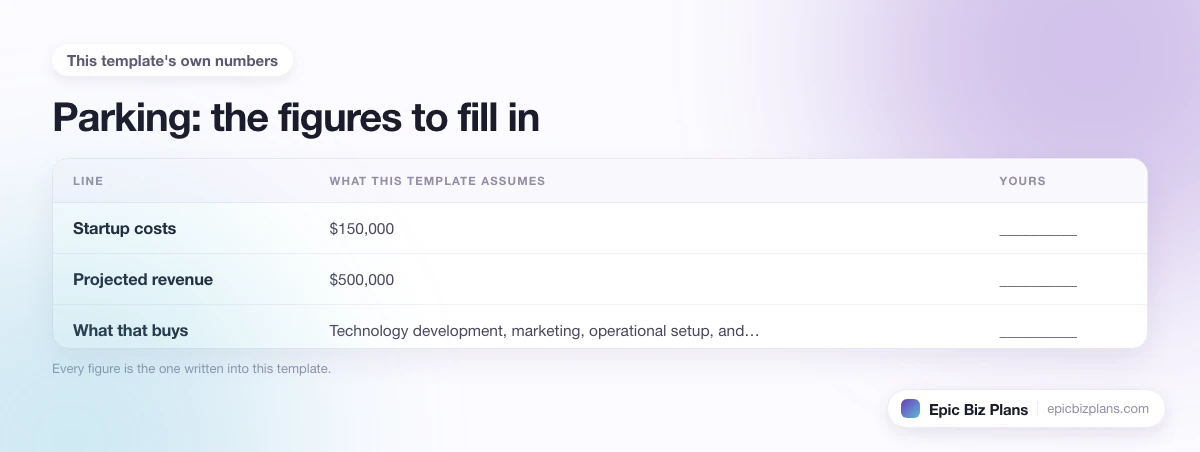
Startup costs are estimated at approximately $150,000, covering technology development, marketing, operational setup, and legal registrations. First-year revenue is expected to start modestly as the platform builds awareness, growing to approximately $500,000 by year two as more lots are onboarded and customer acquisition compounds. Ongoing expenses, including platform maintenance, marketing, and staff, are projected at around $250,000 annually, with cash-flow positive operations targeted by the end of year two.
Legal and Compliance
We will comply with local and national regulations governing parking services, including business registration, liability insurance, and any zoning or permit requirements specific to each city we operate in. Intellectual property protection (for proprietary technology, the brand name, and the app) will be addressed before launch.
The accessible-space count is set for you
Parking is one of the few businesses where a federal design standard fixes part of your inventory before you price anything. Table 208.2 of the 2010 ADA Standards for Accessible Design sets the minimum number of accessible spaces by lot size: 1 space in a lot of 1 to 25, 2 at 26 to 50, 4 at 76 to 100, 8 at 301 to 400, and 2 percent of the total once a lot holds 501 to 1,000. Past 1,000 spaces the rule becomes 20 spaces plus one more for every additional 100 or part of 100.
Section 208.2.4 then requires at least one in every six accessible spaces to be van accessible, which carries a wider access aisle with it. Work those counts out for every site you are underwriting before you build the revenue model, because accessible spaces take the best positions nearest the entrance and you cannot sell them as premium inventory. Getting the layout and markings right is its own job, covered in the parking lot striping business plan template. City registration, liability cover and site-specific zoning conditions sit on top of all that.
Operational Plan
Operations cover three main functions: lot owner partnerships, technology platform reliability, and customer support. We will build a lot-owner pipeline through direct outreach, broker partnerships, and inbound interest generated by marketing. The technology platform requires uptime monitoring, regular updates, and a clear escalation path for issues that surface during peak demand windows. For founders looking at the dealership-side of the auto industry, the auto dealership business plan template covers a more capital-intensive automotive business model.
Contingency Planning
Key risks include demand volatility tied to economic conditions, technology failures during peak demand, and competitive pressure from larger or city-backed alternatives. Mitigation includes diversifying revenue streams across hourly, monthly, and event parking; building redundancy into the technology platform; and maintaining a cash buffer to handle quieter periods without cutting marketing or technology investment. Customer retention strategies (including loyalty programs and corporate accounts) also reduce dependence on continual new-user acquisition.
-
 SemrushSemrush is a platform with literally any online tool you will need to promote your business. Spy on your competitors, get search traffic, keyword research, social info, ad copies and much more. Used by most of the top online companies in the world. Besides all its tools, Semrush also has many available integrations possible with many other tools that will make your work even better.
 -
 Surfer SEOSurfer SEO is an incredibly smart AI tool that will give you exact explanations what to do in order to make your website rank better. They use hundreds of parameters, check your competitors and decide on the best course of action. Whether it be inner links, bold text, paragraphs, headers, images and much more. Surfer is a must-have in 2026.
Building Your Future with a Parking Business Plan
A parking business is an operationally focused service. It succeeds on consistent execution, smart site selection, and a customer experience that actually works the way users expect. Whether the operation is a single neighborhood lot, an event parking service, an app-based aggregator, or a multi-city network, the underlying disciplines are the same: clear unit economics, reliable technology, and strong relationships with the lot owners who supply the actual inventory.
Types of Parking Businesses
The space includes a wide range of business models: small neighborhood lots, event-focused parking operations, valet services, multi-site networks, and software-led aggregators that connect drivers with available spaces. Each model has its own capital requirements, customer acquisition profile, and operational complexity. The right plan reflects the specific business you are building rather than a generic version that could apply to any parking operation.
Adapting Your Parking Business Plan
Treat the plan as a working document. The numbers in your initial financial model will be different from your actual results (sometimes by a meaningful margin) and the most useful thing you can do is update the plan with what you learn. Refine your assumptions about usage rate, average session length, and customer acquisition cost as real data comes in.
Practical Uses for Your Plan
Use your parking business plan to pitch lot owners, secure financing, brief a technology partner, or align your team. A specific, credible plan communicates that you understand both the market and the operational realities of the business, which matters when you are asking partners or lenders to commit to working with you.
Your Time is Now
Your parking business plan is 100% free: with unlimited edits, unlimited downloads, and unlimited chances to get it right. Start building the version that reflects your actual operation today.
