
Car Business Plan Template
-
 ShopifyPut your brand on Shopify. Launch your online store with tools designed for growth and success. Ready to turn your idea into profit? Start building your e-commerce business today.
 -
 SquarespaceShowcase your brand with Squarespace’s sleek designs. Build a professional online presence with ease. Start with a template that already looks finished.
 -
 WixBring your ideas to life with Wix. Customize every aspect of your site with unmatched flexibility. Start creating your unique online space and let your creativity shine.
 -
 ElementorCraft captivating websites effortlessly with Elementor. Enjoy complete creative control without coding. Make your site stand out to your audience. Start turning your vision into reality now.
- Executive Summary
- Business Info
- Business Model Overview
- SWOT Analysis
- Car Business Name Ideas
- Website
- Marketing Details
- Industry Trends
- Competitor Information
- Financial Information
- Legal and Compliance
- Operational Plan
- Inventory Sourcing and Reconditioning
- Sales Process and Customer Experience
- Financing and F&I
- Contingency Planning
- Embrace Your Passion
- Adaptability is Key
- Practical Uses You'll Appreciate
- Take the Leap
A Car business plan maps the path from initial inventory purchase to long-term customer retention, covering the full operating cycle of a vehicle dealership or related automotive service. The car market rewards operators who can buy well, recondition efficiently, and sell with transparent pricing, regardless of whether the focus is new vehicles, pre-owned inventory, or specialty segments like classics or EVs. Your plan should be specific about the lane you choose, since the working capital, staffing, and marketing mix are very different across each model. Operators considering parking services as part of a wider vehicle-service operation should also review the parking business plan template for site selection and pricing detail.
A useful Car business plan reads like a working strategy, not marketing copy. It should describe your sourcing approach, your target customer, your average gross per unit, your floor-plan financing terms, and the service-and-warranty mix that protects gross margin on every sale. Specifics, not slogans, are what make the plan credible to lenders, lot suppliers, and the experienced sales managers you will want to hire.
Executive Summary
We will operate an automotive dealership focused on quality pre-owned vehicles for budget-conscious buyers in our regional market. Our mission is to be the trusted source for reliable pre-owned cars by combining honest pricing, mechanical inspections on every vehicle, and a transparent buying process. Our vision is to build a repeat-customer base through service quality rather than aggressive sales tactics. Financially, we target profitability within the first two years and $2 million in annual revenue by year five, with at least 30% of revenue coming from existing customers and their referrals.
Business Info
Our business will offer a curated range of pre-owned vehicles, including sedans, SUVs, and trucks priced from $8,000 to $35,000. We cater to first-time car buyers, families looking for affordable transportation, and tradespeople who need reliable work vehicles. Owners adding a vehicle-care service line can also review a mobile auto detailing business plan template. Operators planning to expand into newer or higher-end inventory should also review an auto dealership model for the additional capital and franchise considerations.
Business Model Overview
We operate through a physical dealership backed by a strong online inventory listing, allowing customers to browse, request financing, and schedule test drives before ever visiting the lot. Revenue comes primarily from vehicle sales with secondary income from extended warranty plans, GAP insurance, financing reserve, and a small reconditioning service line for trade-in vehicles we choose not to retail. F&I (finance and insurance) revenue is targeted at 8 to 10% of total gross profit by year two. For another angle, see our car group business plan.
SWOT Analysis
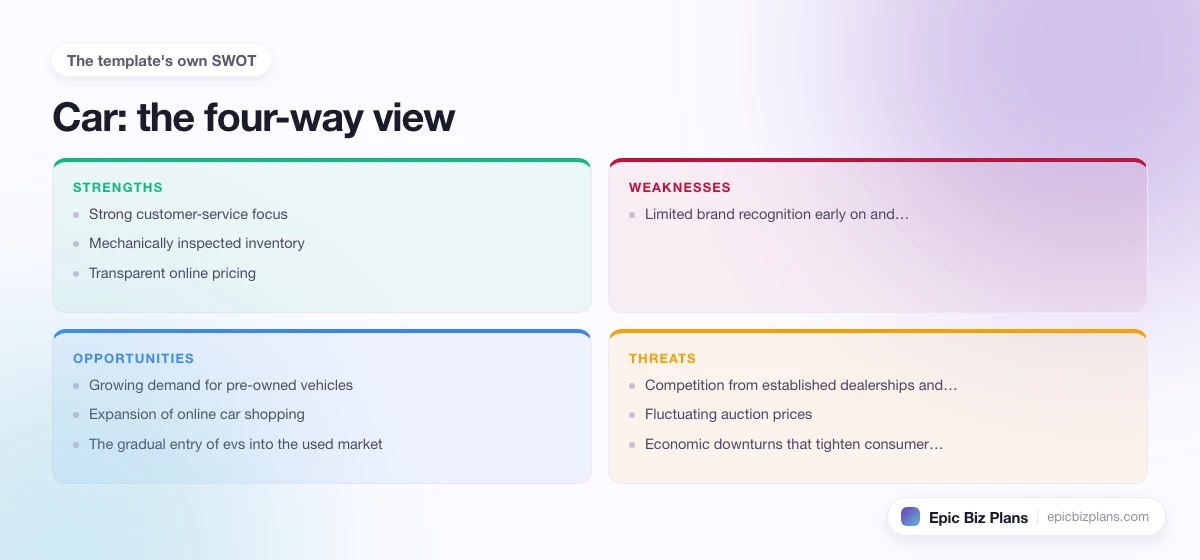
- Strengths: Strong customer-service focus, mechanically inspected inventory, and transparent online pricing.
- Weaknesses: Limited brand recognition early on and dependence on the local labor pool for skilled technicians.
- Opportunities: Growing demand for pre-owned vehicles, expansion of online car shopping, and the gradual entry of EVs into the used market.
- Threats: Competition from established dealerships and online-only retailers, fluctuating auction prices, and economic downturns that tighten consumer credit.
Car Business Name Ideas
Website
We will build the website on Shopify or a dedicated dealer DMS-connected platform so the inventory listings stay in sync with the lot in real time. Photos, VIN-decoded vehicle history, financing prequalification, and trade-in valuation are the four most-used pages and are designed for fast mobile loading. A Squarespace mini-site can host a polished About and Our Process page for prospects who want to learn how the dealership operates before visiting. A clear request-a-quote form and a click-to-text option drive most of our online inquiries.
Marketing Details
Our marketing combines local SEO, paid search, and social proof. Semrush guides keyword research so the site ranks for queries like "used [your make] for sale [your city]" and long-tail phrases tied to popular trim levels. HubSpot handles email automations including post-inquiry nurture, service-reminder campaigns, and lapsed-buyer outreach. TikTok and Instagram Reels showcase walk-around videos, customer pickups, and shop-day content that performs well with younger buyers. Referral incentives for existing customers and accountants round out the channel mix.
Industry Trends
The auto retail market is shifting on three fronts: continued growth of online-first buying journeys, the early-stage entry of EVs into the used market, and consumer demand for greater transparency on vehicle history and pricing. Dealers that pair clean online inventory with same-day delivery and a documented inspection process pull ahead of the legacy "haggle and hope" model. Adjacent business lines like used car programs and auto body repair services have natural cross-sell potential with our customer base.
Competitor Information
Direct competitors include other independent used-car dealerships, franchise pre-owned departments, and online-only retailers. Indirect competitors include ride-sharing, leasing, and private-party sales. We differentiate on three points: every vehicle is inspected and reconditioned by an in-house technician, pricing is posted and held without haggling, and every sale comes with a 30-day limited warranty on major mechanical components. Customers who want full-service support after the sale appreciate that we partner with local car detailing shops for post-purchase paint and interior care.
Financial Information
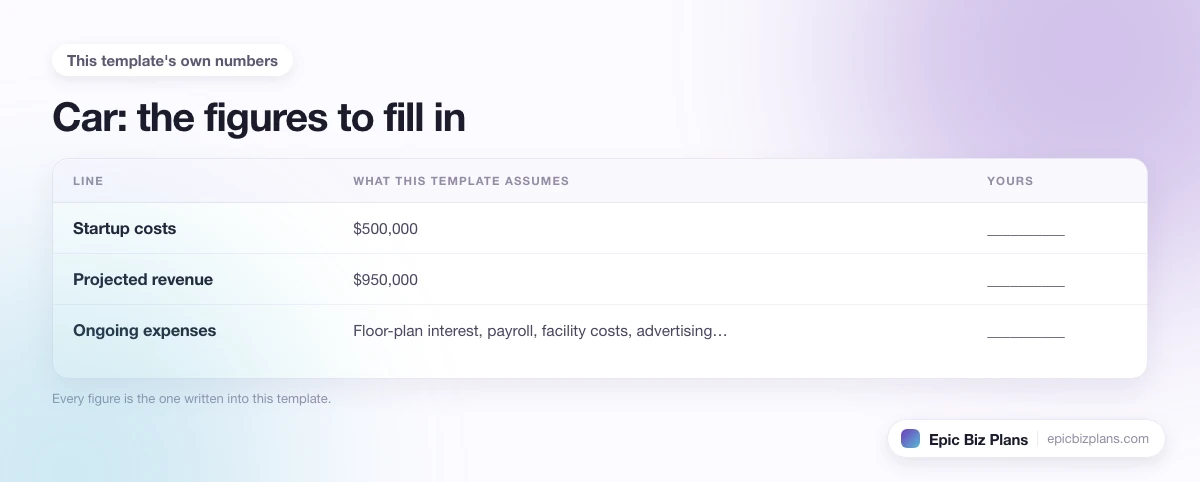
Startup costs are projected at approximately $500,000, covering initial inventory (roughly 25 to 35 vehicles), a small reconditioning bay, dealer license and bond, software, signage, and the first six months of marketing. Year-one revenue is projected at $950,000, growing roughly 20% annually as inventory turn and brand recognition compound. Ongoing expenses include floor-plan interest, payroll, facility costs, advertising, and reconditioning supplies. A six-month cash reserve protects against auction price spikes and slower selling months.
Legal and Compliance
We will register the business, secure a state dealer license, post the required surety bond, and confirm zoning allows automotive retail at our chosen site. Every vehicle is sold with the required disclosures, including Buyer's Guide window forms, lemon-law notices where applicable, and full odometer documentation. Sales staff complete mandatory state F&I and consumer-finance compliance training every year. Trademarks covering our brand name and signature service marks are filed once revenue justifies the legal spend.
Operational Plan
Day-to-day operations center on a six-step vehicle lifecycle: source, inspect, recondition, photograph, price, and sell. Each step has documented standards and a target turnaround time so a newly acquired car is on the lot and online within 7 to 10 days. Dealers that also run delivery or courtesy vehicles can review the fleet business plan template for managing those vehicles efficiently. The sales team works a structured follow-up cadence (24-hour, 7-day, and 30-day touches) tied to a CRM that flags lapsed leads automatically. Service-bay scheduling is integrated so trade-ins and customer service-work share the same technician capacity without queuing conflicts.
Inventory Sourcing and Reconditioning
Inventory comes from a mix of trade-ins, local auctions, and direct purchases from private sellers responding to instant cash offers on our website. Every vehicle passes a documented 120-point inspection, with a reconditioning budget capped per unit so a low-margin car cannot consume the gross from a higher-margin one. Reconditioning includes mechanical repairs, detailing, photography, and any cosmetic touch-ups needed to hit our retail-ready standard. Aging policies move slow-moving inventory to wholesale auction at the 60-day mark to keep capital turning.
Sales Process and Customer Experience
The sales process is structured around a no-haggle policy, written prices on every vehicle, and a single point-of-contact salesperson per customer. Test drives include a documented walk-around video that becomes part of the customer's record. After purchase, customers receive a welcome email with service-reminder triggers and a 30-day check-in call. A post-sale survey at 30 days feeds directly into staff coaching and quarterly process reviews. Documented sales playbooks keep tone, pricing language, and disclosures consistent across every team member.
Financing and F&I
Financing is offered through a panel of prime, near-prime, and subprime lenders selected for fair pricing and clean compliance records. Customers see real rate quotes before they commit to a vehicle, which protects trust and reduces back-end deal collapse. Extended service contracts, GAP, and tire-and-wheel protection are offered as menu-presented options rather than high-pressure add-ons. F&I revenue is targeted at $1,000 per retail unit by month 18 and is reviewed monthly against compliance training scores.
-
 SemrushSemrush is a platform with literally any online tool you will need to promote your business. Spy on your competitors, get search traffic, keyword research, social info, ad copies and much more. Used by most of the top online companies in the world. Besides all its tools, Semrush also has many available integrations possible with many other tools that will make your work even better.
 -
 Surfer SEOSurfer SEO is an incredibly smart AI tool that will give you exact explanations what to do in order to make your website rank better. They use hundreds of parameters, check your competitors and decide on the best course of action. Whether it be inner links, bold text, paragraphs, headers, images and much more. Surfer is a must-have in 2026.
Contingency Planning
Risks include market downturns, sudden auction price shifts, and the loss of a key sales or service team member. We mitigate with a six-month cash reserve, multi-source inventory contracts, and documented runbooks for floor-plan management, customer escalations, and severe-weather closures. Cross-training across sales, F&I, and service prevents single points of failure. A documented incident-response plan covers consumer complaints, regulatory inquiries, and any major vehicle-quality issue traced back to our reconditioning process.
If you're focused specifically on pre-owned inventory, our used car business plan covers pricing, sourcing, and inventory mix in more depth.
Embrace Your Passion
Building an auto business is about more than profit. It is about earning a reputation in a market where word-of-mouth and online reviews drive the next decade of growth. Whether you open an independent dealership, an auto repair shop, an e-commerce platform for enthusiasts, or a niche specialty operation, the work begins with a clear plan and steady execution. Operators expanding into accessories or specialty parts often pair the dealership plan with a focused car parts roadmap to capture more of the customer's lifetime spend.
Adaptability is Key
Your car business plan should grow with the operation. Update pricing, refine your inventory mix, adjust marketing channels, and add service lines as the market shifts. Schedule a formal review every six months and a lighter check at the end of each quarter so the plan stays aligned with real numbers.
Practical Uses You'll Appreciate
Your car business plan can be used to support partner conversations, lender applications, lot leases, and quarterly leadership reviews. Each pass through the document is a chance to retire stale assumptions and replace them with sharper numbers from the previous quarter.
Take the Leap
Your car business plan is 100% free, with unlimited edits, unlimited downloads, and unlimited chances to get it right. Set ambitious targets, work the plan, and let results compound as every satisfied customer becomes a referral source.
