
Caterer Business Plan Template
-
 ShopifyPut your brand on Shopify. Launch your online store with tools designed for growth and success. Ready to turn your idea into profit? Start building your e-commerce business today.
 -
 SquarespaceShowcase your brand with Squarespace’s sleek designs. Build a professional online presence with ease. Start with a template that already looks finished.
 -
 WixBring your ideas to life with Wix. Customize every aspect of your site with unmatched flexibility. Start creating your unique online space and let your creativity shine.
 -
 ElementorCraft captivating websites effortlessly with Elementor. Enjoy complete creative control without coding. Make your site stand out to your audience. Start turning your vision into reality now.
- Executive Summary
- Business Info
- Business Model Overview
- SWOT Analysis
- Website
- Marketing Details
- Industry Trends
- Competitor Information
- Financial Information
- Legal and Compliance
- Operational Plan
- Contingency Planning
- Ignite Your Culinary Passion
- Adapt and Evolve Your Caterer Business Plan
- Use Your Plan Wisely
- Ready to Take the Leap?
A Caterer business plan gives you a clear structure for entering a competitive food-service market. Catering is about more than the food; it covers logistics, staffing, and the experience guests remember at weddings, corporate events, and private parties. A solid plan documents your menu focus, your pricing, and how your service differs from other caterers in your area. It also keeps your licensing and kitchen requirements organized before you book your first event.
The plan should connect your culinary strengths to a workable business model. Decide which events you want to serve, what you charge per head, and how you will source ingredients reliably. Map out your staffing for peak weekends and your equipment needs for off-site service. Every menu item, service detail, and marketing decision should support a clear answer to why a client should book you over the competition.
Executive Summary
We are dedicated to providing exceptional catering services for events of all sizes. Our mission is to deliver a unique culinary experience that delights our clients and their guests, emphasizing quality and customer satisfaction. Our vision is to become a leading caterer in the region, known for creative menus and outstanding service. Taco-bar pop-up operators often start from the taco truck business plan template.
Our value proposition includes personalized menu planning, fresh ingredients, and a commitment to sustainability. We aim to achieve annual revenue growth of 15% and increase our client base by developing strong relationships with local businesses and event planners.
Business Info
Our catering business specializes in a variety of cuisines, offering services for weddings, corporate events, private parties, and more. Caterers who later move toward a fixed dining location can compare the model in our restaurant business plan template. We target a varied clientele, including individuals, businesses, and organizations looking for high-quality catering. Operators who also run a fixed venue can compare cost structures with the restaurant business plan template.
Business Model Overview
We operate on a service-based model, providing customized catering services that meet the unique needs of each client. Our revenue streams include event catering fees, delivery services, and menu customization options.
SWOT Analysis
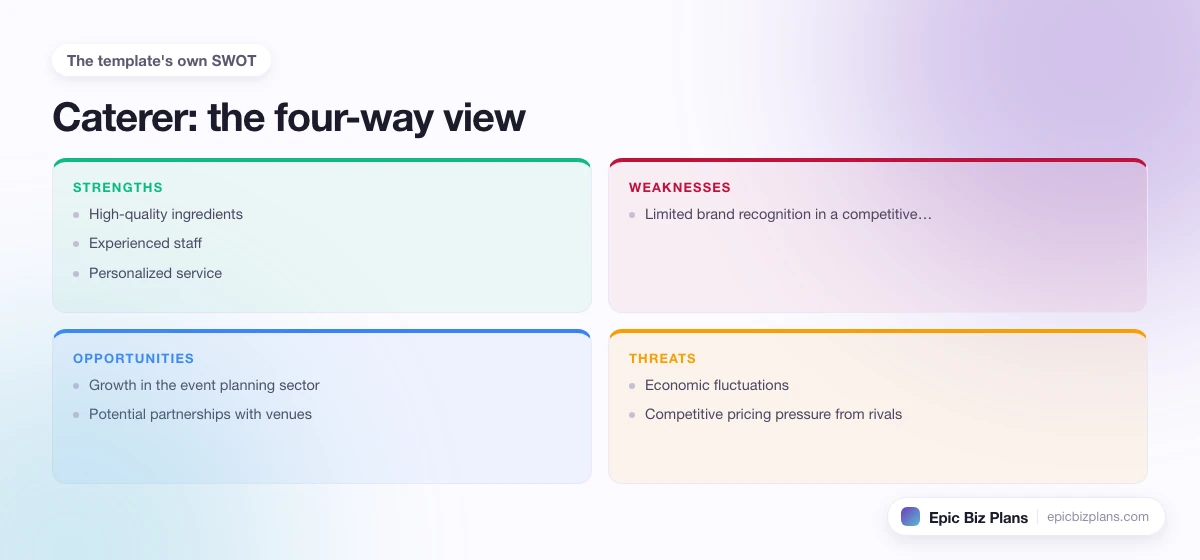
- Strengths: High-quality ingredients, experienced staff, personalized service.
- Weaknesses: Limited brand recognition in a competitive market.
- Opportunities: Growth in the event planning sector, potential partnerships with venues.
- Threats: Economic fluctuations, competitive pricing pressure from rivals.
Website
We will build our website on Wix, as it offers an easy-to-use platform for showcasing our services and managing updates effectively. Wix will help us create visually appealing pages to highlight our catering options, client testimonials, and contact information.
Marketing Details
Our marketing strategy will incorporate both digital and traditional methods to reach a wider audience. We will use Semrush for SEO to enhance our online visibility and HubSpot for email campaigns to engage with potential clients. Additionally, we will run TikTok ads to target younger demographics who are planning events.
Industry Trends
The catering industry is currently experiencing significant technological advancements, including online event planning tools and digital menus. Furthermore, consumers are increasingly interested in sustainable practices and locally-sourced ingredients, which we will incorporate into our offerings.
Competitor Information
We will analyze both direct and indirect competitors in our area. Our main competitors include established catering firms that offer similar services, while indirect competitors include restaurants and food trucks serving events. We will differentiate ourselves through personalized service, distinctive menu offerings, and flexible packages tailored to client needs. Caterers who specialize in events can also study the wedding events business plan template.
Financial Information
Our startup costs will involve purchasing kitchen equipment, initial inventory, marketing, and business registration fees. We anticipate projected revenue to grow steadily over the first three years, aiming for a $100,000 milestone by the end of year three. Ongoing expenses will include staff salaries, ingredient procurement, and marketing expenditures. We will maintain a detailed cash flow forecast and P&L statements to track financial health and sustainability.
Legal and Compliance
We will ensure compliance with local regulations by obtaining the necessary business licenses and permits. Additionally, we will seek to protect our intellectual property through trademarks for our brand and unique recipes.
Operational Plan
Key operations will include menu planning, ingredient sourcing from local suppliers, food preparation, and delivery logistics. We will establish a reliable supply chain to ensure quality and consistency, while also focusing on efficient service execution during events.
Contingency Planning
We recognize potential risks, such as changes in market conditions, supply chain disruptions, or staffing issues. To mitigate these risks, we will develop alternative supplier relationships, create scalable operational models, and maintain a reserve fund to address unforeseen circumstances.
Ignite Your Culinary Passion
Starting a catering business rewards cooks who can manage logistics as well as food. Whether you prepare plated meals for weddings or run cozy meal deliveries for the local community, the work depends on consistency and timing. Options range from large catering firms to small niche operations and pop-up events, so you can match the model to your kitchen and budget. People drawn to baked goods can also review the bakery business plan template.
-
 SemrushSemrush is a platform with literally any online tool you will need to promote your business. Spy on your competitors, get search traffic, keyword research, social info, ad copies and much more. Used by most of the top online companies in the world. Besides all its tools, Semrush also has many available integrations possible with many other tools that will make your work even better.
 -
 Surfer SEOSurfer SEO is an incredibly smart AI tool that will give you exact explanations what to do in order to make your website rank better. They use hundreds of parameters, check your competitors and decide on the best course of action. Whether it be inner links, bold text, paragraphs, headers, images and much more. Surfer is a must-have in 2026.
Adapt and Evolve Your Caterer Business Plan
As you build your catering business, treat your business plan as a living document. Update it as you grow, adjusting for different audiences, testing new pricing, expanding your menu, or adding sales channels. Staying flexible helps you respond to what each season and client base tells you.
Use Your Plan Wisely
Your caterer business plan is a working tool. Use it to present to potential partners, plan your launch, apply for funding, or clarify your overall strategy. It keeps you focused and prepared for the bookings that come your way.
Ready to Take the Leap?
Your caterer business plan is 100% free, with unlimited edits, unlimited downloads, and unlimited chances to get it right. Use it to start building your catering business today.
