
Bakery Business Plan Template
-
 ShopifyPut your brand on Shopify. Launch your online store with tools designed for growth and success. Ready to turn your idea into profit? Start building your e-commerce business today.
 -
 SquarespaceShowcase your brand with Squarespace’s sleek designs. Build a professional online presence with ease. Start with a template that already looks finished.
 -
 WixBring your ideas to life with Wix. Customize every aspect of your site with unmatched flexibility. Start creating your unique online space and let your creativity shine.
 -
 ElementorCraft captivating websites effortlessly with Elementor. Enjoy complete creative control without coding. Make your site stand out to your audience. Start turning your vision into reality now.
Executive Summary
Our mission is to provide fresh, high-quality baked goods made from organic ingredients, promoting a healthy lifestyle and supporting local farmers. Financially, we aim to achieve profitability within the first year of operation, with projected revenues of $150,000 in our second year.
Business Info
We will offer a variety of products, including sourdough bread, croissants, tarts, muffins, and cakes for special occasions. For a focused approach to naturally leavened loaves, the sourdough rustic business plan covers sourcing and pricing in depth. Our target market includes health-conscious individuals, families, and local businesses looking for catering kitchen business plan services. We will adopt a brick-and-mortar business model with an option for online orders. Bakeries that want to build a dedicated pastry line - including éclairs, croissants, and specialty seasonal items - alongside their core bread and cake range should review the pastries business plan for a framework covering wholesale supply, production scheduling, and the café and restaurant distribution model. For a niche cookie-dessert concept, the Oreo business plan template is a useful reference. Bakeries adding a frozen dessert counter can also review our gelato business plan template or the melt business plan template for artisan frozen treats. Operators focused mainly on loaves can also follow a dedicated bread business plan. We will establish a bakery that specializes in artisanal bread, pastries, and custom cakes. Our vision is to become the go-to bakery in our community, known for our exceptional products and warm customer service. Our value proposition lies in our commitment to quality, sustainability, and creativity.
SWOT Analysis
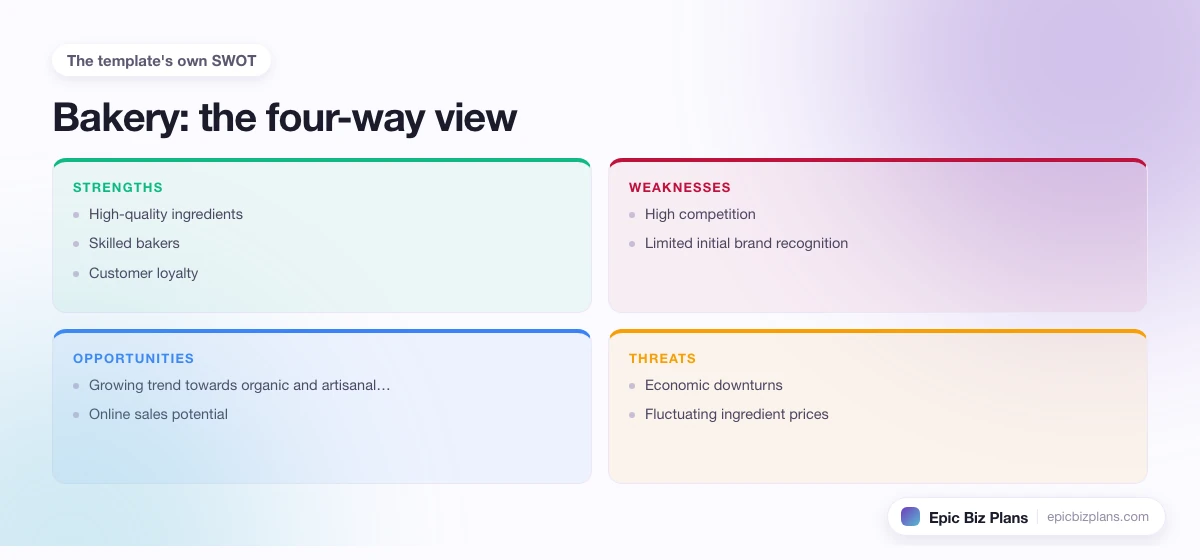
- Strengths: High-quality ingredients, skilled bakers, customer loyalty.
- Weaknesses: High competition, limited initial brand recognition.
- Opportunities: Growing trend towards organic and artisanal foods, online sales potential.
- Threats: Economic downturns, fluctuating ingredient prices.
Business Name Ideas
Website
We will build our website using Shopify to facilitate e-commerce capabilities, allowing customers to place orders online for pickup and delivery. Shopify offers an excellent platform for managing our inventory and sales efficiently. For more on this topic, see our cheese business plan.
Marketing Details
We will implement a complete marketing strategy that includes digital marketing efforts using Semrush for SEO to optimize our website for search engines and attract organic traffic. Our email campaigns will be managed through HubSpot to keep our customers informed and engaged with our offerings. Additionally, we will use TikTok ads to reach younger demographics, showcasing our products in fun and engaging videos. For a related angle, look at our Buttermilk Business Plan Template.
Industry Trends
The bakery industry is witnessing a trend towards health and wellness, with consumers increasingly seeking organic and gluten-free options. There is also a growing demand for artisanal products and locally sourced ingredients. Technological advancements in e-commerce and digital marketing are enabling bakeries to reach wider audiences efficiently. For a related angle, our pretzel walk-through goes deeper. Bakers planning a health-focused product line can also review the artisanal bakery business plan template.
Competitor Information
We will analyze both direct and indirect competitors, such as local bakeries and grocery stores that sell baked goods. Our strategies to differentiate include offering unique flavors, customizing cakes for special events, and forging partnerships with local farmers for fresh ingredients. Bakers considering a specialty croissant-focused concept should review the croissant business plan template for detailed laminated dough production economics and equipment requirements. For food entrepreneurs focused on premium confectionery and chocolate products, the luxury chocolate business plan template covers artisan production, ethical sourcing, and gifting market strategy. Those centering their concept on artisan, organic bread should also look at a Crust business plan for sourcing and pricing ideas.
Financial Information
- Startup Costs: $50,000 for equipment, initial inventory, and lease.
- Projected Revenue: $150,000 by the second year.
- Ongoing Expenses: Rent, utilities, ingredient costs, and salaries.
- Cash Flow: Positive cash flow expected by month six.
- P&L Statements: Prepared quarterly to monitor financial health.
Legal and Compliance
We will ensure compliance with all local health regulations, register the business, and obtain the necessary permits. Additionally, we will explore intellectual property protection for our unique recipes and branding. If you're considering adjacent ventures, check out our tearoom business plan.
Operational Plan
Key operations will include sourcing ingredients from local suppliers, maintaining a clean and efficient workspace, and managing inventory effectively. Our supply chain will ensure that we receive fresh ingredients weekly, enabling us to produce high-quality baked goods consistently. For additional context, see our cookie business plan template. Shared equipment is the usual failure point for a gluten-free claim, as the waffle business plan sets out.
Contingency Planning
We will identify potential risks, such as supply chain disruptions or economic downturns, and develop strategies to mitigate these risks. For instance, establishing relationships with multiple suppliers can help minimize impacts from any one supplier failing to deliver. For an adjacent topic, see our confectionary business plan.
