
Casual Wear Business Plan Template
-
 ShopifyPut your brand on Shopify. Launch your online store with tools designed for growth and success. Ready to turn your idea into profit? Start building your e-commerce business today.
 -
 SquarespaceShowcase your brand with Squarespace’s sleek designs. Build a professional online presence with ease. Start with a template that already looks finished.
 -
 WixBring your ideas to life with Wix. Customize every aspect of your site with unmatched flexibility. Start creating your unique online space and let your creativity shine.
 -
 ElementorCraft captivating websites effortlessly with Elementor. Enjoy complete creative control without coding. Make your site stand out to your audience. Start turning your vision into reality now.
- Executive Summary
- Business Info
- SWOT Analysis
- Casual Wear Business Name Ideas
- Website
- Marketing Details
- Industry Trends
- Competitor Information
- Financial Information
- Legal and Compliance
- Operational Plan
- Common Pitfalls in Casual Wear Launches
- Contingency Planning
- Build Your Casual Wear Brand
- Adapt as You Grow
- Practical Uses of Your Plan
The casual wear market rewards brands that understand what their customers actually want to wear on a daily basis - and build a business around delivering it consistently. Comfort, style, and price point are the three levers every casual wear brand manages, and getting that balance right is what separates sustainable businesses from short-lived trends. Your Casual Wear business plan should reflect your specific take on that balance. Entrepreneurs building in closely related niches should also explore the lounge wear business plan template for parallel planning frameworks.
Authenticity is the defining quality of successful casual wear brands. Customers in this space are discerning, and they can tell when a brand is chasing trends versus genuinely building something with a point of view. Make sure your business plan captures exactly what your brand stands for - and who it's built for.
Executive Summary
Our mission is to provide comfortable, stylish, and affordable casual wear that meets the everyday needs of our customers, and seasonal collections like a summer dresses business plan can extend the range. Founders launching a name-led apparel brand can also reference a Levi business plan template for brand-naming and positioning frameworks. We are building a brand that embodies relaxed elegance and appeals to a wide audience. Our value proposition is rooted in quality materials and contemporary design, ensuring our products stand out in a crowded market. We aim to break even within the first year and reach a 20% profit margin by the end of year two.
Business Info
Our product range includes t-shirts, sweatshirts, joggers, dresses, and trend-driven bottoms such as a flared pants line, and crossover pieces with our home clothes business line - everyday pieces built for comfort and versatility. We serve young adults aged 18 to 35 who prioritize comfort without sacrificing style. The business operates through an eCommerce platform as the primary channel, with potential for a physical retail presence in high-traffic areas as the brand grows. Businesses building a broader fashion offering alongside casual wear should review the clothing business plan for a wider framework covering production sourcing, sizing, and multi-category retail strategy.
SWOT Analysis
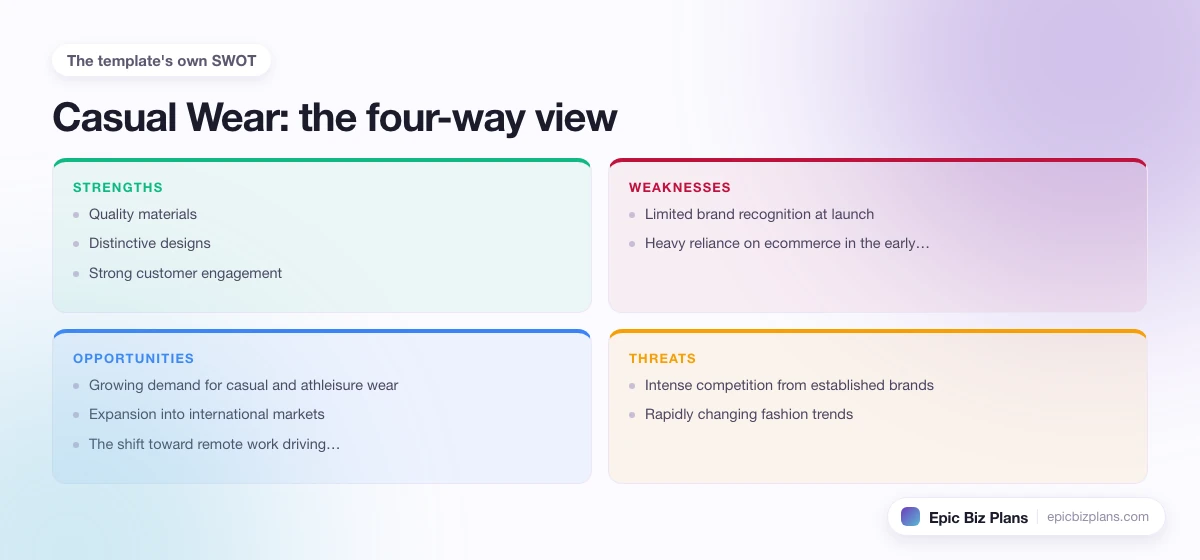
- Strengths: Quality materials, distinctive designs, strong customer engagement.
- Weaknesses: Limited brand recognition at launch, heavy reliance on eCommerce in the early stages.
- Opportunities: Growing demand for casual and athleisure wear, expansion into international markets, and the shift toward remote work driving consistent demand for comfortable clothing.
- Threats: Intense competition from established brands, rapidly changing fashion trends.
Casual Wear Business Name Ideas
Website
We will build our website on Shopify, which handles eCommerce operations well for fashion brands - inventory management, discount codes, and checkout flows all work cleanly at launch and scale. Squarespace is an alternative for brands that want a more editorial, look-book style presentation. Either platform supports the visual storytelling that casual wear customers expect before they buy.
Marketing Details
Our marketing strategy focuses on digital channels where our target customers spend time. We will use Semrush to identify and target high-intent keywords in the casual and everyday fashion space, and HubSpot to manage email sequences that keep existing customers engaged with new drops and promotions. TikTok ads will drive new customer acquisition by reaching the 18-to-35 demographic through short-form video content that shows the product in real everyday contexts. Founders building general apparel collections alongside casual wear lines should also review the casual clothing business plan for a closely related operational and merchandising framework.
Industry Trends
The casual wear industry has shifted decisively toward sustainable and ethically produced clothing, with more customers making brand choices based on supply chain transparency. Remote work has also sustained demand for comfortable yet presentable clothing that works across home, commute, and social settings. Personalized shopping experiences - driven by on-site recommendations and size guides - are becoming a key differentiator in online fashion retail. Entrepreneurs building within the sustainable fashion segment should also review the sustainable fashion business plan for a detailed approach to ethical sourcing, certifications, and eco-conscious brand positioning. Brands with a seasonal casual line can also plan warm-weather stock using our summer clothes business plan template.
Competitor Information
Direct competitors include established casual wear brands with strong online presence and repeat customer bases. Brands building a dedicated men's line can also study our menswear business plan template for category-specific positioning. Indirect competitors include athletic wear companies whose product lines overlap with casual and athleisure categories. Our differentiation comes from stronger design identity and customer service that larger brands cannot match at scale. Casual wear brands that want to expand into coordinated outfit curation should review the outfit business plan for a framework covering complete look retail, sustainable sourcing, and DTC positioning.
Financial Information
Startup costs cover inventory, website development, marketing, and operational expenses. We project break-even within year one, with revenue growth of 20% year-over-year thereafter. Ongoing expenses include production costs, marketing spend, and staffing as the team grows. Cash flow management is critical in the early stages - detailed monthly profit and loss reviews will guide spending decisions and flag any margin issues early.
Legal and Compliance
We will register the business, obtain all required licenses, and protect brand identity through trademark registration. Product safety compliance is a priority - especially for any items marketed toward children or active use - to maintain a trustworthy brand reputation from the start.
Operational Plan
Core operations center on materials sourcing, production oversight, and inventory management. We will build strong supplier relationships to maintain consistent product quality across seasons. Logistics will include shipping partnerships that support fast, reliable delivery - a key factor in online fashion customer satisfaction and return rates.
Common Pitfalls in Casual Wear Launches
Over-ordering inventory before validating product-market fit is the most common reason casual wear brands fail in the first year. Cash that should fund marketing ends up locked in unsold stock, and discounting to clear it damages brand positioning. Inconsistent sizing across product lines is another recurring issue - high return rates from sizing problems erode margins fast and hurt repeat purchase rates. Founders also tend to underinvest in product photography, which directly affects conversion on every channel and is rarely worth saving money on.
Contingency Planning
Key risks include supply chain disruptions, shifting consumer preferences, and margin pressure from rising production costs. Mitigation strategies include working with a diversified supplier base, monitoring trend data to anticipate demand shifts, and building a product mix that spans multiple price points to retain customers when spending tightens. Casual wear businesses that include footwear should also review the Croc business plan for size management, return rate control, and go-to-market approach for comfort-focused footwear brands. Brands looking to add denim as a core product category should also explore the denim business plan for production considerations specific to that material and the pricing expectations of denim customers.
Build Your Casual Wear Brand
Starting a casual wear business is about building something customers reach for repeatedly - not just once. The brands that grow in this space are the ones that earn genuine loyalty by delivering comfort, quality, and consistency. Whether you are launching an online boutique focused on sustainable fabrics or a streetwear label built around a specific aesthetic, the fundamentals are the same: know your customer, price your product correctly, and execute reliably.
Adapt as You Grow
Your Casual Wear business plan should evolve as the business does. New customer segments, pricing adjustments, product line extensions, and channel expansions (such as adding a focused mens garments line) all warrant updates. Treating the plan as a living document keeps it useful as a decision-making tool rather than a one-time exercise.
-
 SemrushSemrush is a platform with literally any online tool you will need to promote your business. Spy on your competitors, get search traffic, keyword research, social info, ad copies and much more. Used by most of the top online companies in the world. Besides all its tools, Semrush also has many available integrations possible with many other tools that will make your work even better.
 -
 Surfer SEOSurfer SEO is an incredibly smart AI tool that will give you exact explanations what to do in order to make your website rank better. They use hundreds of parameters, check your competitors and decide on the best course of action. Whether it be inner links, bold text, paragraphs, headers, images and much more. Surfer is a must-have in 2026.
Practical Uses of Your Plan
Use your plan to pitch potential investors or retail partners, map out your launch sequence, or apply for a business loan. A clear, specific plan communicates that you understand your market and have a credible path to profitability - which matters to anyone considering backing your brand.
Your Casual Wear business plan is 100% free - with unlimited edits, unlimited downloads, and unlimited chances to get it right. Start with the version that reflects where you are today, and update it as the business develops.
