
Carplay Business Plan Template
-
 ShopifyPut your brand on Shopify. Launch your online store with tools designed for growth and success. Ready to turn your idea into profit? Start building your e-commerce business today.
 -
 SquarespaceShowcase your brand with Squarespace’s sleek designs. Build a professional online presence with ease. Start with a template that already looks finished.
 -
 WixBring your ideas to life with Wix. Customize every aspect of your site with unmatched flexibility. Start creating your unique online space and let your creativity shine.
 -
 ElementorCraft captivating websites effortlessly with Elementor. Enjoy complete creative control without coding. Make your site stand out to your audience. Start turning your vision into reality now.
- Executive Summary
- Business Info
- Products and Services
- Target Market
- Business Model Overview
- SWOT Analysis
- Carplay Business Name Ideas
- Website
- Marketing Details
- Industry Trends
- Competitor Information
- Startup Cost Breakdown
- Legal and Compliance
- Operational Plan
- Contingency Planning
- Charting Your Path in Automotive Technology
- Adapt as the Market Evolves
- Use Your Plan
- Your Next Step
The Carplay business plan outlined here is a practical starting point for building a business in the automotive technology space - specifically around the growing aftermarket demand for Apple CarPlay integration. Connectivity has become a purchasing factor for car buyers, and the aftermarket segment serves the large installed base of vehicles that didn't come equipped with it from the factory. A clear business plan helps you define which part of this market you're entering, how you'll differentiate, and what the financial path to profitability looks like.
The automotive tech space moves quickly. New vehicle models expand native CarPlay support, while the aftermarket opportunity shifts toward installation services, compatible accessories, and software solutions. Your Carplay business plan needs to account for this pace of change - building a strategy that remains relevant as the technology evolves rather than one that depends on static market conditions.
Executive Summary
Our mission is to make seamless in-car connectivity accessible to drivers who want the CarPlay experience without purchasing a new vehicle. We will sell and install aftermarket CarPlay head units compatible with a wide range of vehicle models, backed by expert installation services and responsive customer support. In our first year, we project $500,000 in revenue across product sales and installation services, growing at 20% annually as we expand our compatible vehicle list and service footprint.
Business Info
Products and Services
Our core product line includes aftermarket CarPlay head units compatible with major vehicle brands, wiring harness adapters, and installation accessories. We offer professional installation services for customers in our local area and provide detailed installation guides and remote technical support for customers who purchase online and prefer self-installation. Software updates and firmware support are included with all hardware purchases for the first two years.
Target Market
Our primary customers are vehicle owners aged 25–50 who drive cars that are 3–15 years old - old enough to lack factory CarPlay but recent enough that the owner expects modern technology features. Secondary markets include fleet managers looking to standardize in-vehicle connectivity and car enthusiasts who modify and upgrade vehicles as a hobby. Urban markets have higher initial demand, but suburban customers with longer commutes represent strong long-term potential.
Business Model Overview
We operate on a direct-to-consumer model through our Shopify-powered e-commerce site, supplemented by partnerships with independent auto shops that offer our installation services to their existing customers. This two-channel approach gives us reach beyond our local market while keeping margins strong on direct web sales.
SWOT Analysis
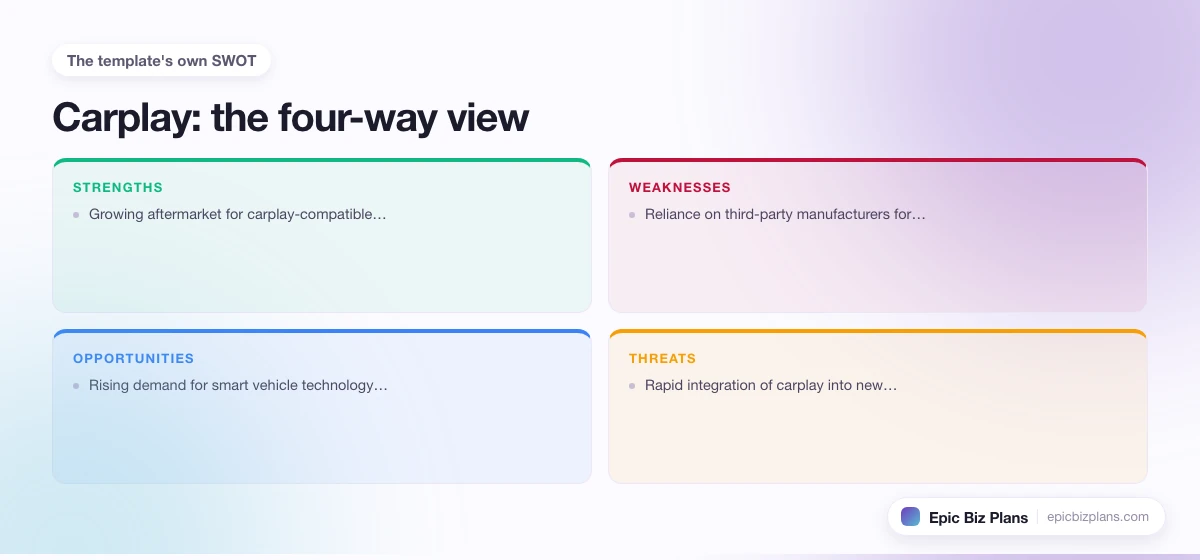
- Strengths: Growing aftermarket for CarPlay-compatible hardware; strong customer support capability; first-mover advantage in underserved regional markets.
- Weaknesses: Reliance on third-party manufacturers for hardware; potential compatibility gaps as vehicle platforms update.
- Opportunities: Rising demand for smart vehicle technology; partnerships with car dealerships and auto service chains for installation referrals.
- Threats: Rapid integration of CarPlay into new vehicles reduces long-term aftermarket demand; intense competition from established electronics brands.
Carplay Business Name Ideas
Website
We will build our e-commerce website on Shopify, which offers the product catalog management, payment processing, and app integrations needed for a hardware business selling to multiple vehicle types. A well-organized compatibility database - showing which head units work with which vehicles - will be a core feature of the site and a meaningful differentiator from competitors with generic product pages. Squarespace is an option for businesses that need a more design-forward portfolio presence, but Shopify's commerce infrastructure is better suited to the product and installation booking model.
Marketing Details
Our marketing strategy focuses on high-intent search traffic, YouTube content, and targeted social ads. We will use Semrush to identify search queries from drivers looking for CarPlay compatibility for their specific vehicle model - these high-intent searches convert well because the user already knows what they want. HubSpot will handle email sequences for customers post-purchase, including installation reminders, update notifications, and referral requests.
YouTube tutorials showing installation on specific vehicle models serve dual purposes: they build trust with prospective buyers and rank organically for vehicle-specific search queries. TikTok ads targeting car enthusiasts aged 18–34 will drive awareness and direct traffic to the site. This audience responds well to short demonstration videos showing the before-and-after of a CarPlay installation.
Industry Trends
The automotive connectivity market continues to grow as consumers expect their vehicles to integrate seamlessly with their smartphones. While newer vehicles increasingly include native CarPlay, the global vehicle fleet turns over slowly - meaning the addressable aftermarket will remain substantial for years. Electric vehicle adoption is also creating new installation opportunities, as EV owners in older-model vehicles represent a tech-forward demographic likely to invest in connectivity upgrades. Related businesses in the car audio and car accessories spaces are seeing similar demand patterns.
Competitor Information
Our main competitors include consumer electronics brands that sell CarPlay units through Amazon and big-box retailers. These competitors have strong brand recognition and distribution reach but often lack vehicle-specific technical support or professional installation services. Our strategy emphasizes three differentiators: comprehensive vehicle compatibility data on our website, in-person and remote installation support, and a two-year software update commitment that competitors rarely match.
Startup Cost Breakdown
Total startup costs are estimated at $100,000. Initial inventory - a curated selection of head units compatible with the top 20 most common vehicle models - requires approximately $55,000. Website development, Shopify setup, and the compatibility database will cost around $15,000. Marketing spend for the first quarter, including YouTube content production, TikTok ads, and SEO content, is budgeted at $20,000. The remaining $10,000 covers LLC registration, insurance, and a working capital reserve.
First-year revenue is projected at $500,000 based on 1,200 unit sales at an average order value of $350, plus installation revenue. Ongoing monthly expenses - inventory replenishment, marketing, Shopify fees, and a part-time support hire - are estimated at $30,000. The car customization business plan and gadgets business plan offer additional context for pricing and margin structures in automotive and consumer electronics.
Legal and Compliance
We will register the business as an LLC and ensure product compliance with FCC regulations for electronic devices sold in the US market. All head units sold will include CE and FCC certifications from the manufacturer. Trademark registration for our brand name and logo will be filed within the first six months. We will also review import regulations and applicable tariffs on electronic goods sourced internationally.
Operational Plan
Core operations involve inventory management, order fulfillment, technical support, and installer partnerships. We will maintain relationships with two to three manufacturers to avoid single-source dependency and respond quickly to stock shortages. Orders will be fulfilled through a third-party logistics provider once volume exceeds 100 units per month. Technical support will be handled in-house by team members with certified automotive electronics experience.
-
 SemrushSemrush is a platform with literally any online tool you will need to promote your business. Spy on your competitors, get search traffic, keyword research, social info, ad copies and much more. Used by most of the top online companies in the world. Besides all its tools, Semrush also has many available integrations possible with many other tools that will make your work even better.
 -
 Surfer SEOSurfer SEO is an incredibly smart AI tool that will give you exact explanations what to do in order to make your website rank better. They use hundreds of parameters, check your competitors and decide on the best course of action. Whether it be inner links, bold text, paragraphs, headers, images and much more. Surfer is a must-have in 2026.
Contingency Planning
Key risks include market competition from new entrants, supply chain disruptions for hardware components, and Apple's potential changes to CarPlay licensing terms. Mitigation strategies include maintaining 90-day inventory reserves for top-selling SKUs, diversifying our product mix beyond CarPlay to include Android Auto and Bluetooth upgrade units, and monitoring Apple's developer communications closely. Regular competitive analysis - quarterly at minimum - will ensure our pricing and product selection remain appropriate for current market conditions.
Charting Your Path in Automotive Technology
Building a CarPlay business requires navigating a market that sits at the intersection of consumer electronics and automotive aftermarket services. The businesses that succeed in this space tend to combine strong product curation with credible technical expertise - customers want to know the unit will work in their specific vehicle before they buy. Building that trust through vehicle-specific content, responsive support, and a solid warranty policy is more durable than competing on price alone.
Adapt as the Market Evolves
As OEM CarPlay adoption increases in new vehicles, the aftermarket opportunity will shift. Revisit your Carplay business plan each year to assess which vehicle cohorts still represent viable customers and which products are gaining or losing demand. Businesses that adapt early - adding Android Auto, wireless upgrade units, or adjacent car tech products - will build more resilient revenue streams than those that depend on a single product category.
Use Your Plan
Your Carplay business plan can serve multiple functions: it gives you a structured framework for evaluating supplier relationships, guides your marketing spend allocation, and serves as a credible document when approaching auto shops about installation partnerships. Keep it updated and treat it as a working tool rather than a one-time exercise.
Your Next Step
Your Carplay business plan is 100% free, with unlimited edits, unlimited downloads, and unlimited chances to get it right. Use it to build a business with real technical differentiation and lasting customer relationships.
