
Car Audio Business Plan Template
-
 ShopifyPut your brand on Shopify. Launch your online store with tools designed for growth and success. Ready to turn your idea into profit? Start building your e-commerce business today.
 -
 SquarespaceShowcase your brand with Squarespace’s sleek designs. Build a professional online presence with ease. Start with a template that already looks finished.
 -
 WixBring your ideas to life with Wix. Customize every aspect of your site with unmatched flexibility. Start creating your unique online space and let your creativity shine.
 -
 ElementorCraft captivating websites effortlessly with Elementor. Enjoy complete creative control without coding. Make your site stand out to your audience. Start turning your vision into reality now.
- Executive Summary
- Business Info
- Products and Services
- Target Market
- Business Model Overview
- SWOT Analysis
- Car Audio Business Name Ideas
- Website
- Marketing Details
- Industry Trends
- Competitor Information
- Financial Information
- Licensing Requirements
- Operational Plan
- Contingency Planning
- Startup Cost Breakdown
- Your Process Starts Here
- Understanding the Landscape
- Adapting Your Business Plan
- Practical Steps Ahead
- Embrace Your Potential
Starting a car audio business requires more than enthusiasm for sound - it takes a clear understanding of your market, your costs, and the kind of customer experience that keeps people coming back. The car audio industry rewards businesses that combine technical expertise with genuine customer service, whether you're running a small installation shop or building a full-scale retail and service operation. This business plan template gives you a concrete starting point, covering everything from startup costs to competitive strategy. Entrepreneurs in related sectors should also review the speaker business plan template for complementary business planning frameworks.
The most successful car audio businesses succeed because they build trust with a specific customer base - car enthusiasts, daily commuters, or fleet operators - rather than trying to serve everyone at once. Your plan should define who you're serving, what you're offering, and how you'll make the numbers work. Use this template as a foundation and adapt it to your local market conditions and the unique strengths you bring to the business.
Executive Summary
We will establish a car audio business offering high-quality audio products and professional installation services to automobile enthusiasts and everyday drivers. Our mission is to improve the in-car listening experience through carefully selected equipment and skilled, reliable installation. We aim to become the go-to car audio provider in our region, known for technical expertise and honest pricing.
Our value proposition is built on a curated product selection, certified installation technicians, and post-installation support that larger retailers rarely offer. We are targeting $500,000 in revenue within the first three years, with a path to profitability in year two driven by repeat business and referral growth.
Audio installers often expand their catalog into seat covers and gadgets, which is where an auto accessories business plan helps.
Business Info
Products and Services
Our product lineup will include speakers, subwoofers, amplifiers, head units, and complete system packages, alongside loud sound systems for home and event use from brands known for performance and durability. Installation services will range from basic head unit swaps to full custom system builds. We will also offer tune-up services for existing systems, addressing common issues like distortion, poor bass response, and integration with factory electronics.
Target Market
Our primary customers will be car enthusiasts seeking competition-grade equipment, young professionals upgrading factory sound systems, and families who want better audio for road trips. We will focus on urban and suburban areas where vehicle modification culture is established and discretionary spending on car upgrades is consistent.
Business Model Overview
Revenue will come from two sources: product sales through our retail location and e-commerce store, and service revenue from installations and system upgrades. This model allows us to capture customers at different price points - from those buying individual components online to those investing in full custom installs. Recurring service work and warranty follow-ups will support steady monthly revenue.
SWOT Analysis
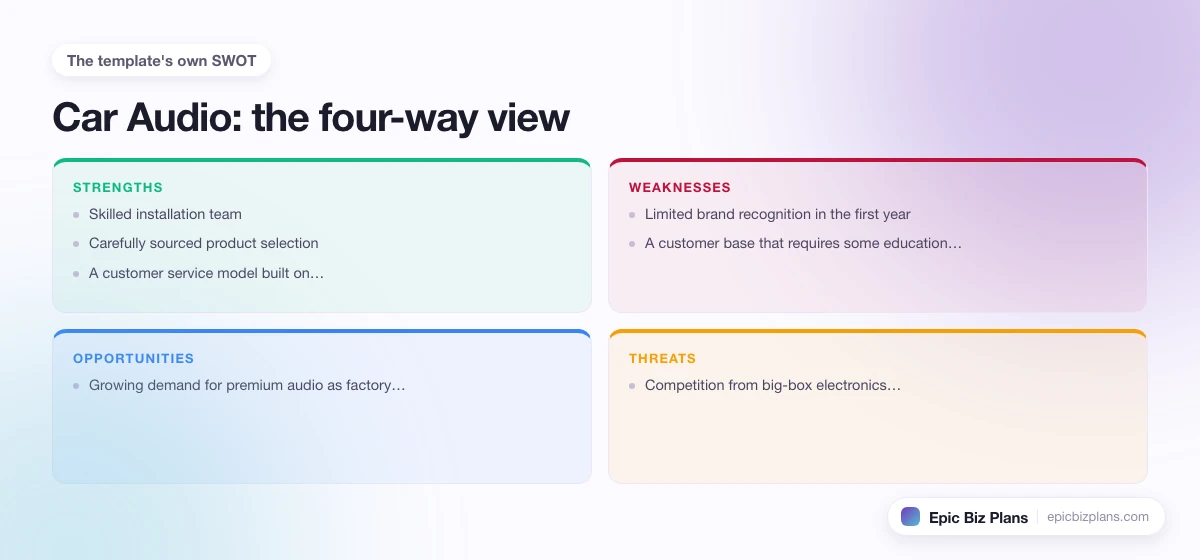
- Strengths: Skilled installation team, carefully sourced product selection, and a customer service model built on transparency and follow-through.
- Weaknesses: Limited brand recognition in the first year, and a customer base that requires some education on product differences and installation value.
- Opportunities: Growing demand for premium audio as factory systems remain mediocre in most vehicle classes; potential to partner with car dealerships for upgrade packages.
- Threats: Competition from big-box electronics retailers and online-only sellers who undercut on price; rapidly changing head unit and integration technology.
Car Audio Business Name Ideas
Website
We will build our e-commerce presence on Shopify, which handles product listings, inventory management, and payment processing in a single platform. Our site will feature a product catalog organized by category and vehicle type, making it easy for customers to find compatible equipment. A booking tool for installation appointments will be integrated directly on the site to reduce friction from inquiry to sale.
We will also use the website to publish installation guides and audio education content, which supports SEO and positions us as a credible authority in the car audio space. Customer-submitted photos of completed installs will serve as social proof alongside written reviews.
Marketing Details
Our digital marketing strategy will center on organic search and targeted social media. We will use Semrush to identify high-intent search terms related to car audio installation in our area and build content that captures that traffic. HubSpot will manage our email list, with sequences designed to nurture leads who have browsed products but haven't purchased yet.
On social media, short-form video content showing real installations - before and after audio comparisons, wiring walk-throughs, and product demonstrations - will drive engagement on TikTok and Instagram. These formats work particularly well for car audio because the product benefit is immediately audible and visual. Referral incentives will reward existing customers who bring in new business.
Industry Trends
Bluetooth connectivity and smartphone integration have become baseline expectations for car audio buyers, pushing the market toward head units with Apple CarPlay and Android Auto compatibility. DSP (digital signal processor) technology is increasingly accessible at mid-range price points, allowing for precise audio tuning without custom fabrication. Businesses that can educate customers on these technologies - and demonstrate the difference in a listening environment - convert at significantly higher rates. Founders building a related parts brand can also reference our car parts business plan template.
The shift toward electric vehicles is also creating new demand: EVs produce less ambient noise, making audio quality differences more noticeable, and many EV owners are motivated to upgrade factory systems early in ownership. Staying current on EV-specific installation requirements is worth tracking as part of our long-term product strategy.
Competitor Information
Our direct competitors are local car audio specialists and regional chains offering similar products and installation services. Big-box electronics retailers carry overlapping inventory but typically lack the installation expertise and personalized service that dedicated shops provide. Our differentiation comes from technical depth: our staff can diagnose audio problems, recommend the right solution for a given vehicle and budget, and deliver a finished install that sounds as good as it looks. Businesses selling a broader range of automotive products beyond their core category should also review the car accessories business plan template for product sourcing strategy, eCommerce setup, and safety compliance guidance.
-
 SemrushSemrush is a platform with literally any online tool you will need to promote your business. Spy on your competitors, get search traffic, keyword research, social info, ad copies and much more. Used by most of the top online companies in the world. Besides all its tools, Semrush also has many available integrations possible with many other tools that will make your work even better.
 -
 Surfer SEOSurfer SEO is an incredibly smart AI tool that will give you exact explanations what to do in order to make your website rank better. They use hundreds of parameters, check your competitors and decide on the best course of action. Whether it be inner links, bold text, paragraphs, headers, images and much more. Surfer is a must-have in 2026.
Loyalty programs, service guarantees, and a structured follow-up process after each installation will help us retain customers and generate word-of-mouth referrals that national chains can't easily replicate. Businesses in adjacent automotive services categories, such as those using a car customization business plan, often cross-refer customers and represent a strong partnership opportunity.
Financial Information
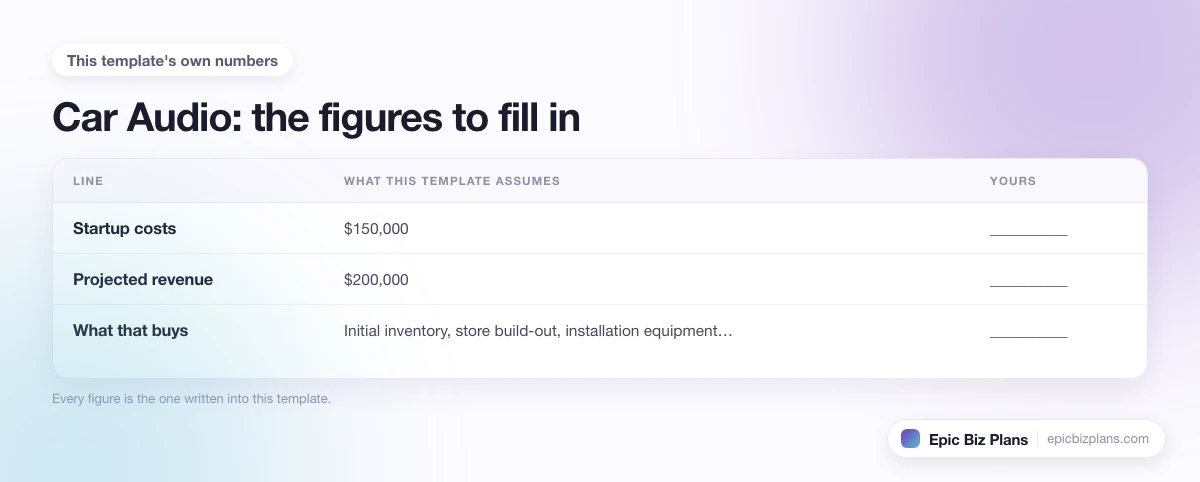
Startup costs are estimated at $150,000, covering initial inventory, store build-out, installation equipment, and first-quarter marketing spend. We project year-one revenue of $200,000, rising to $500,000 by the end of year three as brand recognition builds and installation capacity increases. Monthly operating expenses - including rent, technician salaries, utilities, and inventory replenishment - are budgeted at approximately $15,000.
Cash flow management will be critical in the early months. We will maintain a 60-day inventory buffer and track gross margin by product category to identify where to focus purchasing. Service revenue carries higher margins than product-only sales, so we will actively promote bundled install packages over standalone product purchases.
Licensing Requirements
Operating a car audio retail and installation business requires a standard business license from your city or county, along with a seller's permit if you are collecting sales tax on product sales. Shops that handle vehicle interiors and electrical systems may need an automotive services license depending on state regulations. If you plan to hire technicians, verify whether your state requires any certification for automotive electrical work.
Carrying liability insurance is essential for any business that works on customer vehicles, as damage claims during installation can be costly. We will also review our lease agreement for any commercial property requirements related to vehicle service operations before signing.
Operational Plan
Our day-to-day operations will center on the installation bay and the retail floor. Installations will be scheduled in advance with time blocks appropriate to the complexity of the job - a basic head unit install runs 1-2 hours, while a full custom system build may take a full day or more. Clear scheduling prevents bottlenecks and ensures technicians aren't rushed on complex jobs.
Product sourcing will rely on relationships with 2-3 primary distributors, with backup suppliers for high-demand items. Inventory will be tracked using the Shopify backend to align online stock levels with what's physically on the shelf. Those considering adjacent retail ventures should also review an audio installation business plan for service-specific operational considerations.
Contingency Planning
Supply chain disruptions are the most likely near-term risk, particularly for high-demand components from overseas manufacturers. We will maintain relationships with multiple distributors and keep a buffer stock of our top-selling SKUs to protect against short-term shortages. If a key product line becomes unavailable, having vetted alternatives already on our radar reduces the sales impact.
A downturn in discretionary spending would likely hit the premium segment harder than the entry-level market. We will maintain a value-oriented product tier that remains accessible even when customers are watching budgets, ensuring we don't lose foot traffic entirely during economic slowdowns. Entrepreneurs exploring the broader automotive accessories market should also review a car accessories business plan for complementary revenue ideas.
Startup Cost Breakdown
Understanding where your startup capital goes helps you prioritize spending and identify areas where costs can be phased over time. The table below reflects typical costs for a retail and installation operation:
-
ShopifyPut your brand on Shopify. Launch your online store with tools designed for growth and success. Ready to turn your idea into profit? Start building your e-commerce business today.
-
SquarespaceShowcase your brand with Squarespace’s sleek designs. Build a professional online presence with ease. Start with a template that already looks finished.
-
WixBring your ideas to life with Wix. Customize every aspect of your site with unmatched flexibility. Start creating your unique online space and let your creativity shine.
-
ElementorCraft captivating websites effortlessly with Elementor. Enjoy complete creative control without coding. Make your site stand out to your audience. Start turning your vision into reality now.
- Initial inventory (products for sale and installation): $60,000–$80,000
- Store build-out and installation bay setup: $20,000–$30,000
- Tools and installation equipment: $8,000–$12,000
- POS and e-commerce platform setup: $2,000–$4,000
- Initial marketing and branding: $5,000–$10,000
- Working capital reserve (3 months): $20,000–$30,000
Total estimated startup investment: $115,000–$166,000. Businesses that start with a smaller footprint - fewer SKUs, one installation bay - can open at the lower end of this range and scale as revenue grows. For related retail planning, you may also find value in reviewing a car parts business plan for inventory and supplier management strategies. Car audio shops looking to expand into digital connectivity upgrades should also review the CarPlay business plan for a framework on head unit sales, installation services, and vehicle compatibility marketing.
Your Process Starts Here
Car audio is a business where deep product knowledge and skilled hands make the difference between a one-time transaction and a customer who sends everyone they know to your shop. This plan gives you the framework - your job is to fill it with specifics that reflect your market, your budget, and the customer experience you want to deliver. The businesses that succeed in this space aren't the ones with the flashiest storefronts; they're the ones their customers trust.
Understanding the Landscape
From boutique installation shops focused on high-end custom builds to e-commerce operations shipping components nationwide, car audio businesses take many forms. Local installers who develop a reputation for clean, reliable work often find their schedule full within the first year through referrals alone. An online store can complement a physical operation by generating revenue when the installation bay is closed.
Adapting Your Business Plan
As you grow, revisit and update your car audio business plan to reflect what's working. If installation revenue is outpacing product sales, consider expanding your service capacity before adding more inventory. If a particular vehicle type - trucks, imports, or EVs - is generating a disproportionate share of your customers, it may be worth specializing. A living plan keeps your strategy aligned with where your business is actually heading.
Practical Steps Ahead
Use this plan as a working document - bring it to meetings with potential investors, landlords, or supplier reps who want to understand your business model. Update the financial projections as you gather real data in your first few months of operation. The clearer your plan, the easier it is to make confident decisions as opportunities and challenges emerge.
Embrace Your Potential
Your Car Audio business plan is 100% free - with unlimited edits, unlimited downloads, and unlimited chances to get it right. Build it with the same care you'd put into a custom install, and it will serve you well.
