
Card Games Business Plan Template
-
 ShopifyPut your brand on Shopify. Launch your online store with tools designed for growth and success. Ready to turn your idea into profit? Start building your e-commerce business today.
 -
 SquarespaceShowcase your brand with Squarespace’s sleek designs. Build a professional online presence with ease. Start with a template that already looks finished.
 -
 WixBring your ideas to life with Wix. Customize every aspect of your site with unmatched flexibility. Start creating your unique online space and let your creativity shine.
 -
 ElementorCraft captivating websites effortlessly with Elementor. Enjoy complete creative control without coding. Make your site stand out to your audience. Start turning your vision into reality now.
- Executive Summary
- Business Info
- SWOT Analysis
- Card Games Business Name Ideas
- Website
- Marketing Details
- Industry Trends
- Competitor Information
- Financial Information
- Legal and Compliance
- Operational Plan
- Contingency Planning
- Funding a Print Run
- Building Your Card Games Business: A Path to Doing What You Love
- Exploring the Niche
- Adapting as You Grow
- Practical Applications of Your Plan
A Card Games business plan maps how a deck-design company actually earns revenue, not just how it makes fun products. This template covers what you publish, who buys it, how you distribute, and the numbers a backer or retailer will ask about. The tabletop market is established, so the plan has to show why players and stores pick your games. Read it through once, then replace the example figures with your own.
The version below is built around an independent studio selling original card games direct, through retail, and via crowdfunding. Every section ties to a real decision: production cost, target player, distribution mix, and risk. Keep the plan short enough to revise each quarter. A plan you actually update beats a long one you never reopen.
Executive Summary
The studio designs and sells original card games for families, casual players, and dedicated hobbyists. The goal is a recognizable catalog known for sharp mechanics and solid component quality. The value proposition is well-tested designs that play well and last, sold across multiple channels. The financial target is $500,000 in first-year revenue at a 60% gross margin.
Business Info
The studio creates and distributes original card games aimed at families, casual gamers, and enthusiasts. Revenue comes from direct e-commerce sales, retail partnerships, and gaming conventions. Crowdfunding campaigns will test demand and pre-fund production before each new launch. If you plan to expand into larger boxed products, the board games business plan template covers the higher production costs and shelf logistics involved.
SWOT Analysis
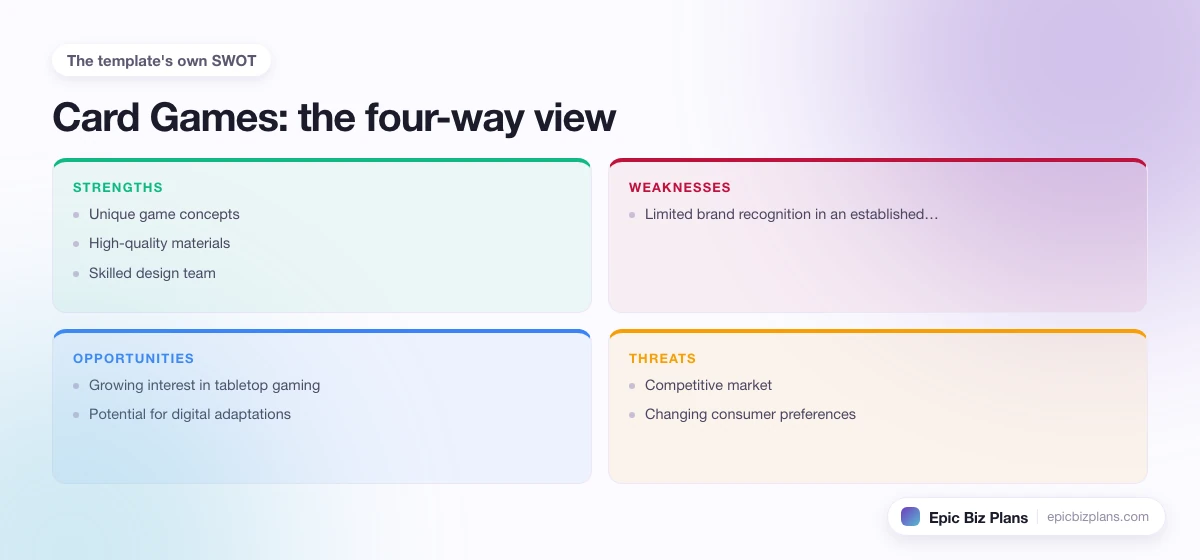
- Strengths: Unique game concepts, high-quality materials, skilled design team.
- Weaknesses: Limited brand recognition in an established market.
- Opportunities: Growing interest in tabletop gaming, potential for digital adaptations.
- Threats: Competitive market, changing consumer preferences.
Card Games Business Name Ideas
Website
The store will run on Shopify or Squarespace so checkout, inventory, and shipping work without custom code. These platforms scale from a first print run to a full catalog without a rebuild. Product pages will lead with short gameplay clips, since card games sell better when buyers see a round played. Keeping the stack simple also makes fulfillment and restocking easier to manage.
Marketing Details
Marketing combines search, email, and short-form social rather than relying on one channel. Semrush guides keyword and content work so the store earns organic traffic that does not cost per click. HubSpot runs email, from launch announcements to backer follow-ups after a campaign. Each channel gets a budget line and a target cost per sale so spend stays accountable.
TikTok ads carry the top of the funnel because short, shareable gameplay clips reach younger players well. Convention demos and local game nights build the community that drives repeat purchases. The tabletop games business plan template goes deeper on convention and community marketing if that channel is central to your launch.
Industry Trends
Tabletop gaming keeps growing, especially among younger players who want in-person social time away from screens. Online communities and streaming have made game discovery faster, which helps small studios reach buyers. Digital adaptations of physical games are a realistic add-on revenue line worth planning for; studios weighing an app or online port can compare notes with a computer games business plan template. Tracking these shifts keeps the catalog aligned with where players actually are. Card game businesses adding RPG accessories to their catalog should review the dice business plan template for a practical look at the dice market, custom set production, and the convention and community marketing channels that drive sales in this segment.
Competitor Information
Main competitors are established card game publishers and independent designers. The studio competes on original mechanics and themes that are not already crowding the market. A strong community, built through events and online interaction, raises repeat-purchase rates. Knowing where competitors are weak (slow releases, weak community) shapes the positioning. Studios that lean toward limited print runs and rarity-driven demand can also study a collectable cards business plan template for how scarcity affects pricing and resale.
Financial Information
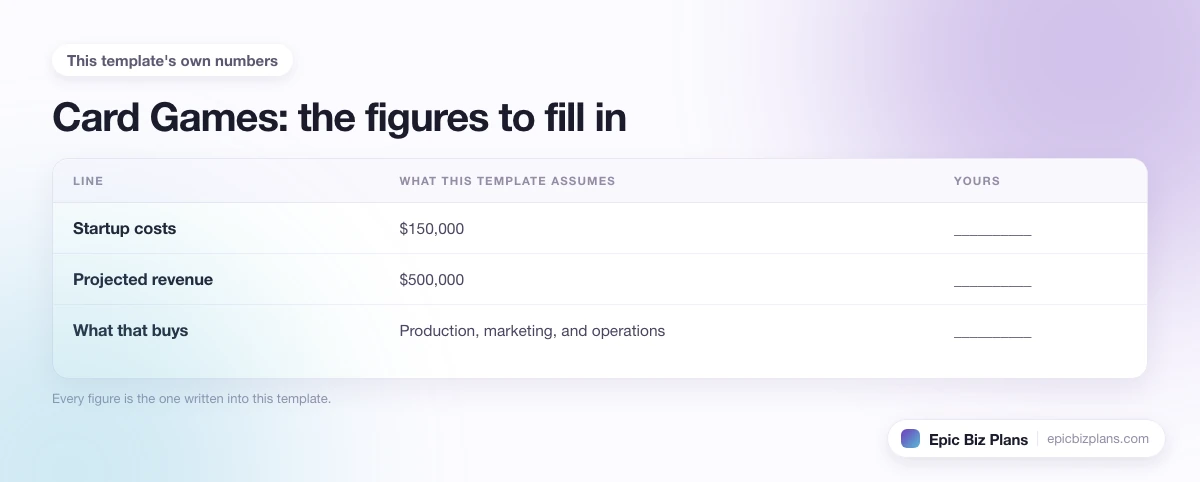
Startup costs are estimated at around $150,000, covering production, marketing, and operations. First-year revenue is projected at $500,000 with a 60% gross margin. Ongoing costs include marketing, production runs, and staffing, tracked monthly against targets. A detailed profit and loss statement is built out as volume grows.
Legal and Compliance
The studio will register the business and obtain the licenses required to publish and sell games. Intellectual property protection covers original game designs and artwork to deter copycats. Crowdfunding campaigns will follow platform rules and clear fulfillment promises. Sorting this before launch prevents disputes once a game ships at volume. For a related model, see the TCG business plan template.
Operational Plan
Operations cover sourcing components, managing print runs, and handling distribution logistics. The studio will work with fulfillment partners so order processing scales without an in-house warehouse. At least two suppliers will be qualified for critical components so one delay does not stop shipping. Quality checks happen before dispatch so defects do not reach backers. Retailers planning around supplier allocation will find that risk modelled in the Pokemon business plan.
Contingency Planning
The main risks are supply disruptions and shifts in player taste. The plan keeps diversified suppliers and gathers community feedback to adjust the catalog early. A cash reserve covers a slow quarter without emergency decisions. Flexibility in the release schedule keeps the studio responsive when a launch underperforms.
Funding a Print Run
Card game production is front-loaded: you pay the printer before you sell a single copy, so funding the run gets its own plan. Crowdfunding is the standard route because it pre-sells inventory and proves demand at the same time. Set the funding goal to cover printing, shipping, and platform fees with margin, not just unit cost. Build the fulfillment budget into the campaign from day one, since shipping is where most first-time publishers lose their profit.
Building Your Card Games Business: A Path to Doing What You Love
Starting a card games business is about identity and creativity as much as revenue. You might design original tabletop experiences, run an online store of rare finds, or host game nights that build a local following. The plan is what keeps that ambition tied to numbers that work. Pick the model that matches your capital and the time you can commit.
-
 SemrushSemrush is a platform with literally any online tool you will need to promote your business. Spy on your competitors, get search traffic, keyword research, social info, ad copies and much more. Used by most of the top online companies in the world. Besides all its tools, Semrush also has many available integrations possible with many other tools that will make your work even better.
 -
 Surfer SEOSurfer SEO is an incredibly smart AI tool that will give you exact explanations what to do in order to make your website rank better. They use hundreds of parameters, check your competitors and decide on the best course of action. Whether it be inner links, bold text, paragraphs, headers, images and much more. Surfer is a must-have in 2026.
Exploring the Niche
This space ranges from solo indie designers making custom decks to larger retailers carrying a full catalog. Card shops, subscription boxes, and digital adaptations of classic games are all viable models. The subscription box business plan template is a useful next read if recurring revenue is part of your plan. Match the model to the audience you actually want to serve.
Adapting as You Grow
The plan should change as the studio does. Update it to reflect new audiences, pricing, products, and sales channels as you learn what sells. Revising on a set schedule keeps the strategy aligned with the market. Date each revision so you can track what changed and why.
Practical Applications of Your Plan
The plan does several jobs: it briefs partners, guides launches, supports funding requests, and states your direction plainly. Keep a short version for pitching and a detailed one for running the studio. Both should pull from the same numbers so they never contradict each other. A clear plan is also a more convincing one.
The Card Games business plan template is 100% free, with unlimited edits, unlimited downloads, and unlimited chances to get it right.
