
Board Games Business Plan Template
-
 ShopifyPut your brand on Shopify. Launch your online store with tools designed for growth and success. Ready to turn your idea into profit? Start building your e-commerce business today.
 -
 SquarespaceShowcase your brand with Squarespace’s sleek designs. Build a professional online presence with ease. Start with a template that already looks finished.
 -
 WixBring your ideas to life with Wix. Customize every aspect of your site with unmatched flexibility. Start creating your unique online space and let your creativity shine.
 -
 ElementorCraft captivating websites effortlessly with Elementor. Enjoy complete creative control without coding. Make your site stand out to your audience. Start turning your vision into reality now.
- Executive Summary
- Business Info
- SWOT Analysis
- Board Games Business Name Ideas
- Website
- Marketing Details
- Industry Trends
- Competitor Information
- Financial Information
- Legal and Compliance
- Operational Plan
- Contingency Planning
- Embrace Your Passion
- Explore Your Options
- Adapt and Grow
- Put Your Plan to Work
- Your Path to Success
The board game industry has grown steadily for years, driven by crowdfunding, hobby stores, and a strong community of repeat buyers. A solid board games business plan is what turns a fun idea into a venture you can actually fund and run. The category covers design, publishing, retail, and cafe-style play spaces, and each has very different cost and revenue structures. Your plan should make clear which of those you are building and how you reach your players. For a deeper teardown, our geek business plan walks through the same kind of operational and financial detail.
The details that make or break a board game business are easy to underestimate. Manufacturing minimums, shipping heavy boxes, inventory storage, and distributor margins all eat into profit if you do not plan for them. Define your target players, your price points, and whether you sell direct, through retailers, or both. A plan grounded in those specifics is far more useful when you approach manufacturers, backers, or stores.
Executive Summary
We will create a board games business that aims to transform the tabletop gaming experience by offering a diverse range of unique and creatively engineered board games. Our vision is to become a leading provider in the board game industry, catering to both casual gamers and enthusiasts. Our value proposition lies in providing high-quality, engaging games that encourage social interaction and creativity. Brands expanding into children's educational games and toy products should also review the toys business plan template for product safety requirements and institutional sales channel strategies. For a related approach, see the card games business plan template.
We will strive for an annual growth rate of 20%, with a goal of reaching $500,000 in revenue by the end of our third year of operation.
Business Info
Our business will specialize in the design, manufacture, and retail of board games. We will target a market consisting of families, friends, and game enthusiasts aged 8 and above. Our business model will focus on direct-to-consumer sales through our website as well as partnerships with local retailers and game cafes. Creators interested in digital adaptations of their board games can explore a mini games business model for mobile and web distribution.
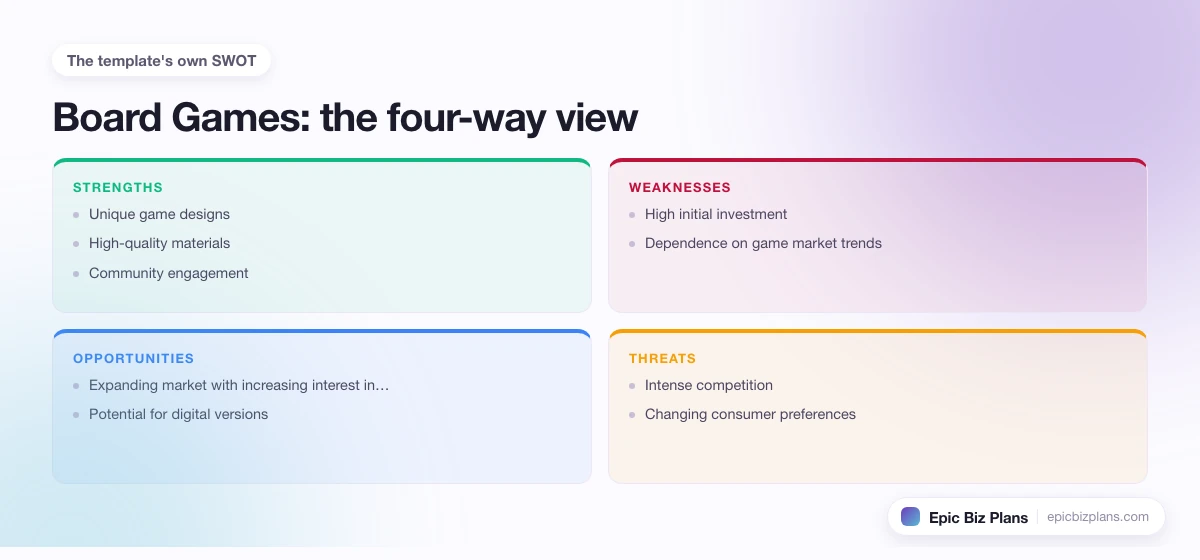
SWOT Analysis
- Strengths: Unique game designs, high-quality materials, community engagement.
- Weaknesses: High initial investment, dependence on game market trends.
- Opportunities: Expanding market with increasing interest in board games, potential for digital versions.
- Threats: Intense competition, changing consumer preferences.
Board Games Business Name Ideas
Website
For our online presence, we will build our website using Shopify or Squarespace, given their strong support for eCommerce businesses. Shopify will allow us to easily manage our products, while Squarespace offers attractive design options. Both platforms are user-friendly for non-technical developers and will support our goal of direct-to-consumer sales.
Marketing Details
Our marketing strategy will include a strong digital marketing campaign. We will use Semrush for SEO optimization to increase visibility on search engines. For customer outreach, we will implement HubSpot for email campaigns, ensuring that our audience remains engaged with our latest products and promotions.
We will also explore TikTok ads to attract younger demographics who are increasingly finding interest in board gaming through social media trends.
Industry Trends
We will monitor industry trends such as the rise of social board games, increased sales of family-friendly titles, and the integration of technology into traditional gaming experiences. Impulse-buy items such as a fidget spinner business often sell alongside these at the same hobby and gift outlets. Staying ahead of these trends will let us refresh and adapt our product offerings over time.
Competitor Information
Our main competitors will include established board game companies and indie developers. To differentiate our business, we will focus on unique storytelling and mechanics in our game designs, as well as community-building initiatives such as game nights and tournaments to enhance customer loyalty.
Financial Information
Startup costs will include game design, manufacturing, marketing, and website development, estimated at $150,000. We project annual revenue to grow to $500,000 by the third year, alongside ongoing expenses such as production costs and operational overhead, estimated at $300,000 annually. Cash flow will be maintained through effective inventory management and customer engagement strategies. Furthermore, we will develop a profit and loss statement to track our financial health regularly.
Legal and Compliance
We will register our business, obtain necessary licenses, and protect our intellectual property through trademarks and copyrights for our game designs. Compliance with local regulations regarding product safety and quality standards will also be prioritized.
Operational Plan
Key operations will include game design, partnerships with manufacturers, and logistics for distribution. We will establish a reliable supply chain, ensuring timely delivery of products to customers and retailers for a smooth experience.
Contingency Planning
Potential risks include supply chain disruptions and fluctuations in market demand. We will develop mitigation strategies such as diversifying suppliers and maintaining a flexible product line that can respond to changing consumer preferences.
Embrace Your Passion
Starting a business is about more than just profit; it’s about weaving your identity into what you create. The Board Games business plan you create could very well define your lifestyle, allowing you to immerse yourself in a culture that celebrates creativity, community, and connection. By launching this venture, you’re not just selling games; you’re offering an avenue for friends and families to bond over shared experiences and laughter.
-
 SemrushSemrush is a platform with literally any online tool you will need to promote your business. Spy on your competitors, get search traffic, keyword research, social info, ad copies and much more. Used by most of the top online companies in the world. Besides all its tools, Semrush also has many available integrations possible with many other tools that will make your work even better.
 -
 Surfer SEOSurfer SEO is an incredibly smart AI tool that will give you exact explanations what to do in order to make your website rank better. They use hundreds of parameters, check your competitors and decide on the best course of action. Whether it be inner links, bold text, paragraphs, headers, images and much more. Surfer is a must-have in 2026.
Explore Your Options
The board games niche covers several distinct models, each suited to different skills and budgets. You might open a local hobby shop and play space, run an online store focused on popular titles, or design and publish your own games. A related tabletop games business plan or a card games business plan shows how nearby categories handle production and sales. Pick the model that fits your resources, then build depth there first.
Adapt and Grow
Your board games business plan is a living document, so update it as the business grows. Revisit it when you target new audiences, test pricing, or widen your product range. If you branch into accessories, a dice business plan or a collectible business plan can show how to add complementary lines. Keeping the plan current is key to staying profitable as the market shifts.
Put Your Plan to Work
Use your board games business plan as a working tool, not a formality. Present it to partners, plan a product launch, apply for funding, or clarify your strategy. A well-structured plan helps you explain your vision and purpose clearly to anyone you pitch. Each revision sharpens both your numbers and your direction.
Your Path to Success
Your Board Games business plan is 100% free, with unlimited edits, unlimited downloads, and unlimited chances to get it right. Equip yourself with the tools to build your dream and step into a world where your passion meets opportunity.
