
Cabin Business Plan Template
-
 ShopifyPut your brand on Shopify. Launch your online store with tools designed for growth and success. Ready to turn your idea into profit? Start building your e-commerce business today.
 -
 SquarespaceShowcase your brand with Squarespace’s sleek designs. Build a professional online presence with ease. Start with a template that already looks finished.
 -
 WixBring your ideas to life with Wix. Customize every aspect of your site with unmatched flexibility. Start creating your unique online space and let your creativity shine.
 -
 ElementorCraft captivating websites effortlessly with Elementor. Enjoy complete creative control without coding. Make your site stand out to your audience. Start turning your vision into reality now.
- Executive Summary
- Business Info
- SWOT Analysis
- Cabin Business Name Ideas
- Website
- Marketing Details
- Industry Trends
- Competitor Information
- Financial Information
- Legal and Compliance
- Operational Plan
- Contingency Planning
- Additional Considerations for Cabin Rental Businesses
- Why Start a Cabin Business?
- Adapt as You Grow
- Get Started
A Cabin business plan lays the groundwork for entering the short-term rental and vacation accommodation market with a clear strategy. Cabin rentals attract travelers who want an experience that hotels, a typical guest house business, and standard vacation rentals do not provide - seclusion, nature, and a sense of place. Getting that experience right requires more planning than most first-time operators expect, and your business plan is where that planning happens before you commit capital to land, construction, or renovation.
Demand for unique cabin experiences has grown considerably as travelers move away from generic accommodation and toward destinations that feel genuinely different. The opportunity is real, but so is the competition. Your plan needs to define what makes your cabins worth choosing over the dozens of other options guests will compare you against on Airbnb, Vrbo, and direct booking searches.
Executive Summary
Our mission is to offer cabin accommodations that give guests a genuine connection with nature alongside comfort and thoughtful design. We will target nature enthusiasts, families seeking weekend getaways, and individuals looking for rest and relaxation away from urban environments. Our business model is built on short-term rental income supplemented by packages combining outdoor activities and local experiences. We aim to reach break-even within two years and maintain a 20% profit margin by year three.
Business Info
We will offer cabin rentals marketed through Airbnb, Vrbo, and our own direct booking website. Package deals that include guided outdoor activities, meals from local providers, or wellness experiences add revenue per booking and improve the overall guest experience. Our target guests are families with children, couples seeking weekend escapes, and remote workers looking for a change of scenery with reliable internet access. Owners considering tent or glamping sites can also consult a campsite business plan template.
SWOT Analysis
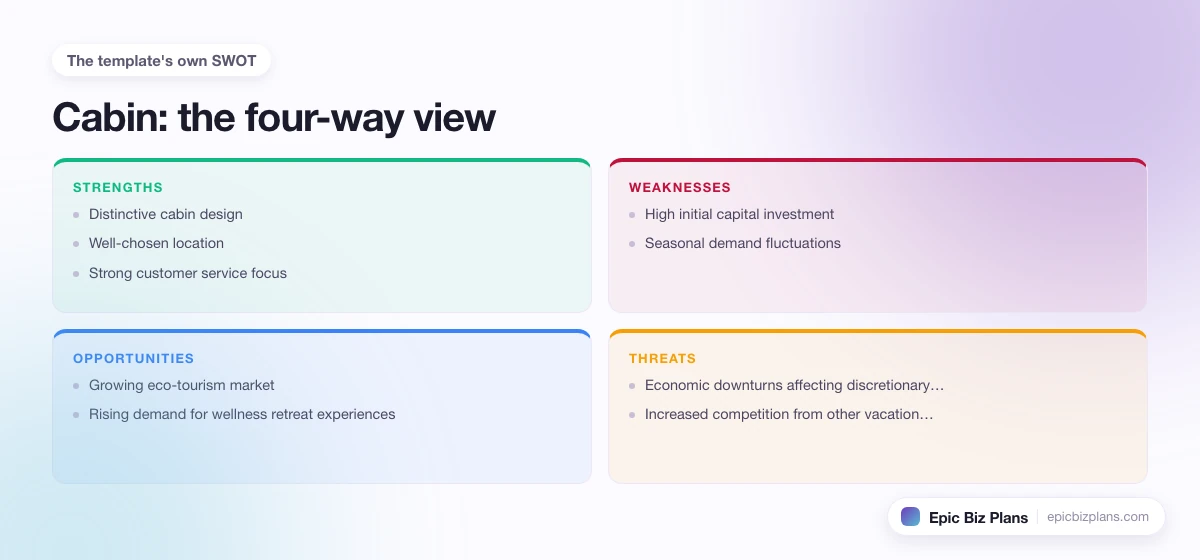
- Strengths: Distinctive cabin design, well-chosen location, strong customer service focus.
- Weaknesses: High initial capital investment, seasonal demand fluctuations.
- Opportunities: Growing eco-tourism market, rising demand for wellness retreat experiences.
- Threats: Economic downturns affecting discretionary travel, increased competition from other vacation rentals.
Cabin Business Name Ideas
Website
A direct booking website reduces your dependence on platform fees from Airbnb and Vrbo, which can significantly improve margins over time. Shopify or Squarespace both work for cabin rental sites that need booking functionality and strong visual presentation. For a property with a strong aesthetic and story, Squarespace tends to produce cleaner results without requiring custom design work. Wix is a practical option if you want something up quickly with minimal technical effort. Whichever platform you choose, professional photography of the property is the single biggest driver of bookings - invest in it before launch.
Marketing Details
SEMrush will help identify the search terms travelers use when looking for cabin rentals in your region - terms like "cabin rental [your location]" and "secluded cabin getaway [your state or region]" have high intent. Listing on major platforms is necessary for initial visibility, but building a direct booking channel through email marketing (managed through HubSpot) reduces long-term platform dependency. TikTok content showcasing the property, the surrounding area, and guest experiences reaches the younger traveler demographic effectively and often generates organic reach without paid promotion.
Industry Trends
Smart home technology is becoming standard in higher-end cabin rentals - keyless entry, smart thermostats, and reliable streaming setup are expected by guests used to modern accommodation. Eco-friendly design and sustainable practices (solar power, composting, locally sourced materials) appeal to a growing segment of travelers and also reduce operating costs over time. Remote work demand has extended the typical cabin stay from weekend trips to week-long bookings, which is a significant revenue opportunity for properties with reliable internet connectivity.
Competitor Information
Primary competition comes from other Airbnb and Vrbo listings in the same area, plus established vacation rental companies. The differentiation strategy that consistently works in this market is a compelling and specific experience - not just "a nice cabin" but "a cabin with a wood-fired hot tub, hiking trails accessible from the property, and a curated guide to local farms and restaurants." The more specific the experience you can articulate, the easier it is to stand out in platform search results and justify premium pricing.
Financial Information
Startup costs vary significantly based on whether you are building new or renovating an existing structure, and on land acquisition costs. Construction and renovation costs should include a 20% contingency budget - cabin builds almost always run over initial estimates. Revenue comes from rental bookings and activity packages. Ongoing expenses include mortgage or land payments, utilities, maintenance, property management if you are not on-site, and marketing. A detailed cash flow model for the first 24 months is critical given the seasonal nature of cabin rental income.
Legal and Compliance
Short-term rental regulations vary significantly by location - some counties and municipalities have strict limits on how many days per year a property can be rented, require specific permits, or impose lodging taxes that must be collected and remitted. Research local regulations thoroughly before purchasing or developing a property. Business registration, liability insurance, and compliance with building safety codes (smoke detectors, fire extinguishers, carbon monoxide detectors) are non-negotiable before accepting guests.
Operational Plan
Managing bookings, guest communications, cleaning turnover, and property maintenance are the core daily operations. A property management system (tools like Lodgify or Hostfully) automates booking calendar synchronization across platforms, sends automated check-in instructions, and manages guest communications. For a remote property, a reliable local cleaning and maintenance team is essential - guest satisfaction lives or dies on property condition at check-in.
Contingency Planning
Seasonal demand means cash flow can be uneven - a strong summer or fall season followed by a slow winter requires cash reserves to cover fixed costs year-round. We will build a three-month operating expense reserve before accepting first bookings. Extreme weather events (storms, flooding) are a real risk for rural properties and require adequate property insurance and a documented emergency plan for guests. A second or third cabin, once the first is cash-flow positive, diversifies both income and risk.
Additional Considerations for Cabin Rental Businesses
Guest reviews are the most important marketing asset in the short-term rental business. A property with 50 positive reviews outperforms a property with zero reviews at almost any price point. Getting those first reviews requires making the early guest experience exceptional - sometimes that means pricing below market initially, responding instantly to any issues, and going beyond what guests expect. The investment pays back compounding through better search placement and higher booking rates.
Pricing optimization in cabin rentals is more sophisticated than it used to be. Dynamic pricing tools (PriceLabs, Wheelhouse) adjust nightly rates based on demand, local events, and competitor availability. Using these tools from the start rather than setting a flat rate leaves significant revenue on the table during peak periods.
For related planning resources, see our vacation rental business plan template and cozy cabin business plan template for closely related models. The yoga retreat business plan template is useful if your cabin concept includes wellness programming. For broader hospitality planning, the RV rental business plan template covers the outdoor accommodation market from a different angle. The room rental business plan template is worth reviewing for the operational side of property management at scale.
-
 SemrushSemrush is a platform with literally any online tool you will need to promote your business. Spy on your competitors, get search traffic, keyword research, social info, ad copies and much more. Used by most of the top online companies in the world. Besides all its tools, Semrush also has many available integrations possible with many other tools that will make your work even better.
 -
 Surfer SEOSurfer SEO is an incredibly smart AI tool that will give you exact explanations what to do in order to make your website rank better. They use hundreds of parameters, check your competitors and decide on the best course of action. Whether it be inner links, bold text, paragraphs, headers, images and much more. Surfer is a must-have in 2026.
Why Start a Cabin Business?
Cabin rentals offer a real estate investment that also generates active operating income. Done well, the business produces strong returns through high occupancy at premium nightly rates, supplemented by activity packages that increase revenue per booking. The creative side - designing the space, curating the experience, building the brand - attracts founders who want to build something guests remember rather than just a generic income-producing property.
Adapt as You Grow
Your cabin business plan should evolve as you gather real data. Which guest segments book most frequently? Which platforms produce the best guests? What additional services do guests request that you are not yet offering? Update the plan to reflect what you learn, and use it as a tool for evaluating expansion decisions when you are ready to add a second property.
Get Started
Your Cabin business plan is 100% free - with unlimited edits, unlimited downloads, and unlimited chances to get it right. Use it as a planning tool from site selection through first booking and beyond.
