
Bim Business Plan Template
-
 ShopifyPut your brand on Shopify. Launch your online store with tools designed for growth and success. Ready to turn your idea into profit? Start building your e-commerce business today.
 -
 SquarespaceShowcase your brand with Squarespace’s sleek designs. Build a professional online presence with ease. Start with a template that already looks finished.
 -
 WixBring your ideas to life with Wix. Customize every aspect of your site with unmatched flexibility. Start creating your unique online space and let your creativity shine.
 -
 ElementorCraft captivating websites effortlessly with Elementor. Enjoy complete creative control without coding. Make your site stand out to your audience. Start turning your vision into reality now.
- Executive Summary
- Business Info
- Business Model Overview
- SWOT Analysis
- Business Name Ideas
- Website
- Marketing Details
- Industry Trends
- Competitor Information
- Financial Information
- Legal and Compliance
- Operational Plan
- Contingency Planning
- Put Your BIM Business Plan to Work
- Adapt and Evolve
- Practical Uses for Your BIM Business Plan
A BIM business plan is the blueprint for a building-information-modeling practice that serves architects, engineers, and contractors. This is more than a formality; it sets out how your firm will deliver coordinated 3D models, clash detection, and as-built documentation for real projects. The goal is a plan that reflects your technical approach and shows clients why your modeling work is worth paying for. Done right, it positions your services clearly against other firms competing for the same AEC contracts.
Working in BIM means handling the details of model coordination, file standards, and tight project deadlines. Your plan should be as precise as the deliverables you produce. Each decision, from the software you standardize on to the pricing you set per model, shapes whether a project earns a margin or eats into one. A focused plan keeps your strategy aligned with how the industry actually buys these services.
Executive Summary
Our mission is to deliver high-quality services that meet the needs of our customers while ensuring profitability and sustainability. We envision becoming a leading provider in our industry, recognized for our exceptional customer service and innovative solutions. Our value proposition lies in providing tailored services that solve specific problems for our clients, building long-term relationships. Our financial goals include achieving a revenue of $500,000 within the first two years of operation, with a positive cash flow by the end of year one.
Business Info
We will offer a range of services focused on enhancing customer experience and satisfaction. Our target market includes small to medium-sized businesses looking for support in operations and logistics. The following outlines our business model overview and SWOT analysis. Firms expanding from modeling into full project delivery often reference a design and construction business plan template to scope that broader role.
Business Model Overview
Our business model is primarily service-based, offering on-demand solutions tailored to the specific needs of our clients. We will implement a subscription model for ongoing services, ensuring consistent revenue while maintaining flexibility for one-time service requests.
SWOT Analysis
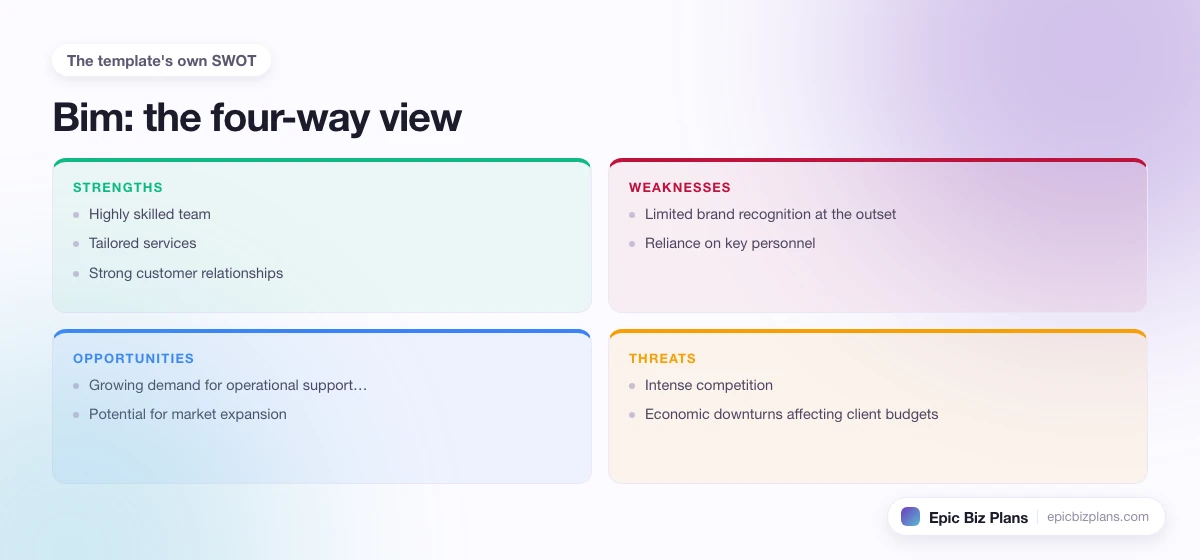
- Strengths: Highly skilled team, tailored services, strong customer relationships.
- Weaknesses: Limited brand recognition at the outset, reliance on key personnel.
- Opportunities: Growing demand for operational support services, potential for market expansion.
- Threats: Intense competition, economic downturns affecting client budgets.
Business Name Ideas
Website
We will build our website on Wix, which is user-friendly and ideal for non-savvy developers. This choice will enable us to maintain and update our site easily. Additionally, we may consider Shopify or Squarespace if we decide to implement eCommerce functionalities in the future.
Marketing Details
Our marketing strategy will focus on digital marketing and social media. We will use Semrush for SEO optimization to increase our online visibility, complemented by HubSpot for targeted email campaigns to connect with our audience effectively. We will also use TikTok ads to reach younger demographics, engaging potential customers through creative and appealing content.
Industry Trends
Current trends show significant technological advancements in automation and process optimization. Many firms are adopting AI and machine learning to improve service delivery and reduce modeling errors. Staying competitive means adopting these technologies to improve efficiency and client satisfaction. Drafting-focused studios upgrading to full BIM workflows often start from a drafting business plan template before adding model coordination services.
Competitor Information
We will analyze both main and indirect competitors within our industry. Key strategies for differentiation will include our personalized service offerings, competitive pricing, and exceptional customer support. Building a strong brand presence and establishing ourselves as recognized specialists will also be important in standing out among competitors. Practices that also offer load and structural analysis can compare scope with a structural engineering business plan template.
Financial Information
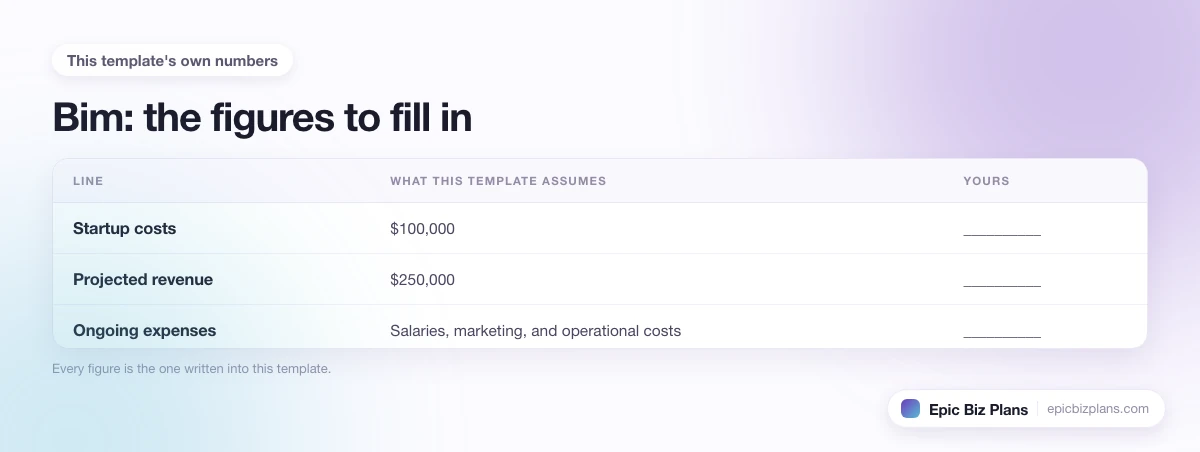
We anticipate startup costs to be approximately $100,000, which will cover equipment, marketing, and initial staffing. Projected revenue within the first year is estimated to reach $250,000 with growth in subsequent years. Ongoing expenses will include salaries, marketing, and operational costs. We will maintain a detailed cash flow statement and a Profit & Loss statement to track our financial health.
Legal and Compliance
We will ensure compliance with legal requirements including business registration, obtaining necessary licenses, and intellectual property protection. We will work with legal advisors to safeguard our brand and services from potential infringements.
Operational Plan
Our operational framework will include efficient supply chain management and logistics to ensure timely delivery of services. This will involve key partnerships with vendors and service providers to enhance our service offerings and simplify operations.
Contingency Planning
We will address potential risks such as economic downturns and competitive pressures by diversifying our service portfolio and establishing an emergency fund. Additionally, we will develop risk mitigation strategies, including contingency marketing campaigns and operational adjustments to adapt to market changes.
Put Your BIM Business Plan to Work
A BIM practice rewards precision and consistency, and your plan should reflect both. Whether you run a small modeling studio or a firm offering full coordination across disciplines, the work ranges from clash detection to detailed as-built documentation. Each service line you add should earn its place in your plan and in your project pipeline. Clients in the AEC space pay for reliability, so build that promise into how you describe your offering. A clear plan keeps your scope and your pricing honest.
Adapt and Evolve
As you start, remember that your BIM business plan is not a static document. It should grow as you adjust to different clients, test new pricing models, expand your service lines, or move into new project types. Frequent updates keep your strategy current and useful. Firms moving toward on-site delivery often pair the plan with a building construction business plan template.
-
 SemrushSemrush is a platform with literally any online tool you will need to promote your business. Spy on your competitors, get search traffic, keyword research, social info, ad copies and much more. Used by most of the top online companies in the world. Besides all its tools, Semrush also has many available integrations possible with many other tools that will make your work even better.
 -
 Surfer SEOSurfer SEO is an incredibly smart AI tool that will give you exact explanations what to do in order to make your website rank better. They use hundreds of parameters, check your competitors and decide on the best course of action. Whether it be inner links, bold text, paragraphs, headers, images and much more. Surfer is a must-have in 2026.
Practical Uses for Your BIM Business Plan
The applications of your business plan are wide. Whether you are presenting to potential partners, planning a launch, securing funding, or clarifying your strategy, every section moves you closer to your goals.
Take ownership and make this process yours, knowing that your BIM business plan is 100% free, with unlimited edits, unlimited downloads, and unlimited chances to get it right. The work ahead is demanding, but a solid plan makes it manageable.
