
Bubble Tea Business Plan Template
-
 ShopifyPut your brand on Shopify. Launch your online store with tools designed for growth and success. Ready to turn your idea into profit? Start building your e-commerce business today.
 -
 SquarespaceShowcase your brand with Squarespace’s sleek designs. Build a professional online presence with ease. Start with a template that already looks finished.
 -
 WixBring your ideas to life with Wix. Customize every aspect of your site with unmatched flexibility. Start creating your unique online space and let your creativity shine.
 -
 ElementorCraft captivating websites effortlessly with Elementor. Enjoy complete creative control without coding. Make your site stand out to your audience. Start turning your vision into reality now.
- Executive Summary
- Business Info
- SWOT Analysis
- Bubble Tea Business Name Ideas
- Website
- Marketing Details
- Industry Trends
- Competitor Information
- Financial Information
- Legal and Compliance
- Operational Plan
- Contingency Planning
- Startup Cost Breakdown
- Embrace Your Passion with a Bubble Tea Business Plan
- Explore Diverse Business Models
- Refine Your Vision
- Take the Next Step
Bubble tea has become one of the most successfully globalized specialty beverages of the past two decades, moving from a niche Taiwanese export to a mainstream drink category with dedicated shops in every major market. Entrepreneurs interested in a complementary seasonal hot beverage format should also review the hot cocoa stand business plan template, which covers stand setup, seasonal pricing, and event-based location strategy for artisan warm drink businesses. The business model is relatively accessible - lower capital requirements than a full restaurant, a product that photographs well and markets itself on social media, and strong customer loyalty once you find your core audience. Entrepreneurs building in the functional and energy tea segment should also review our loaded tea business plan template for a framework covering the loaded tea market specifically.
The challenge is that the market is increasingly crowded. In most urban areas, there are now multiple established bubble tea chains competing with independent shops. Differentiation needs to be deliberate from the start: better ingredients, more interesting flavor innovation, faster service, a superior in-store experience, or a combination of these. A business plan that does not address specifically how you will stand out from existing competitors is not yet ready.
Executive Summary
Our mission is to build the best independent bubble tea brand in our market - one that regulars choose over chains because of demonstrably better ingredients, more interesting menu innovation, and a store environment that is worth visiting rather than just passing through. Our vision is a profitable, community-rooted business with strong daily customer loyalty and a clear path to a second location by year three. We will target $500,000 in first-year revenue at an estimated 200 customers per day and a $6–$8 average ticket, achieving profitability within the first year of operation.
Business Info
Our menu will center on traditional milk teas, fruit teas, and taro-based drinks, with seasonal specials and a rotating innovation menu that gives regular customers a reason to try something new each visit. All toppings - tapioca pearls, popping boba, jelly, grass jelly - will be made or sourced fresh daily rather than pre-packaged. Customization will be offered across sweetness level, ice level, and topping combinations without adding meaningful wait time through a streamlined prep workflow. For businesses pairing bubble tea with a broader Asian-inspired menu, the green tea business plan template provides complementary product and brand positioning guidance.
SWOT Analysis
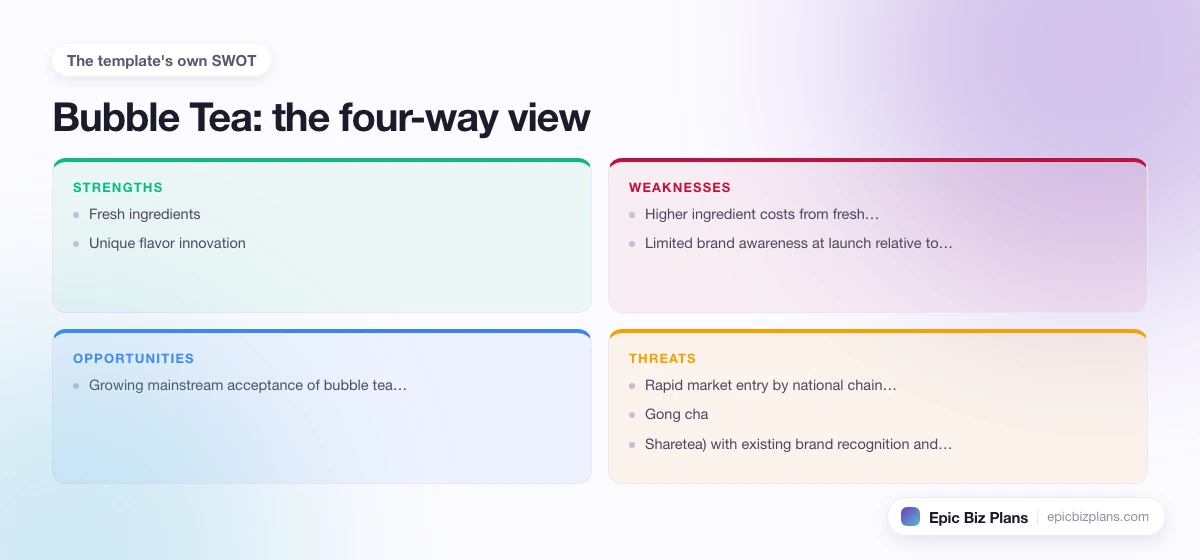
- Strengths: Fresh ingredients, unique flavor innovation, and a streamlined service model that maintains quality at high volume.
- Weaknesses: Higher ingredient costs from fresh preparation vs. pre-packaged alternatives, and limited brand awareness at launch relative to established chains.
- Opportunities: Growing mainstream acceptance of bubble tea across age demographics beyond the original teen/young adult core market.
- Threats: Rapid market entry by national chain competitors (Tiger Sugar, Gong Cha, Sharetea) with existing brand recognition and supply chain advantages.
Bubble Tea Business Name Ideas
Website
We will build our ordering platform on Shopify with a dedicated online ordering integration for pickup and delivery. The website will prioritize mobile experience - the majority of bubble tea customers are under 35 and order primarily from mobile. Product photography is critical for a bubble tea brand because the visual appeal of the drinks drives social sharing and influences first-time orders significantly. We will invest in professional photography for every core menu item before launch and plan for quarterly photo updates when seasonal specials launch. For founders weighing related options, our bobba business plan template covers the relevant structure in detail.
Marketing Details
TikTok and Instagram are the primary acquisition channels for a bubble tea brand targeting teens and young adults. Short-form video content - tapioca pearl prep, drink builds, first-sip reactions, customer testimonials - consistently outperforms static imagery for beverage brands on these platforms. We will post three to five times per week on Instagram and four to six times per week on TikTok in the first six months. Influencer collaborations with local food content creators (10,000–100,000 followers) typically outperform larger macro-influencer campaigns for local businesses because the audience is more geographically concentrated. A loyalty app or punch card will be implemented from day one - bubble tea customers who return weekly are the financial backbone of the business. For a broader beverage business framework that complements this plan, the loaded tea business plan template covers an adjacent specialty drinks category worth reviewing.
Industry Trends
Bubble tea is successfully expanding its demographic beyond its original teen and young adult core into older demographics who are now familiar with the product. Health-conscious bubble tea variants - lower-sugar options, fresh fruit teas, matcha-based drinks, dairy-free alternatives - are among the fastest-growing menu segments. Premium positioning (using higher-quality tea bases, real fruit, artisan toppings) is gaining market share against the lower-cost, pre-packaged ingredient model used by many national chains. Subscription and pre-purchase models are also emerging - monthly flavor memberships and pre-loaded digital wallets improve customer retention and provide the business with more predictable cash flow. Operators expanding into non-carbonated iced beverages can also review an ice tea business plan for organic, non-dairy cold drink positioning. For a related Asian-inspired beverage concept, the tea time business plan template covers the specialty tea café model in detail.
Competitor Information
Direct competitors include national bubble tea chains (Gong Cha, Tiger Sugar, Kung Fu Tea, Sharetea) and existing independent bubble tea shops in the target market. Operators considering a wider beverage product mix should also review the soda business plan for craft beverage launch and co-packing details. Indirect competition comes from specialty coffee shops, smoothie bars, fresh-squeezed stands following a lemonade business plan, and other specialty beverage concepts. Our competitive strategy focuses specifically on fresh ingredient quality - a claim that national chains cannot make because their supply chain depends on pre-packaged, shelf-stable ingredients. We will make this difference visible and verifiable to customers through behind-the-counter transparency and daily freshness timestamps on key ingredients. Entrepreneurs considering a broader specialty tea concept alongside or instead of bubble tea should review the tea house business plan template for retail and café hybrid models that complement a bubble tea operation.
Financial Information
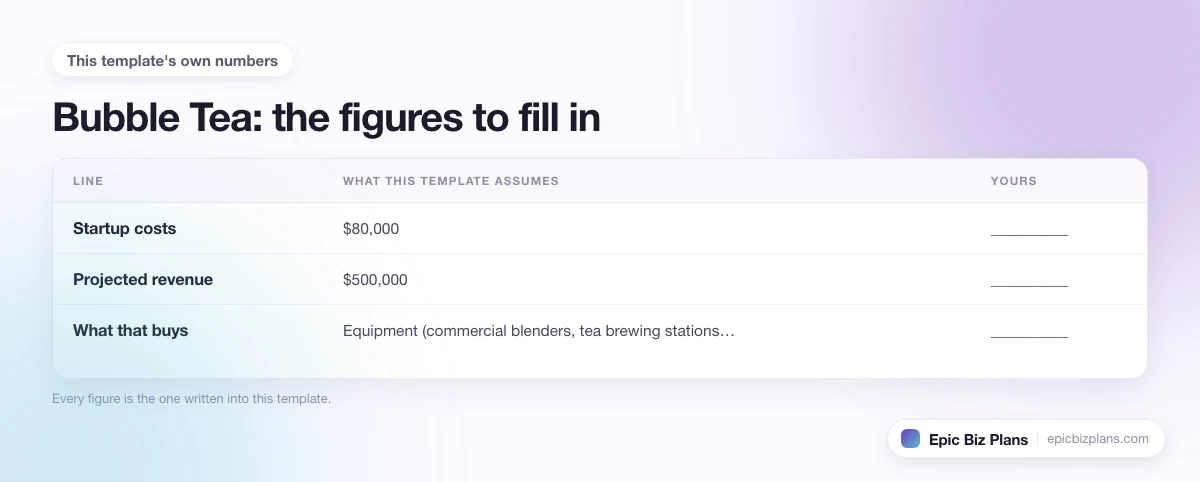
Startup costs are projected at $80,000–$120,000 covering equipment (commercial blenders, tea brewing stations, refrigeration), lease deposit, initial inventory, branding, and marketing. Revenue target is $500,000 in year one based on 200 customers per day at an average ticket of approximately $7. Cost of goods for a bubble tea business typically runs 28–35% of revenue. Labor runs 30–35%. Combined with rent (10–15%) and other operating costs, the target operating margin at full capacity is 15–20%. The financial model is volume-dependent - achieving target customer counts quickly is essential for unit economics to work. Weekend and after-school traffic are the highest-volume periods and should be planned for from an operational staffing standpoint. For comparison against another specialty drinks business model, the fresh juice business plan template provides a useful parallel for high-volume beverage operations.
Legal and Compliance
A bubble tea shop requires a food establishment license, food handler permits for all staff, and health department inspection approval before opening. If using imported tea base products, ensure they comply with FDA import regulations - this is a common compliance issue for shops sourcing directly from Taiwanese or Chinese suppliers. Business registration, sales tax, and workers' compensation insurance are standard requirements. Trademark your brand name and logo before any significant marketing investment.
Operational Plan
Operational consistency is the most important daily execution priority. Customers who visit twice a week expect the same drink to taste the same every time - any variation in pearl texture, sweetness, or tea strength generates negative reviews and reduces retention. Standard operating procedures for every drink and topping will be documented, trained, and monitored through regular quality checks. Peak-hour staffing (after school 3–6 PM, weekends 12–4 PM) requires two to three staff members at minimum to maintain service speed under 3 minutes per drink. Inventory management must track daily usage rates to prevent both stockouts on popular items and waste on slow-moving toppings.
Contingency Planning
Key risks are a supply chain disruption for tapioca pearls or tea base (which can have multi-week lead times from Asian suppliers), a competitor opening directly adjacent to the shop, and a negative food safety incident. Tapioca pearl supply risk is mitigated by maintaining 30 days of inventory and having a domestic backup supplier on file. A new competitor is managed through accelerated loyalty program enrollment and menu innovation that highlights fresh-ingredient differentiation. Food safety incidents require an immediate documented response - clean all equipment, test all ingredients, notify health authorities as required, and communicate transparently with customers. Hiding a food safety issue is always worse than addressing it directly.
Startup Cost Breakdown
Bubble tea shops have moderate startup costs relative to full restaurants, primarily because the kitchen equipment requirements are simpler and the menu does not require full commercial cooking infrastructure.
- Commercial equipment (blenders, tea brewers, refrigeration, sealing machine): $20,000–$35,000
- Lease deposit and initial rent: $6,000–$15,000
- Store fit-out and interior design: $15,000–$30,000
- Branding, signage, and packaging design: $5,000–$10,000
- Initial ingredient inventory: $5,000–$8,000
- Marketing and launch: $5,000–$10,000
- Operating reserve (3 months): $15,000–$25,000
- Total estimated startup range: $71,000–$133,000
Embrace Your Passion with a Bubble Tea Business Plan
A bubble tea business built on genuine ingredient quality and operational discipline has real competitive advantages over chain competitors who prioritize cost efficiency over customer experience. The customers who become your daily regulars - and they will, if you earn it - are more valuable than any advertising campaign. Your business plan is the framework that ensures you are building toward that outcome systematically rather than hoping for it.
Explore Diverse Business Models
Within bubble tea, there are meaningful model variations: a sit-down café experience versus a high-throughput counter service model versus a food truck or kiosk format. Each has different capital requirements, customer capacity, and average ticket dynamics. Your business plan should reflect which model you are actually pursuing and why it is the right choice for your specific location and target market.
-
 SemrushSemrush is a platform with literally any online tool you will need to promote your business. Spy on your competitors, get search traffic, keyword research, social info, ad copies and much more. Used by most of the top online companies in the world. Besides all its tools, Semrush also has many available integrations possible with many other tools that will make your work even better.
 -
 Surfer SEOSurfer SEO is an incredibly smart AI tool that will give you exact explanations what to do in order to make your website rank better. They use hundreds of parameters, check your competitors and decide on the best course of action. Whether it be inner links, bold text, paragraphs, headers, images and much more. Surfer is a must-have in 2026.
Refine Your Vision
Review your business plan at 90 days, 6 months, and 12 months post-launch, comparing actual customer counts, average ticket, and cost percentages against your projections. The businesses that succeed are those that use real data to make real adjustments, not those that wait for the numbers to eventually match the original plan.
Take the Next Step
Your Bubble Tea business plan is 100% free - with unlimited edits, unlimited downloads, and unlimited chances to get it right. Use the support available to you, stay motivated, and watch your dreams turn into reality.
