
Bobba Business Plan Template
-
 ShopifyPut your brand on Shopify. Launch your online store with tools designed for growth and success. Ready to turn your idea into profit? Start building your e-commerce business today.
 -
 SquarespaceShowcase your brand with Squarespace’s sleek designs. Build a professional online presence with ease. Start with a template that already looks finished.
 -
 WixBring your ideas to life with Wix. Customize every aspect of your site with unmatched flexibility. Start creating your unique online space and let your creativity shine.
 -
 ElementorCraft captivating websites effortlessly with Elementor. Enjoy complete creative control without coding. Make your site stand out to your audience. Start turning your vision into reality now.
- Executive Summary
- Business Info
- SWOT Analysis
- Bobba Business Name Ideas
- Website
- Marketing Details
- Industry Trends
- Competitor Information
- Financial Information
- Startup Cost Breakdown
- Legal and Compliance
- Operational Plan
- Contingency Planning
- Building Your Bobba Brand
- Business Opportunities in the Bobba Space
- Adapt and Evolve Your Bobba Business Plan
- Use Your Plan for Real Outcomes
A Bobba business plan turns interest in this fast-growing beverage category into a real shop with a defined menu, daily operations, and a steady stream of repeat customers. The bobba (boba) market continues to expand as a younger demographic adopts the format and chains keep the category in front of new audiences. Your plan should describe exactly what you serve, how you source ingredients, and how you handle the operational challenges of fresh tea, perishable toppings, and peak-hour throughput.
Treat the document as the operating handbook for the first 12 months. Menu engineering, supplier choices, and station layout are easier to set up before you sign the lease, not after.
Executive Summary
Our mission is to provide high-quality bobba drinks to our community, with consistent recipes and an experience that earns repeat visits. We aim to become the local destination for bobba lovers, recognized for our flavor selection, ingredient quality, and dependable service. Our value proposition is a customizable menu that delivers consistent drinks across every shift. Financially, we aim to reach break-even within the first year and grow steadily through new menu items, repeat business, and a small online ordering channel.
Business Info
We are opening a bobba tea shop with a focused menu of classic and seasonal drinks. Our target customers are young adults and teenagers looking for a reliable spot for an afternoon or evening drink, plus families and remote workers who want a comfortable seating option. The model combines walk-in sales, mobile ordering for pickup, and limited delivery through third-party platforms. Founders weighing closely related concepts may also reference a bubble tea business plan template for a wider category view.
SWOT Analysis
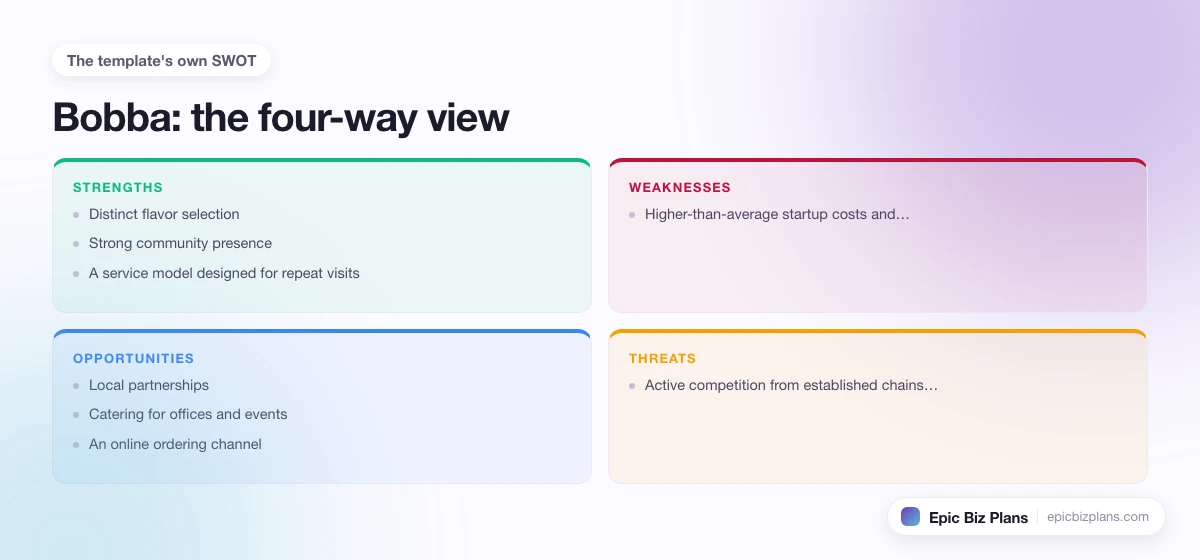
- Strengths: Distinct flavor selection, strong community presence, and a service model designed for repeat visits.
- Weaknesses: Higher-than-average startup costs and reliance on consistent foot traffic.
- Opportunities: Local partnerships, catering for offices and events, and an online ordering channel.
- Threats: Active competition from established chains and shifting consumer preferences.
Bobba Business Name Ideas
Website
We will build the website on Shopify so the same backend supports retail packs, gift cards, and online ordering for pickup. The site features the full menu, a clear store hours block, and a loyalty signup form. We keep the design simple so customers can place an order from a phone in under a minute.
Marketing Details
Our marketing combines local SEO, paid social, and a tight loyalty program. We use Semrush for local keyword work and on-page SEO. HubSpot manages email campaigns to existing customers segmented by purchase frequency.
For top-of-funnel reach we run TikTok and Instagram ads showing drink builds, behind-the-counter clips, and seasonal menu launches. The category responds well to short-form video, and rising chains in this space have proven the channel can drive real foot traffic. Founders running adjacent beverage formats can compare notes with a loaded tea business plan template.
Industry Trends
The bobba market continues to grow steadily, with shoppers asking for healthier base options, lower-sugar syrups, and plant-based dairy alternatives. Sourcing has improved as more suppliers ship directly to U.S. shops, and tech platforms have made online ordering and loyalty programs accessible to small operators. We watch for shifts in topping trends - popping pearls, jellies, and seasonal specials - and rotate the menu accordingly.
Competitor Information
We will analyze direct competitors (other bobba shops, regional chains) and indirect competitors (coffee shops and juice bars). Our differentiation comes from three things: a tighter menu that lets us train staff to consistency, sourcing decisions that show up in flavor, and a community presence at local events.
Financial Information
Startup costs include the lease deposit, equipment, build-out, initial inventory, and a launch marketing budget. Revenue is modeled on a clear daily ticket count and average order size, with seasonality built into the forecast. We track cash flow weekly during the launch phase and review the P&L monthly with attention to gross margin per drink category.
Startup Cost Breakdown
- Lease and build-out: $40,000–$80,000 depending on the location and condition of the space.
- Equipment: $25,000–$45,000 for tea brewers, sealers, refrigeration, blenders, and POS hardware.
- Initial inventory: $5,000–$10,000 covering tea, milk, syrups, toppings, cups, and packaging.
- Permits and licensing: $2,000–$5,000 depending on location.
- Marketing and launch: $5,000–$10,000 to cover signage, opening promotion, and initial paid social.
- Working capital: Three to six months of operating costs held in reserve.
Legal and Compliance
We will secure all required food service permits and complete the local health department inspections before opening. Staff handling food and drink will hold current food handler certifications, and we will follow proper allergen labeling for non-dairy and other substitutions.
Operational Plan
Daily operations cover opening and closing checklists, inventory cycle counts, tea brewing schedules, and station cleaning. We will use a single POS that integrates with online orders, loyalty, and inventory, so the team has one place to track everything during a shift. Founders running a similar service-bar concept can reference a tea and coffee business plan template for cross-applicable operational details.
Contingency Planning
Risks include supplier delays for tapioca pearls and specialty syrups, equipment failure during peak hours, and shifting consumer preferences. We mitigate with backup suppliers, a service contract on key equipment, and a quarterly menu review that adds and retires items based on real sales data.
Building Your Bobba Brand
A bobba shop is more than a place to sell drinks - it’s a small, repeat-business operation built on consistency, service, and the right menu for the neighborhood. Whether you envision a single location, a small chain, or an e-commerce extension that sells retail packs and merchandise, the plan you build now sets the working pace for everything that follows.
Business Opportunities in the Bobba Space
The model has room for many shapes. You can run a tight cafe-style shop, a mall kiosk with high throughput, a mobile truck that travels to community events, or a brand built around DIY bobba kits sold online. Each has its own margin profile and operational rhythm.
-
 SemrushSemrush is a platform with literally any online tool you will need to promote your business. Spy on your competitors, get search traffic, keyword research, social info, ad copies and much more. Used by most of the top online companies in the world. Besides all its tools, Semrush also has many available integrations possible with many other tools that will make your work even better.
 -
 Surfer SEOSurfer SEO is an incredibly smart AI tool that will give you exact explanations what to do in order to make your website rank better. They use hundreds of parameters, check your competitors and decide on the best course of action. Whether it be inner links, bold text, paragraphs, headers, images and much more. Surfer is a must-have in 2026.
Adapt and Evolve Your Bobba Business Plan
As your shop grows, revisit and refine the plan. Update pricing, menu items, sourcing decisions, and the marketing budget as you learn what your customers actually buy. A plan that gets edited every quarter stays useful.
Use Your Plan for Real Outcomes
Your bobba business plan is a working tool. Use it to present to partners, plan a launch, secure funding, or clarify your strategy. Each iteration brings you closer to the shop you want to run.
Your bobba business plan is 100% free - with unlimited edits, unlimited downloads, and unlimited chances to get it right.
