
Bubble Business Plan Template
-
 ShopifyPut your brand on Shopify. Launch your online store with tools designed for growth and success. Ready to turn your idea into profit? Start building your e-commerce business today.
 -
 SquarespaceShowcase your brand with Squarespace’s sleek designs. Build a professional online presence with ease. Start with a template that already looks finished.
 -
 WixBring your ideas to life with Wix. Customize every aspect of your site with unmatched flexibility. Start creating your unique online space and let your creativity shine.
 -
 ElementorCraft captivating websites effortlessly with Elementor. Enjoy complete creative control without coding. Make your site stand out to your audience. Start turning your vision into reality now.
- Executive Summary
- Business Info
- Products and Services
- Target Market
- Business Model Overview
- SWOT Analysis
- Website
- Menu Development and Ingredient Sourcing
- Marketing Details
- Industry Trends
- Competitor Information
- Financial Information
- Legal and Compliance
- Operational Plan
- Contingency Planning
- Building Your Bubble Tea Brand
- Adapt and Evolve
- Practical Applications
A Bubble business plan provides the roadmap for launching a bubble tea shop or beverage brand in one of the fastest-growing segments of the specialty drink market. Bubble tea has moved well beyond its origins in Taiwan to become a mainstream beverage category in cities worldwide. A solid plan addresses everything from menu development and ingredient sourcing to location selection and customer acquisition.
The bubble tea market rewards operators who combine product quality with strong branding and efficient operations. Your plan needs to account for the costs of premium ingredients, the logistics of perishable inventory, and the marketing strategies that drive foot traffic and online orders. This is a competitive category, but the demand is real and growing.
Executive Summary
Our mission at Bubble is to deliver a refreshing and customizable beverage experience built around high-quality bubble tea and related drinks. We will establish a brand known for creative flavor combinations, premium organic ingredients, and a welcoming in-store atmosphere. Our commitment to sustainability in sourcing and packaging will differentiate us from competitors who prioritize speed over quality.
Our financial targets include reaching $500,000 in annual revenue by the end of year one and achieving a 20% profit margin by year three. We plan to open a second location within five years, building Bubble into a recognized regional brand in the specialty beverage space.
Business Info
Products and Services
Bubble will specialize in made-to-order bubble tea with a menu of over 30 flavor combinations, including classic milk teas, fruit teas, and specialty seasonal drinks. Toppings will include tapioca pearls, popping boba, jelly, and pudding. We will also offer smoothie bowls and light snacks to complement the drink menu. Those building a similar concept around tea-based beverages should review a bubble tea business plan for category-specific operational details.
Target Market
Our primary customers are adults aged 18-35 who frequent specialty coffee and tea shops. Secondary markets include families and health-conscious consumers looking for alternatives to sugary sodas and energy drinks. We will target urban and suburban locations with high foot traffic near universities, shopping centers, and transit hubs. Founders weighing a sit-down format over a grab-and-go counter can compare a tea house business plan for layout and dwell-time considerations.
Business Model Overview
We will operate a hybrid model combining in-store service with online ordering for pickup and delivery through platforms like DoorDash and Uber Eats. The in-store experience will be designed for social media sharing, with visually appealing drink presentations and photo-friendly interior design.
SWOT Analysis
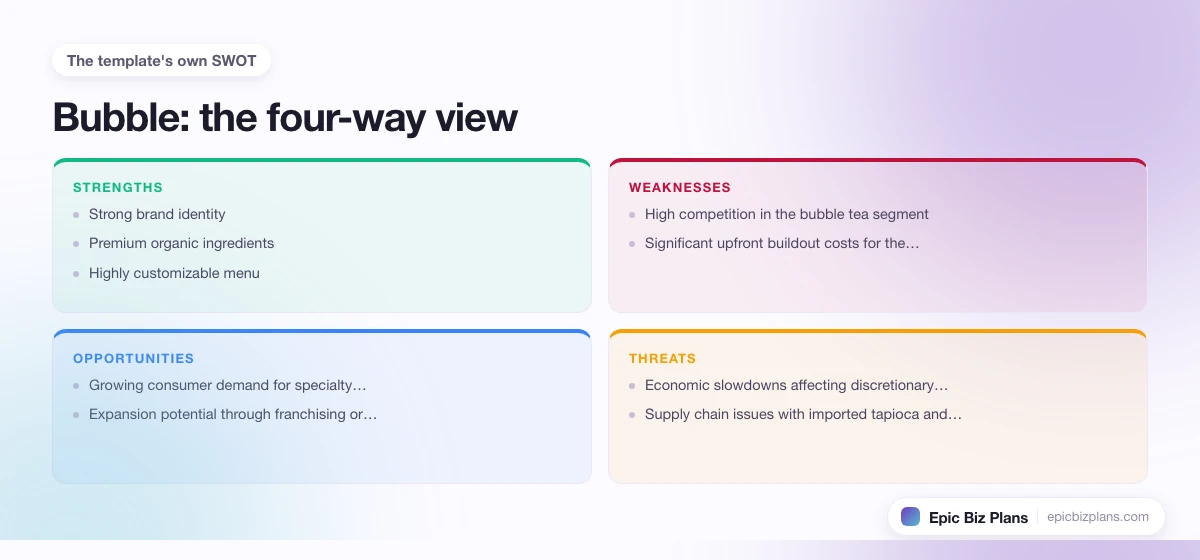
- Strengths: Strong brand identity, premium organic ingredients, highly customizable menu.
- Weaknesses: High competition in the bubble tea segment, significant upfront buildout costs for the first location.
- Opportunities: Growing consumer demand for specialty beverages, expansion potential through franchising or additional locations.
- Threats: Economic slowdowns affecting discretionary spending, supply chain issues with imported tapioca and specialty ingredients.
- Bubble Bliss
- Tea Oasis
- Bubble Haven
- Sip and Swirl
- Tea Fusion
- Bubble Burst
- Flavor Float
- Bubbly Delights
- Tastewave Teas
- BubbleCraze
Website
We will build our website on Shopify to support online ordering, merchandise sales, and gift card purchases. Shopify integrates with delivery platforms and provides the inventory management tools needed for a food and beverage operation. The site will feature our full menu, store location and hours, and a loyalty program signup.
Menu Development and Ingredient Sourcing
Our menu will be organized into four categories: Classic Milk Teas, Fruit Tea Refreshers, Specialty Blends, and Seasonal Limited Editions. Each drink will be available in three sweetness levels and with ice customization. We will source tea leaves from suppliers in Taiwan and Thailand, tapioca pearls from a certified organic producer, and fresh fruit from local distributors.
Average drink cost will range from $5.50 to $8.50, with a target cost of goods sold (COGS) of 25-30 percent. Topping add-ons at $0.75-$1.50 each will provide additional margin. Operators exploring complementary drink categories might also benefit from a smoothie bowl business plan for menu expansion ideas.
Marketing Details
Our marketing strategy centers on social media and local community engagement. Instagram and TikTok will be our primary channels, featuring drink-making videos, customer testimonials, and behind-the-scenes content. We will use Semrush for local SEO to rank for searches like "bubble tea near me" and HubSpot for email campaigns promoting new menu items and loyalty rewards.
Grand opening promotions, student discounts, and a buy-10-get-1-free loyalty card will drive initial customer acquisition. We will allocate $2,000-$3,000 per month to paid social ads during the first six months, scaling back as organic traffic and word-of-mouth referrals grow. Businesses in related beverage categories like green tea operations use similar social-first marketing approaches.
Industry Trends
The global bubble tea market is projected to exceed $4 billion by 2027, driven by consumer interest in customizable and visually appealing beverages. Health-conscious variations using plant-based milks, reduced sugar options, and functional ingredients like collagen and matcha are gaining traction. Operators leaning into that demand can study a matcha-focused business plan for sourcing and menu positioning around premium green tea powders. Technology adoption in ordering, including app-based customization and contactless payment, is now expected rather than optional.
Sustainability is also becoming a competitive factor, with consumers favoring shops that use biodegradable cups, reusable straws, and responsibly sourced ingredients. Brands that lead on sustainability attract a loyal customer base willing to pay a small premium.
Competitor Information
Competitors range from national chains like Kung Fu Tea and Tiger Sugar to independent local shops. National chains compete on brand recognition and consistency, while local shops often win on uniqueness and community connection. We will position Bubble in the premium segment, competing on ingredient quality, customization depth, and store experience rather than price.
-
 SemrushSemrush is a platform with literally any online tool you will need to promote your business. Spy on your competitors, get search traffic, keyword research, social info, ad copies and much more. Used by most of the top online companies in the world. Besides all its tools, Semrush also has many available integrations possible with many other tools that will make your work even better.
 -
 Surfer SEOSurfer SEO is an incredibly smart AI tool that will give you exact explanations what to do in order to make your website rank better. They use hundreds of parameters, check your competitors and decide on the best course of action. Whether it be inner links, bold text, paragraphs, headers, images and much more. Surfer is a must-have in 2026.
Financial Information
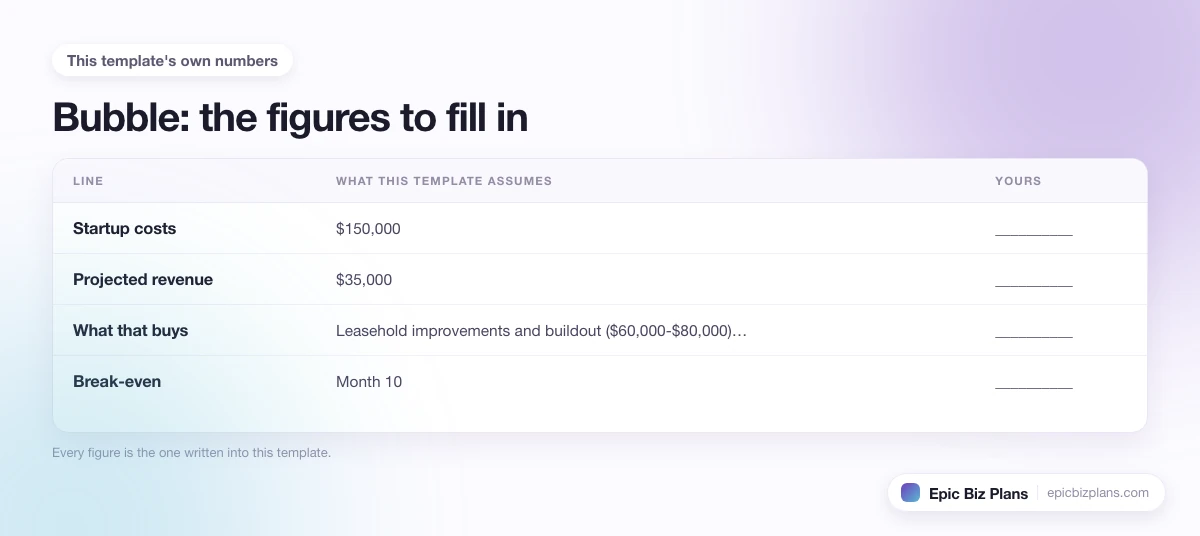
Startup costs are estimated at $150,000, covering leasehold improvements and buildout ($60,000-$80,000), equipment including sealing machines, refrigeration, and POS systems ($20,000-$30,000), initial inventory ($10,000-$15,000), branding and marketing launch ($10,000-$15,000), and working capital ($15,000-$20,000). Monthly operating expenses including rent, labor, ingredients, and marketing will run $25,000-$30,000.
At an average ticket of $7.50 and 150-200 transactions per day, monthly revenue should reach $35,000-$45,000 by month six. We project breakeven at month 10-12 and a health drink product extension could add 15-20 percent in revenue once the core operation stabilizes.
Legal and Compliance
We will register as an LLC, obtain a food service permit, health department certification, and business license. Compliance with local health codes, FDA food labeling requirements for any packaged products, and ADA accessibility standards for the physical location are mandatory. We will carry general liability and product liability insurance, with coverage reviewed annually.
Operational Plan
Daily operations include opening prep (cooking tapioca, cutting fresh fruit, brewing tea bases), service during operating hours, closing cleanup, and inventory counts. We will staff with one manager and three to four baristas per shift, cross-training all team members on every station. Ingredient deliveries will be scheduled twice weekly from local suppliers and bi-weekly for imported specialty items.
Quality control will include daily taste tests of tea bases and weekly reviews of customer feedback from Google Reviews and delivery platform ratings.
Contingency Planning
Primary risks include tapioca supply disruptions (the primary ingredient is imported from Southeast Asia), lease renewal uncertainty, and seasonal demand fluctuations. We will maintain a 30-day tapioca inventory buffer, negotiate lease terms with renewal options, and develop seasonal promotions to smooth revenue across slower months. If delivery platform fees erode margins, we will invest in our own ordering app to shift customers to direct ordering.
Building Your Bubble Tea Brand
A Bubble business plan is about transforming a popular beverage trend into a sustainable local business. The combination of a customizable product, strong visual branding, and community engagement creates a formula that works across markets. Whether you start with a single kiosk or a full storefront, the planning process determines how quickly you reach profitability and how effectively you can scale.
Adapt and Evolve
Keep your Bubble business plan current as you learn from real customer data. Adjust your menu based on sales patterns, refine your marketing based on what actually drives traffic, and update your financial projections as costs and revenue become clearer. The plan should grow with your business.
Practical Applications
Use your Bubble business plan to negotiate lease terms, apply for small business loans, pitch to potential investors, or simply keep your team aligned on priorities. A clear plan saves time and reduces costly mistakes during the launch phase.
Your Bubble business plan is 100% free, with unlimited edits, unlimited downloads, and unlimited chances to get it right. Start building your beverage brand today.
-
ShopifyPut your brand on Shopify. Launch your online store with tools designed for growth and success. Ready to turn your idea into profit? Start building your e-commerce business today.
-
SquarespaceShowcase your brand with Squarespace’s sleek designs. Build a professional online presence with ease. Start with a template that already looks finished.
-
WixBring your ideas to life with Wix. Customize every aspect of your site with unmatched flexibility. Start creating your unique online space and let your creativity shine.
-
ElementorCraft captivating websites effortlessly with Elementor. Enjoy complete creative control without coding. Make your site stand out to your audience. Start turning your vision into reality now.
