
Bridge Business Plan Template
-
 ShopifyPut your brand on Shopify. Launch your online store with tools designed for growth and success. Ready to turn your idea into profit? Start building your e-commerce business today.
 -
 SquarespaceShowcase your brand with Squarespace’s sleek designs. Build a professional online presence with ease. Start with a template that already looks finished.
 -
 WixBring your ideas to life with Wix. Customize every aspect of your site with unmatched flexibility. Start creating your unique online space and let your creativity shine.
 -
 ElementorCraft captivating websites effortlessly with Elementor. Enjoy complete creative control without coding. Make your site stand out to your audience. Start turning your vision into reality now.
- Executive Summary
- Business Info
- SWOT Analysis
- Bridge Business Name Ideas
- Website and Product
- Marketing Details
- Industry Trends
- Competitor Information
- Financial Information
- Startup Cost Breakdown
- Legal and Compliance
- Operational Plan
- Contingency Planning
- Build the Infrastructure Others Depend On
- Explore What Bridge Models Support
- Treat the Plan as a Living Document
- Get Started Today
A Bridge business is built on a powerful and durable concept: connecting parties who need each other but currently lack a reliable pathway to work together. Whether that means a software platform that links service providers to clients, a marketplace that connects buyers to specialized suppliers, or a consulting firm that bridges the gap between enterprise technology and practical implementation, bridge-model businesses address a genuine coordination problem in their market. A well-structured Bridge business plan helps you define exactly what gap you are closing, who benefits, and how the business captures value from that connection.
This template is designed for founders building any bridge-model business: digital platforms, marketplace businesses, integration services, or professional intermediaries. Use it to articulate your value proposition, map your revenue model, and build a financial plan that reflects the specific dynamics of a two-sided or coordination-focused business.
Executive Summary
Our mission is to build a platform that reliably connects small businesses and professionals with the tools, services, or partners they need to operate more effectively. We will deliver our solution through a subscription-based model that creates predictable recurring revenue while building a growing network of connected users on both sides of the marketplace. Our target customers are small businesses, freelancers, and professionals who currently rely on fragmented, manual processes to find or coordinate with service providers. We target break-even within the first year and meaningful profit margins by year three as network effects strengthen the platform's value and reduce customer acquisition costs.
Business Info
Our core product is a subscription platform that simplifies discovery, communication, and transaction management between small business users and the service providers or resources they depend on. We will launch with a focused use case (connecting a specific buyer and seller segment) before expanding to adjacent categories. Our primary revenue model is monthly subscriptions, with premium tiers that open up advanced features, priority matching, and analytics tools. For businesses building a technology-first integration or API-driven bridge between enterprise systems, our API business plan provides a technical product framework for connectivity-focused businesses.
SWOT Analysis
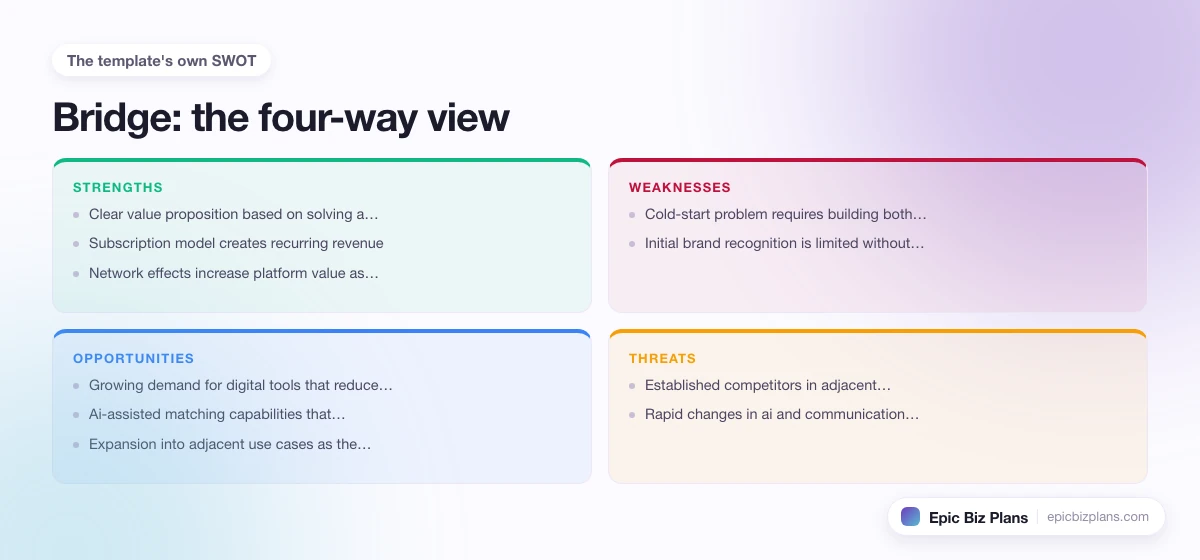
- Strengths: Clear value proposition based on solving a genuine coordination problem, subscription model creates recurring revenue, and network effects increase platform value as user base grows.
- Weaknesses: Cold-start problem requires building both sides of the marketplace simultaneously, and initial brand recognition is limited without significant early marketing investment.
- Opportunities: Growing demand for digital tools that reduce friction in B2B and professional service markets, AI-assisted matching capabilities that improve connection quality over time, and expansion into adjacent use cases as the platform establishes credibility in the initial segment.
- Threats: Established competitors in adjacent categories may expand into our target segment, and rapid changes in AI and communication technology require ongoing product investment to remain competitive.
Bridge Business Name Ideas
Website and Product
We will build our marketing and acquisition site on Wix or WordPress, with the core platform built on a scalable cloud infrastructure that can handle growing user volumes without significant re-engineering. The product experience needs to deliver value to both sides of the bridge quickly: a platform where one side sees no activity loses the other side within days. We will design the onboarding flow to surface immediate utility for new users, rather than requiring them to wait for network effects to develop. A blog and content library will be maintained to drive organic search traffic from users researching solutions to the coordination problem we solve.
Marketing Details
Platform businesses require a two-sided acquisition strategy that builds both user segments in parallel. For our primary user segment (buyers or service seekers), we will use content marketing and SEO to capture users actively searching for solutions, combined with targeted LinkedIn and TikTok advertising to reach our professional demographic. Semrush will guide keyword research and competitive analysis. HubSpot will manage email nurture sequences that move free trial users toward paid subscriptions and existing subscribers toward premium tiers. For the supply side of the platform (service providers or sellers), we will use direct outreach and professional association partnerships to build an early cohort of quality providers whose presence attracts buyers. Founders building complementary freelance or professional service businesses that could integrate with a bridge platform should review our freelance business plan for service positioning and client acquisition frameworks that apply to platform supply-side participants.
Industry Trends
The platform economy continues to grow as businesses increasingly prefer on-demand access to specialized resources over building internal capabilities. AI is transforming platform matching: algorithms that connect the right buyer with the right provider based on behavior, history, and feedback data are becoming a genuine competitive differentiator rather than a feature luxury. Remote work normalization has expanded the addressable market for digital bridge businesses beyond geographic constraints for the first time, enabling platforms to build meaningful scale without a local physical presence. Subscription fatigue is a real counter-trend to monitor: platforms that deliver measurable, recurring value justify their subscriptions; those that are nice-to-have rather than essential face high churn. For technology-focused bridge businesses building software consulting or digital transformation services alongside their platform, our software consulting business plan provides complementary go-to-market and service design frameworks.
Competitor Information
Direct competitors include established marketplace and platform businesses that partially address the same coordination problem. Indirect competitors are the manual processes and relationships that users currently rely on instead of a platform solution: email threads, spreadsheets, and personal referral networks. Our differentiation strategy focuses on depth of solution in a specific segment rather than trying to out-feature broad-based competitors. We will monitor competitor feature releases and pricing changes quarterly and position ourselves around the specific use case we solve better than anyone else. Building strong customer success practices (ensuring users actually achieve the outcomes they signed up for) will be our most durable competitive advantage. Tech and digital businesses building complementary service models can find useful positioning frameworks in our technology solutions business plan.
Financial Information
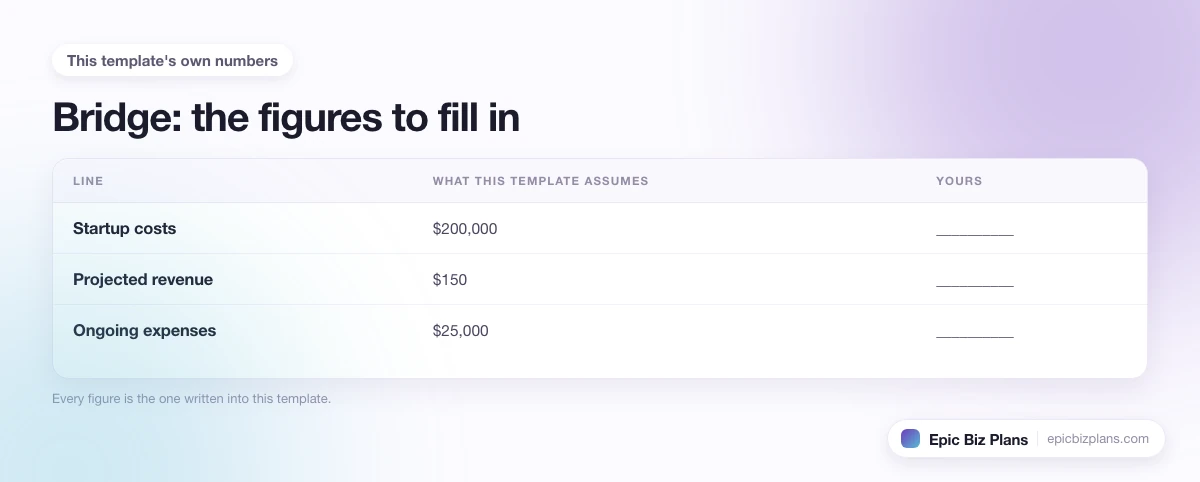
Startup costs are estimated at $200,000, covering platform development, initial marketing, team salaries for the first six months, and operating infrastructure. Revenue will build through subscription growth: we target 200 paying subscribers at an average monthly revenue of $150 by month 12, generating $360,000 in annual recurring revenue. Year three targets 1,500 subscribers with improved conversion rates from a maturing content and referral engine, generating approximately $2.7 million in ARR. Monthly operating expenses are projected at $25,000 in year one, including engineering, customer success, marketing, and infrastructure. We will track monthly recurring revenue (MRR), churn rate, and customer acquisition cost (CAC) as the primary financial health metrics alongside the standard P&L.
Startup Cost Breakdown
Platform businesses require upfront investment in product development and customer acquisition before subscription revenue becomes self-sustaining. Here is a realistic cost breakdown for a bridge platform launch.
- Platform development (MVP build): $80,000
- Team salaries (first 6 months, 2-3 people): $60,000
- Marketing and initial user acquisition: $25,000
- Cloud infrastructure and software tools: $10,000
- Legal, IP registration, and compliance: $8,000
- Website, branding, and content: $7,000
- Operating reserve (3 months): $10,000
Total estimated startup investment: $200,000. Platform development is the largest cost driver, building an MVP that validates the core connection mechanism before investing in advanced features is the highest-use decision in early stage platform development. Avoid building features that are untested by real users.
Legal and Compliance
We will register the business as an LLC and establish terms of service, privacy policy, and data processing agreements that meet applicable consumer and business data protection regulations (GDPR, CCPA where relevant). If our platform facilitates financial transactions between parties, payment processing compliance and escrow regulations will require specific legal structuring. Intellectual property protections will be established for our brand, platform code, and any proprietary matching algorithms. We will consult with a technology startup attorney before launch to ensure our user agreements adequately address liability for platform-facilitated interactions.
Operational Plan
Operations will center on three functions: product development, customer success, and marketplace quality management. The product team will maintain a two-week sprint cadence, prioritizing features based on user feedback and retention data. Customer success will proactively contact new subscribers during their first 30 days to ensure they are achieving value from the platform. Marketplace quality management will involve reviewing provider profiles and user feedback to maintain the signal-to-noise ratio that makes the bridge genuinely useful. We will use HubSpot for all customer communication tracking and Semrush for ongoing SEO and content performance monitoring. For bridge businesses that also provide consulting or advisory services alongside the platform, our strategy consulting business plan outlines service model design, client engagement structures, and consulting revenue frameworks that complement subscription-based platform income.
Contingency Planning
The primary risks are slow platform adoption, high early churn, and technology infrastructure failures. Slow adoption will be addressed by shortening the sales cycle through a free trial that demonstrates value before asking for a credit card. High churn will be monitored through weekly cohort analysis and addressed through proactive customer success outreach at the first sign of disengagement. Infrastructure failures will be mitigated through redundant cloud hosting, automated backups, and an incident response plan that prioritizes transparent communication with affected users. We will review our contingency plan quarterly as the platform scales and new operational risks emerge.
Build the Infrastructure Others Depend On
The most valuable bridge businesses become infrastructure, platforms that their user base depends on so deeply that switching costs become prohibitive. That level of entrenchment does not happen by accident. It is built through consistent reliability, genuine value delivery, and a product roadmap that keeps solving real problems rather than adding features for their own sake. Start by solving one coordination problem exceptionally well, and expand from there.
-
 SemrushSemrush is a platform with literally any online tool you will need to promote your business. Spy on your competitors, get search traffic, keyword research, social info, ad copies and much more. Used by most of the top online companies in the world. Besides all its tools, Semrush also has many available integrations possible with many other tools that will make your work even better.
 -
 Surfer SEOSurfer SEO is an incredibly smart AI tool that will give you exact explanations what to do in order to make your website rank better. They use hundreds of parameters, check your competitors and decide on the best course of action. Whether it be inner links, bold text, paragraphs, headers, images and much more. Surfer is a must-have in 2026.
Explore What Bridge Models Support
Bridge businesses take many forms: two-sided marketplaces, API integration services, professional network platforms, managed service intermediaries, and software tools that replace manual coordination processes. Each has different margin profiles, regulatory considerations, and competitive dynamics. For businesses building a learning or knowledge-transfer platform that bridges educators and learners, our learning platform business plan covers curriculum design, user acquisition, and subscription model specifics for education-focused bridge businesses. Tech-focused founders building AI-driven coordination platforms will also find useful product and go-to-market frameworks in our tech business plan.
Treat the Plan as a Living Document
Your Bridge business plan is a starting point, not a final answer. Platform businesses evolve faster than most: user behavior, competitive dynamics, and technology capabilities all shift quickly. Review your plan monthly in the first year, update your financial projections with actual MRR and churn data, and revise your product roadmap based on what users are actually doing versus what you assumed they would do at launch.
Get Started Today
This Bridge business plan is 100% free, with unlimited edits and unlimited downloads. Use it to communicate your vision to investors, guide your product development decisions, and build the bridge business you have been planning.
