
API Business Plan Template
-
 ShopifyPut your brand on Shopify. Launch your online store with tools designed for growth and success. Ready to turn your idea into profit? Start building your e-commerce business today.
 -
 SquarespaceShowcase your brand with Squarespace’s sleek designs. Build a professional online presence with ease. Start with a template that already looks finished.
 -
 WixBring your ideas to life with Wix. Customize every aspect of your site with unmatched flexibility. Start creating your unique online space and let your creativity shine.
 -
 ElementorCraft captivating websites effortlessly with Elementor. Enjoy complete creative control without coding. Make your site stand out to your audience. Start turning your vision into reality now.
- Executive Summary
- Business Info
- Business Model Overview
- SWOT Analysis
- Business Name Ideas
- Website
- Marketing Details
- Industry Trends
- Competitor Information
- Developer Onboarding and Documentation Strategy
- Financial Information
- Legal and Compliance
- Infrastructure and Scaling Strategy
- Operational Plan
- Contingency Planning
- Build Your API Business
- Keep Iterating
- Put Your Plan to Work
- Get Started
An API business plan outlines how to build a company around application programming interfaces, one of the most in-demand products in the software industry. Businesses across every sector need APIs to connect their systems, process payments, manage data, and automate workflows. If you can deliver reliable, well-documented API solutions, you have a strong foundation for a profitable tech company.
Your API business plan should go beyond a high-level overview. Detail your target customers, your technical architecture, your pricing tiers, and how you will handle support and documentation. The API market is competitive, so your plan needs to clearly explain what sets your product apart and why developers and businesses will choose your solution over existing options.
Executive Summary
We will establish a business focused on providing Application Programming Interface (API) solutions that serve multiple industries. Our mission is to simplify integration processes for businesses, improving connectivity across platforms. We aim to be recognized for reliability, strong documentation, and responsive customer support.
Our value proposition is delivering adaptable APIs tailored to specific client needs. Financially, we target profitability within the first two years, with a growth goal of 30% annually after that.
Business Info
We will offer a range of API services including data integration, payment processing, and cloud-based solutions. Our target market includes software developers, startups, and mid-size businesses looking to add functionality to their applications without building everything from scratch. API businesses that also build marketplace or bridge platforms on top of their integrations should review our bridge business plan for two-sided platform design, subscription pricing models, and network effect strategy.
Business Model Overview
We will operate on a subscription-based model with tiered pricing based on usage volume and feature access. This ensures predictable recurring revenue while accommodating clients of different sizes. A free tier with limited API calls will serve as a lead generation tool to convert developers into paying customers.
SWOT Analysis
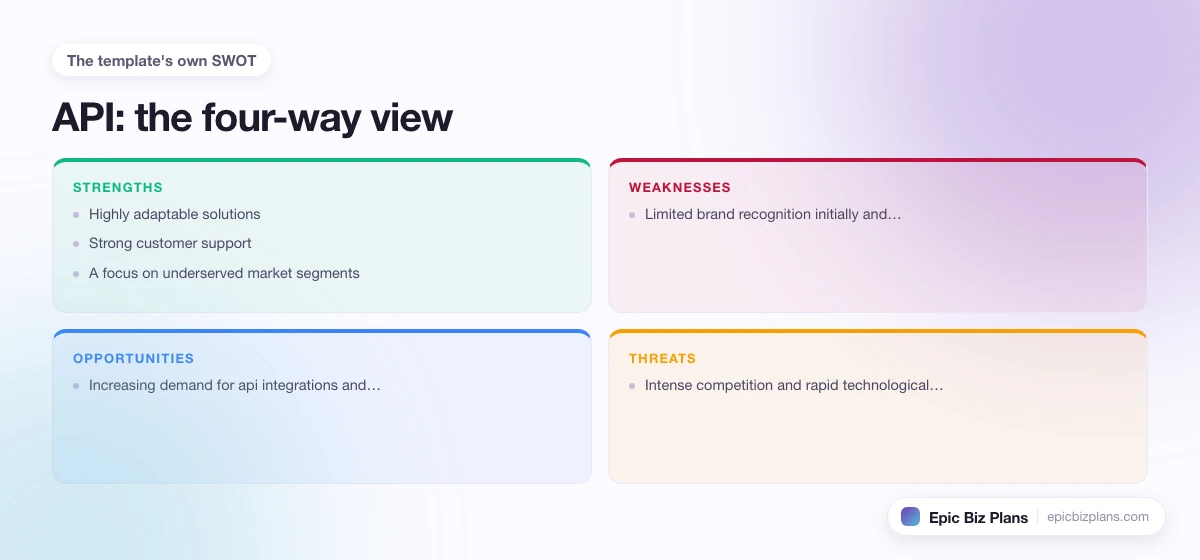
- Strengths: Highly adaptable solutions, strong customer support, and a focus on underserved market segments.
- Weaknesses: Limited brand recognition initially and dependence on technology trends.
- Opportunities: Increasing demand for API integrations and potential for partnerships with other tech companies.
- Threats: Intense competition and rapid technological changes.
Business Name Ideas
Website
We will build our primary website using a custom solution or WordPress, as API businesses need strong documentation pages, developer portals, and interactive demos. For a simpler marketing site, Squarespace offers clean templates that present our brand professionally. The developer documentation site will be the most important part of our online presence.
Marketing Details
Our marketing strategy will focus heavily on content marketing and SEO. Semrush will guide our keyword strategy, targeting terms that developers and technical decision-makers search for. HubSpot will manage email sequences that nurture leads from free tier users to paid subscribers.
Developer communities, GitHub, and technical forums will be key channels for organic growth. Sponsoring developer events and publishing technical tutorials will establish our brand as a credible player. LinkedIn will be our primary social platform for reaching business decision-makers. For related tech business planning, see our technology solutions business plan template.
Industry Trends
The API industry is evolving rapidly, driven by microservices architecture, cloud computing, and demand for automation. Machine learning and AI capabilities are increasingly being delivered through APIs, opening new product opportunities. Companies that offer well-documented, easy-to-integrate APIs with strong uptime guarantees have a significant competitive advantage.
Competitor Information
Direct competitors include established API platforms like Twilio, Stripe, and Plaid that offer comprehensive solutions in specific verticals. Indirect competitors include SDKs and no-code integration tools. We will focus on underserved niche markets where large platforms do not specialize, offering superior documentation and faster support response times.
Developer Onboarding and Documentation Strategy
For an API business, documentation quality directly impacts adoption rates. We will invest in comprehensive, interactive API docs with code samples in multiple programming languages. A sandbox environment where developers can test API calls before committing to a paid plan will reduce friction in the sales process.
Onboarding emails, video tutorials, and a dedicated developer support channel will help new users get value from our product quickly. The faster a developer can ship a working integration, the more likely they are to become a long-term customer.
Financial Information
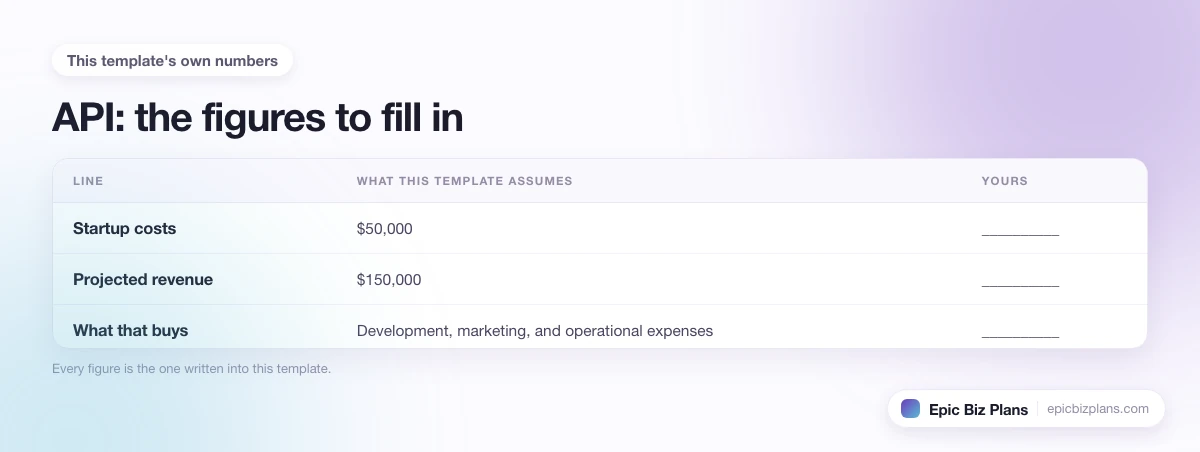
Initial startup costs are estimated at $50,000, covering development, marketing, and operational expenses. We project revenue of $150,000 by end of year two. Server costs, salaries, and marketing make up our primary ongoing expenses. We will track monthly recurring revenue (MRR) and churn rate as our key financial metrics.
Legal and Compliance
All legal requirements will be met, including business registration, licensing, and intellectual property protection through trademarks and copyrights. Compliance with data protection regulations like GDPR and CCPA is critical for an API business handling client data. We will maintain a clear privacy policy and data processing agreements for all customers. For more on compliance in tech businesses, review our data management business plan template.
-
 SemrushSemrush is a platform with literally any online tool you will need to promote your business. Spy on your competitors, get search traffic, keyword research, social info, ad copies and much more. Used by most of the top online companies in the world. Besides all its tools, Semrush also has many available integrations possible with many other tools that will make your work even better.
 -
 Surfer SEOSurfer SEO is an incredibly smart AI tool that will give you exact explanations what to do in order to make your website rank better. They use hundreds of parameters, check your competitors and decide on the best course of action. Whether it be inner links, bold text, paragraphs, headers, images and much more. Surfer is a must-have in 2026.
Infrastructure and Scaling Strategy
We will host our API infrastructure on cloud platforms like AWS or Google Cloud, using auto-scaling to handle traffic spikes without downtime. A multi-region deployment ensures low latency for clients worldwide. Load balancing and redundancy are non-negotiable for maintaining the uptime SLAs that enterprise clients expect.
As usage grows, we will optimize our infrastructure costs by analyzing traffic patterns and right-sizing our server instances. Monitoring tools will alert us to performance issues before they affect customers.
Operational Plan
Operations will center on development, customer support, and infrastructure maintenance. Partnerships with cloud providers will ensure reliable hosting. We will use agile development practices to ship updates quickly and respond to customer feedback. A clear release cycle with versioned APIs ensures backward compatibility for existing users.
Contingency Planning
Key risks include service outages, security breaches, and shifts in technology demand. We will mitigate outage risk with redundant infrastructure and automated failover systems. A security-first development approach with regular penetration testing protects client data. Diversifying our product offerings across multiple verticals reduces dependency on any single market segment. See our IT solution business plan template for related contingency approaches.
Build Your API Business
An API business sits at the intersection of technology and commerce, serving the infrastructure that modern software depends on. Whether you are building a payment API, a data analytics platform, or a specialized integration tool, the market for reliable API products continues to expand. The key is solving a specific problem better than anyone else and making it easy for developers to implement your solution.
Keep Iterating
Your API business plan should be updated as you learn from your users. Developer feedback, usage analytics, and competitive shifts should all inform your product roadmap and pricing strategy. Stay close to your users and let their needs guide your development priorities. For more tech-focused planning, see our programming business plan template.
Put Your Plan to Work
Use your API business plan to pitch investors, recruit technical co-founders, secure partnerships, or guide your product development. A clear, specific plan is your best tool for turning a technical idea into a funded, operational business. For additional SaaS-adjacent planning, explore our Salesforce business plan template.
Get Started
Your API business plan is 100% free with unlimited edits, unlimited downloads, and unlimited chances to get it right. Start building your API company today.
