
Blush Business Plan Template
-
 ShopifyPut your brand on Shopify. Launch your online store with tools designed for growth and success. Ready to turn your idea into profit? Start building your e-commerce business today.
 -
 SquarespaceShowcase your brand with Squarespace’s sleek designs. Build a professional online presence with ease. Start with a template that already looks finished.
 -
 WixBring your ideas to life with Wix. Customize every aspect of your site with unmatched flexibility. Start creating your unique online space and let your creativity shine.
 -
 ElementorCraft captivating websites effortlessly with Elementor. Enjoy complete creative control without coding. Make your site stand out to your audience. Start turning your vision into reality now.
- Executive Summary
- Business Info
- Business Model Overview
- SWOT Analysis
- Blush Business Name Ideas
- Website
- Marketing Details
- Industry Trends
- Competitor Information
- Financial Information
- Legal and Compliance
- Operational Plan
- Contingency Planning
- Frequently Asked Questions
- What does it cost to start a clean-beauty brand?
- Do I need any certifications?
- Where do most new beauty brands find their first 100 customers?
- Embrace Your Vision
- Grow and Evolve
- Make It Work for You
Your Blush business plan is the document that takes a cosmetics brand idea and turns it into a working business. The category is crowded, so a strong plan needs to show clearly which buyers you serve, which products carry your story, and how you will reach those buyers through the right mix of channels. Whether you are focused on beauty, fashion-adjacent products, or the wellness end of cosmetics, the plan is what guides your first launches, your pricing, and your hiring decisions.
Success in cosmetics comes down to a clear point of view and a careful product roadmap. Your Blush business plan should state plainly what the brand stands for and back it up with hard numbers on inventory, COGS, and customer acquisition cost. The sections below work through each part so you can adapt the format to your own brand instead of starting from a blank page.
Executive Summary
We will run Blush as a cosmetics retail business focused on high-quality, cruelty-free makeup. Our mission is to support customers in expressing their own beauty through a tightly curated product line. We aim to become a recognized name in the category, known for sustainability and inclusivity.
Our value proposition is eco-friendly products that serve a diverse customer base, so anyone can find shades and formulas that work for their skin tone and personal style. Our financial goal is to reach $500,000 in revenue within the first three years. The cosmetic business plan template covers regulatory and labeling notes that apply directly here.
Business Info
Blush will offer a range of cosmetics including foundation, lipsticks, eyeshadows, and skincare items. Brands adding a skin range alongside color should review a natural skincare business plan for formulation and shelf-life considerations. Our target market is environmentally conscious shoppers, makeup enthusiasts, and customers looking for clean ingredients without sacrificing performance.
Business Model Overview
We will run a direct-to-consumer model through our own e-commerce site, which lets us reach a broad audience while keeping overhead low compared to retail leases. The vegan cosmetics business plan template covers ingredient and certification details worth referencing.
SWOT Analysis
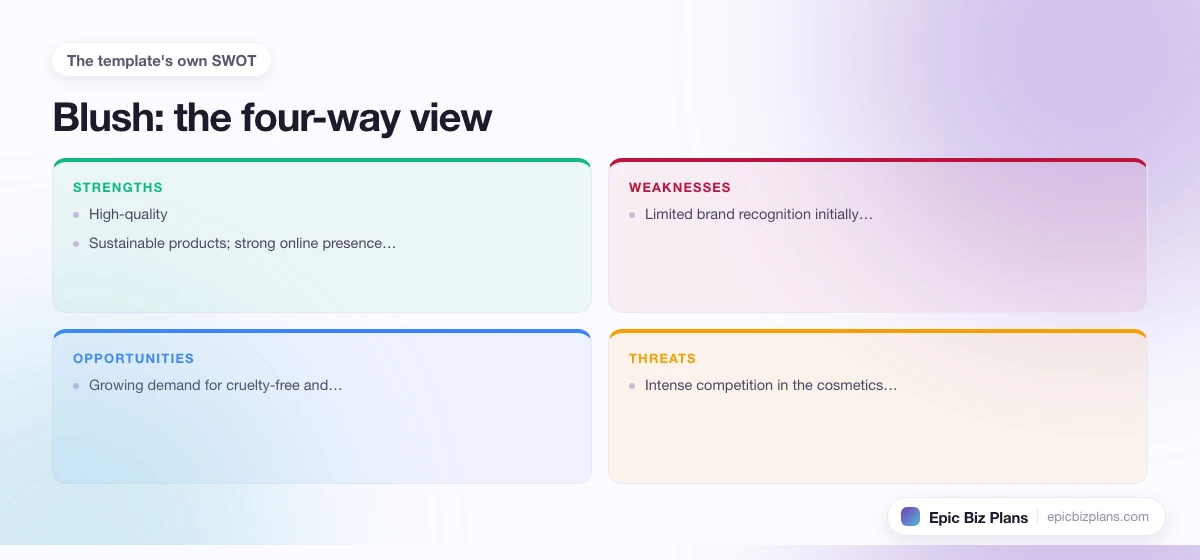
- Strengths: High-quality, sustainable products; strong online presence; responsive customer service.
- Weaknesses: Limited brand recognition initially; dependency on online sales.
- Opportunities: Growing demand for cruelty-free and eco-friendly products; potential partnerships with influencers.
- Threats: Intense competition in the cosmetics industry; fluctuations in consumer demand.
Blush Business Name Ideas
Website
We will build the website on Shopify, the leading e-commerce platform for product-led brands. Shopify makes inventory management, payments, and subscription flows straightforward, which fits our online retail model well. The app ecosystem also lets us add features like shade-finder quizzes and loyalty programs without custom development.
Marketing Details
Our marketing strategy combines SEO using Semrush with email through HubSpot and a small paid social budget. SEO will target shade-finder and ingredient-comparison searches, where small clean-beauty brands tend to outperform larger competitors. Email flows will cover welcome, abandoned cart, and replenishment reminders for refillable products.
For social, we will run TikTok and Instagram with short-form video content that shows real product use, tutorials, and creator collaborations. Partnerships with micro-influencers in the clean-beauty niche tend to outperform broad paid social campaigns, especially in the first 12 months.
Industry Trends
The cosmetics industry continues to shift toward clean ingredients, transparent sourcing, and sustainable packaging, a direction explored in detail in the organic cosmetics business plan. AR-powered virtual try-on tools, shade-finder quizzes, and AI-personalized recommendations are now table stakes for new brands. We will track these trends with monthly category reviews so our roadmap aligns with where demand is going. The beauty products business plan template covers complementary trend benchmarks worth comparing against.
Competitor Information
We will analyze both direct and indirect competitors in the cosmetics space. Major competitors include established brands that already hold shelf space, while indirect competitors include smaller niche brands targeting the same audiences. To set ourselves apart, we will lead on the clean-ingredient story, transparency, and a real community around the brand.
The makeup business plan template covers complementary positioning ideas for a more makeup-focused launch.
Financial Information
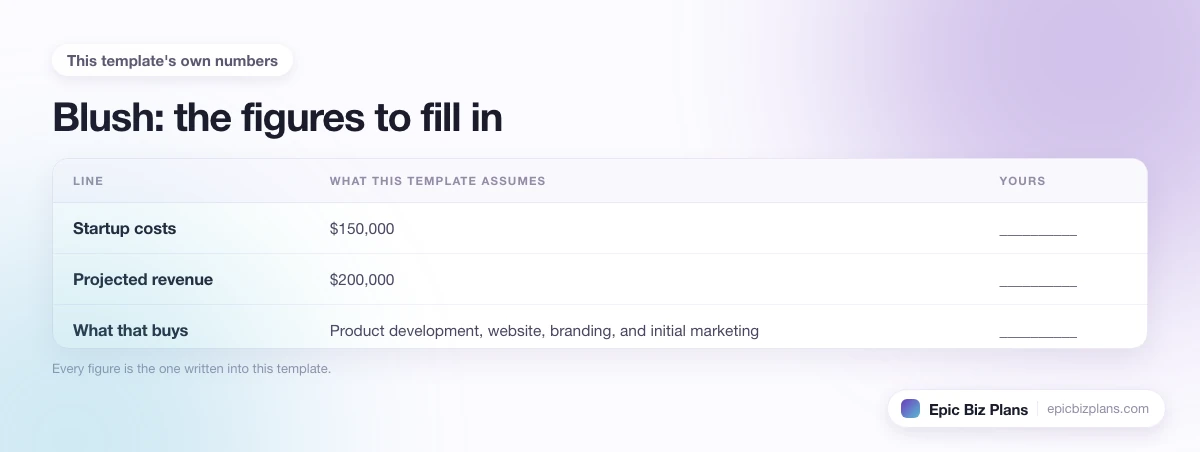
We anticipate startup costs of around $150,000, covering product development, website, branding, and initial marketing. Projected revenue for year one is $200,000, with gradual growth to $500,000 by year three. Ongoing costs will cover production, marketing, shipping, and platform fees, and we will run monthly cash flow and P&L reviews so growth decisions are anchored in real numbers.
Legal and Compliance
We will comply with local regulations by registering the business, obtaining the required licenses, and following FDA cosmetic labeling rules. We will also pursue trademark protection for the brand and product names so we can defend our position as the line grows.
Operational Plan
Our operational framework includes sourcing high-quality ingredients, signing manufacturing agreements with reputable contract manufacturers, and building sustainable practices into the supply chain. We will sign agreements with two or three vetted suppliers per product category so we are not single-source dependent.
-
 SemrushSemrush is a platform with literally any online tool you will need to promote your business. Spy on your competitors, get search traffic, keyword research, social info, ad copies and much more. Used by most of the top online companies in the world. Besides all its tools, Semrush also has many available integrations possible with many other tools that will make your work even better.
 -
 Surfer SEOSurfer SEO is an incredibly smart AI tool that will give you exact explanations what to do in order to make your website rank better. They use hundreds of parameters, check your competitors and decide on the best course of action. Whether it be inner links, bold text, paragraphs, headers, images and much more. Surfer is a must-have in 2026.
For logistics, we will partner with a fulfillment center that can handle pick-pack-ship and basic inventory management once monthly order volume crosses the threshold where in-house fulfillment stops making sense.
Contingency Planning
We see real risks in market shifts, ingredient cost spikes, and supply chain disruptions. To address them, we will run a flexible inventory model, hold a small safety stock of best-sellers, and keep a cash reserve equal to three months of fixed costs. We will review the plan quarterly to make sure it reflects current realities.
Frequently Asked Questions
What does it cost to start a clean-beauty brand?
A lean white-label launch with three to five core products can be done for $20,000 to $50,000. A single-product entry such as a lip tint business can start even leaner. A custom-formulated line with original packaging tends to need $100,000 to $250,000 once you include lab fees, manufacturing minimums, photography, and launch marketing. Founders blending color and care can also reference a makeup and skincare business plan.
Do I need any certifications?
Cruelty-free (Leaping Bunny), vegan (Vegan Society), and clean (EWG Verified, Made Safe) certifications are common in this category. None are legally required, but they help build trust quickly with the buyer segment that cares most about ingredients.
Where do most new beauty brands find their first 100 customers?
Most come from a mix of TikTok and Instagram organic content, an email opt-in tied to a shade-finder quiz, and small influencer seeding. Paid social tends to work better once you have at least 20 product reviews and a clear conversion rate, since the ad math gets brutal without that data.
Embrace Your Vision
Starting a Blush business is more than just a way to earn a living, it is a path into a category where your taste, eye for quality, and customer instincts matter. Whether you launch a small skincare line, a curated boutique, or a beauty-focused online shop, the blush niche has room for several distinct models. From small artisan brands to larger eCommerce operations, the bar to entry has never been lower.
Grow and Evolve
As you start the business, treat your Blush business plan as a living document. Edit and update it regularly to reflect growth and the real market response. Adjust for new audiences, test pricing models, expand the product range, or explore new sales channels as the data justifies. The plan should evolve with you.
Make It Work for You
Use your Blush business plan to anchor strategy, prep for launches, secure funding, or present your ideas to potential partners. The clarity from a written plan supports good decisions when growth pulls you in too many directions at once.
Your Blush business plan is 100% free, with unlimited edits, unlimited downloads, and unlimited chances to refine it. Start the work with a real plan in hand, and the decisions that follow get easier.
