
Biotechnology Business Plan Template
-
 ShopifyPut your brand on Shopify. Launch your online store with tools designed for growth and success. Ready to turn your idea into profit? Start building your e-commerce business today.
 -
 SquarespaceShowcase your brand with Squarespace’s sleek designs. Build a professional online presence with ease. Start with a template that already looks finished.
 -
 WixBring your ideas to life with Wix. Customize every aspect of your site with unmatched flexibility. Start creating your unique online space and let your creativity shine.
 -
 ElementorCraft captivating websites effortlessly with Elementor. Enjoy complete creative control without coding. Make your site stand out to your audience. Start turning your vision into reality now.
- Executive Summary
- Business Info
- SWOT Analysis
- Business Name Ideas
- Website
- Marketing Details
- Industry Trends
- Competitor Information
- Financial Information
- Startup Cost Breakdown
- Legal and Compliance
- Operational Plan
- Key Metrics to Track
- Contingency Planning
- Building a Biotech Business
- Adapt and Evolve with Your Plan
- Practical Applications for Success
A Biotechnology business plan gives founders, researchers, and investors a structured view of how a biotech venture will operate, grow, and achieve profitability. This is a capital-intensive, regulation-heavy industry where a well-documented plan is not optional - it is the foundation for every funding conversation and partnership negotiation.
This template covers the key elements required to build a credible biotech business plan, from R and D strategy and regulatory compliance to financial projections and commercialization pathways. Use it as a working document that evolves alongside your science and your market.
Executive Summary
We are committed to advancing biotechnology by developing innovative solutions that address critical challenges in health and agriculture. Our mission is to use biological systems to create products that improve quality of life and enhance sustainability. We aim to become a recognized leader in our target segments, known for rigorous research and commercially viable products. For a related angle, see the Venom business plan template.
Our value proposition centers on developing modern biotechnological products that are effective and environmentally sustainable. We aim for 20% market share within the first five years while achieving profitability from year two onward. Entrepreneurs building in the pharmaceutical manufacturing space should also review our pharmaceutical manufacturing business plan template for operational frameworks specific to that segment.
Business Info
Our primary products include biopharmaceuticals, agricultural biotech products, and bioinformatics services. We will target healthcare providers, pharmaceutical companies, and agricultural producers as our core market segments. Our business model combines direct sales, strategic partnerships, and licensing agreements to maximize market reach and financial returns.
For founders exploring the broader medical market, our medical lab business plan template covers the laboratory services segment that often intersects with biotech operations.
SWOT Analysis
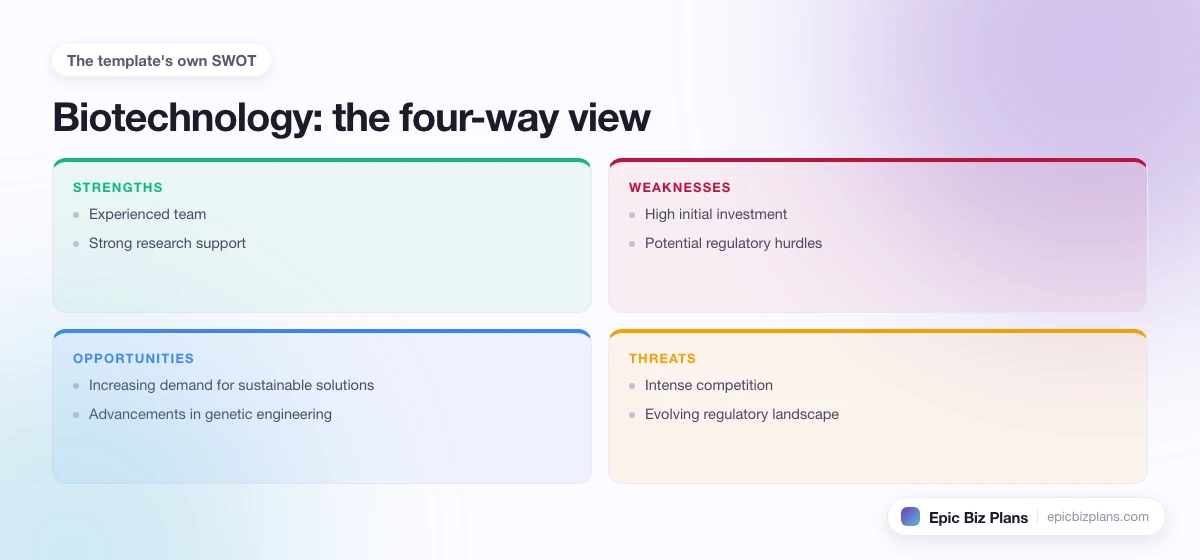
- Strengths: Innovative product development, experienced team, strong research support.
- Weaknesses: High initial investment, potential regulatory hurdles.
- Opportunities: Increasing demand for sustainable solutions, advancements in genetic engineering.
- Threats: Intense competition, evolving regulatory landscape.
Business Name Ideas
Website
We will build our website on Shopify for ecommerce needs related to biopharmaceutical sales and agricultural biotech products. Shopify's inventory management and transaction processing are well-suited to the volume and variety of products we plan to offer. We will also evaluate Squarespace as an option for a portfolio-style site for our bioinformatics services, where design and content presentation matter more than transaction volume.
Marketing Details
Our marketing strategy combines digital marketing with targeted outreach to scientific and healthcare communities. Semrush will guide our SEO strategy to improve organic visibility for technical search queries. HubSpot will handle email campaigns, enabling personalized communication with healthcare providers, researchers, and agricultural companies.
On social media, TikTok ads will reach younger demographics interested in health, sustainability, and science. Our content strategy will focus on explaining our technology in accessible terms to build awareness and credibility outside of specialist circles.
Industry Trends
CRISPR gene editing and synthetic biology are among the most commercially significant advances reshaping biotechnology today. These tools are enabling more precise pharmaceutical development and more efficient agricultural applications than were previously possible. The shift from traditional pharmaceuticals to biologics is well underway, with demand driven by superior efficacy profiles and growing patient preference for targeted treatments. Companies that combine strong IP with a clear regulatory pathway are best positioned to capture the value this shift is creating.
Competitor Information
Our main competitors include established biotech firms and funded startups working in similar product categories. We will differentiate through our commitment to sustainability, rigorous research standards, and a collaborative approach to working with clients and partners. Building a reputation for reliability and scientific integrity is as important as product performance in this market. Our biotech business plan template provides additional context on competitive positioning strategies within this sector.
Financial Information
Estimated startup costs total approximately 2 million USD, covering equipment, R and D, and marketing. We project revenue of 5 million USD by year three, with ongoing expenses at approximately 60% of revenue. Cash flow management will focus on timely invoicing and cost controls across all departments. Quarterly P and L statements will provide the financial oversight needed to stay on track.
Startup Cost Breakdown
Here is a representative breakdown of major startup costs for a biotech venture:
- Research and development (lab setup, equipment): 800,000 to 1,200,000 USD
- Regulatory compliance and patent filings: 200,000 to 400,000 USD
- Initial inventory or pilot production run: 200,000 to 300,000 USD
- Website, CRM, and digital infrastructure: 30,000 to 60,000 USD
- Marketing and business development: 100,000 to 200,000 USD
- Working capital and operational reserve: 200,000 to 400,000 USD
Legal and Compliance
We will comply with all applicable regulations including NIH guidelines and FDA requirements for our pharmaceutical and agricultural products. Patent protection is a strategic priority, and we will file for intellectual property protection on all novel compounds and methods early in the development process. Regulatory strategy will be built into each product's development timeline, not treated as a final hurdle.
Operational Plan
Our operational priorities are R and D efficiency, supply chain reliability for raw materials, and logistics partnerships for distribution. We will build systems that allow us to scale production without proportional increases in overhead. Operational performance reviews will be conducted quarterly to identify inefficiencies before they become cost problems.
-
 SemrushSemrush is a platform with literally any online tool you will need to promote your business. Spy on your competitors, get search traffic, keyword research, social info, ad copies and much more. Used by most of the top online companies in the world. Besides all its tools, Semrush also has many available integrations possible with many other tools that will make your work even better.
 -
 Surfer SEOSurfer SEO is an incredibly smart AI tool that will give you exact explanations what to do in order to make your website rank better. They use hundreds of parameters, check your competitors and decide on the best course of action. Whether it be inner links, bold text, paragraphs, headers, images and much more. Surfer is a must-have in 2026.
Key Metrics to Track
These are the most important metrics for a biotech company in its early years:
- R and D spend as a percentage of revenue to monitor investment intensity
- Patent application and grant timeline to track IP development progress
- Regulatory milestone completion rate against projected timelines
- Revenue per product line to identify top performers
- Customer acquisition cost across direct sales and partnership channels
- Gross margin per product category
Contingency Planning
Our primary risks are regulatory delays, competitive pressure, and funding gaps between development milestones. Mitigation strategies include diversifying our product pipeline so that delays in one area do not halt the entire business, maintaining relationships with multiple funding sources, and conducting regular competitive intelligence reviews to adjust our positioning as the market evolves.
Building a Biotech Business
Biotechnology rewards founders who combine scientific rigor with commercial discipline. The most successful companies in this space are not just doing good science - they are building organizations that can translate research into products, navigate regulatory systems efficiently, and communicate their value clearly to customers and investors. Starting with a structured business plan is how that discipline begins.
Adapt and Evolve with Your Plan
Your biotechnology business plan should change as your research advances and your market understanding deepens. Regulatory decisions, clinical data, and competitive moves will all create reasons to revise your assumptions. Build a habit of reviewing the plan quarterly and updating it based on what you learn from your operations and your market.
Practical Applications for Success
Use this plan when presenting to investors, structuring partnership conversations, applying for grants, or onboarding new team members who need context on your strategy. A well-maintained business plan reduces ambiguity and keeps your organization aligned as it scales.
Your biotechnology business plan is 100% free with unlimited edits, unlimited downloads, and unlimited chances to get it right.
