
Biotech Business Plan Template
-
 ShopifyPut your brand on Shopify. Launch your online store with tools designed for growth and success. Ready to turn your idea into profit? Start building your e-commerce business today.
 -
 SquarespaceShowcase your brand with Squarespace’s sleek designs. Build a professional online presence with ease. Start with a template that already looks finished.
 -
 WixBring your ideas to life with Wix. Customize every aspect of your site with unmatched flexibility. Start creating your unique online space and let your creativity shine.
 -
 ElementorCraft captivating websites effortlessly with Elementor. Enjoy complete creative control without coding. Make your site stand out to your audience. Start turning your vision into reality now.
- Executive Summary
- Business Info
- Business Model Overview
- SWOT Analysis
- Business Name Ideas
- Website
- Marketing Details
- Industry Trends
- Competitor Information
- Financial Information
- Legal and Compliance
- Operational Plan
- Contingency Planning
- Build for Meaningful Impact
- Types of Biotech Businesses
- Keep Your Plan Current
Biotechnology is one of the most capital-intensive and technically demanding sectors to enter, but it also offers the potential for outsized impact and commercial returns when the science and business strategy align. A well-structured biotech business plan is not just a funding document - it is the framework that forces founders to confront the real questions: what problem are you solving, what is the evidence base for your approach, and how will you manage the long runway to commercialization? For a more comprehensive overview that covers biopharmaceuticals alongside agricultural biotech, the biotechnology business plan template provides a useful broader framework.
This template is built for biotech founders who need to present their vision credibly to investors, research institutions, or strategic partners. It covers the key sections any serious reviewer will evaluate: your scientific differentiation, your regulatory pathway, your financial model, and how you plan to compete in a sector where the barriers to entry are real but so are the rewards.
Executive Summary
Our mission is to develop advanced biopharmaceutical solutions that address unmet medical needs in high-priority therapeutic areas. We are focused on producing therapies that are both clinically effective and accessible at a price point that supports broad adoption. Our value proposition combines a strong R&D team, access to modern platform technologies, and a disciplined regulatory strategy that reduces risk at each development milestone. Financial goals include reaching break-even within the first three years while achieving projected revenues of $5 million by the end of year five. For a related angle, see the Venom business plan template.
Business Info
We specialize in the development of biopharmaceutical products with an initial focus on gene therapy and monoclonal antibodies. Our target market includes hospitals, research institutions, and specialty clinics globally, with initial commercial focus on North America and Europe where reimbursement pathways are established and regulatory frameworks are well-defined.
Business Model Overview
Our model combines direct sales of approved products with licensing agreements and partnership arrangements with larger healthcare companies for distribution at scale. We will actively pursue NIH grants and other public research funding to extend our runway during the development phase, reducing dependence on equity dilution. This mixed-funding approach is standard in early-stage biotech and extends the capital efficiency of each development milestone.
SWOT Analysis
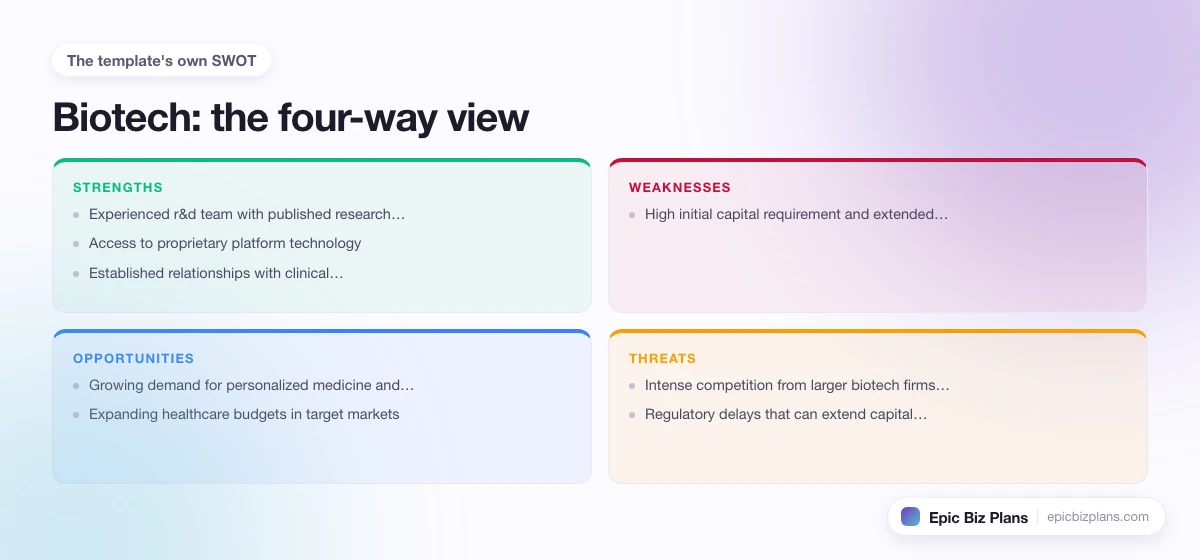
- Strengths: Experienced R&D team with published research credentials, access to proprietary platform technology, and established relationships with clinical research institutions.
- Weaknesses: High initial capital requirement and extended development timelines before first commercial revenue.
- Opportunities: Growing demand for personalized medicine and cell-based therapies, expanding healthcare budgets in target markets.
- Threats: Intense competition from larger biotech firms with bigger R&D budgets, and regulatory delays that can extend capital requirements beyond initial projections.
Business Name Ideas
Website
We will build our website on Shopify for its reliable commerce infrastructure, allowing us to handle direct product inquiries and eventual product sales to healthcare providers. The site will include a scientific overview of our platform technology, a publications and data section for institutional credibility, and a contact structure that routes inquiries to the appropriate team. A Squarespace-based investor relations page may be built separately to present financial and pipeline updates in a clean format.
Marketing Details
Marketing in biotech operates differently from consumer-facing sectors - institutional buyers make decisions based on clinical evidence, regulatory status, and partnership economics rather than advertising. Our primary marketing channels are conference presentations, peer-reviewed publications, and direct outreach to hospital procurement and research partnership teams. We will use Semrush to ensure our web presence ranks well for the therapeutic area terms that institutional researchers and procurement officers actually search.
HubSpot will manage follow-up with conference leads and partnership inquiries. For consumer-facing health technology products in our pipeline, TikTok advertising may be used to reach younger demographics who drive healthcare decisions for their families. For additional guidance on structuring a diagnostics or laboratory-focused operation, a pathology business plan covers relevant laboratory operational frameworks. A broader pharma business plan template provides useful context on regulatory and commercial structures for pharmaceutical development.
Industry Trends
CRISPR-based gene editing has moved from research curiosity to clinical application in under a decade, with approved therapies now available for conditions like sickle cell disease and certain blood disorders. AI-driven drug discovery is accelerating candidate identification and reducing the cost of early-stage research - a trend that benefits smaller biotech firms that can access these tools without the overhead of large research departments. Personalized medicine approaches, including companion diagnostic development alongside therapeutics, are becoming an expected component of regulatory submissions in many therapeutic areas.
Competitor Information
Our direct competitors are established biotech companies with larger R&D budgets and more extensive distribution networks. Companies extending into in-house production should also review the pharmaceutical manufacturing business plan for GMP facility planning. These firms have the advantage of institutional relationships and existing regulatory approvals, but they tend to focus on high-volume indications rather than the niche therapeutic areas where we are targeting initial development. Smaller biotech companies at a similar stage represent competitive pressure for grant funding and partnership attention.
Our differentiation relies on the depth of our scientific expertise in our specific therapeutic area and our ability to generate compelling preclinical data faster than typical development timelines. A focused pipeline in a well-defined indication is a more compelling investment thesis than a broad early-stage portfolio. Those developing health diagnostics or medical testing services should also review a medical lab business plan for operational infrastructure guidance.
Financial Information
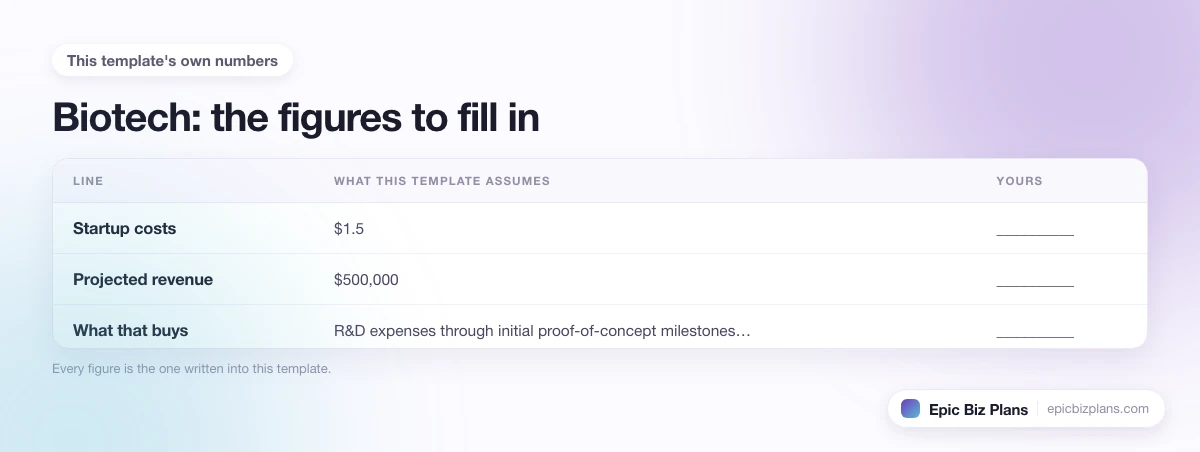
Startup costs are estimated at $1.5 million, covering R&D expenses through initial proof-of-concept milestones, regulatory advisory fees, and initial operating overhead. We anticipate revenues of $500,000 in year one primarily from grants and licensing fees, growing to $5 million by year five as products advance toward commercial readiness. Monthly cash flow is projected to turn positive by year three, contingent on hitting key development milestones on schedule.
Legal and Compliance
We will register the business and pursue patent protection for all novel compounds, delivery mechanisms, and platform technologies before any public disclosure. All clinical research will be conducted in compliance with FDA and applicable international regulatory frameworks. A regulatory affairs advisor will be retained to guide our IND submissions and communication with FDA reviewers throughout the development process. For additional context, see our gene business plan template.
Operational Plan
Core operations center on R&D execution, regulatory filings, and building the manufacturing partnerships needed to scale from lab production to clinical supply. We will contract with a CDMO for early clinical manufacturing rather than building internal production capacity, which preserves capital for research activities. Supplier relationships for research materials will be established with at least two qualified vendors per critical input to prevent supply disruptions from delaying experiments.
Contingency Planning
Regulatory delays are the most common cause of biotech cost overruns and should be planned for explicitly. We will build at least a 12-month buffer into our development timeline projections and maintain relationships with bridge financing sources for scenarios where a milestone takes longer than projected. If a primary therapeutic candidate fails in preclinical studies, we will have a secondary candidate ready to advance, so the pipeline is never dependent on a single asset for its entire commercial thesis.
-
 SemrushSemrush is a platform with literally any online tool you will need to promote your business. Spy on your competitors, get search traffic, keyword research, social info, ad copies and much more. Used by most of the top online companies in the world. Besides all its tools, Semrush also has many available integrations possible with many other tools that will make your work even better.
 -
 Surfer SEOSurfer SEO is an incredibly smart AI tool that will give you exact explanations what to do in order to make your website rank better. They use hundreds of parameters, check your competitors and decide on the best course of action. Whether it be inner links, bold text, paragraphs, headers, images and much more. Surfer is a must-have in 2026.
Build for Meaningful Impact
Starting a biotech business is one of the more demanding entrepreneurial paths available - the timelines are long, the capital requirements are significant, and the regulatory environment is unforgiving of shortcuts. But the businesses that get it right produce therapies that genuinely improve human health at scale. That combination of scientific rigor, commercial discipline, and patient focus is what the best investors in this space are looking for.
Types of Biotech Businesses
The biotech sector encompasses drug development, diagnostic tools, agricultural biotechnology, industrial enzyme production, and health-focused consumer products. Each segment has different regulatory requirements, commercialization timelines, and investor expectations. Your business plan should address the specific pathway relevant to your focus area rather than treating biotech as a monolithic category.
Keep Your Plan Current
As you progress through development milestones, update this plan to reflect your current pipeline status, updated financial projections, and any strategic pivots. Investors evaluating biotech companies at series A or beyond will expect your plan to reflect current regulatory status and updated competitive analysis, not your founding assumptions from two years prior.
Your Biotech business plan is 100% free - with unlimited edits, unlimited downloads, and unlimited chances to get it right.
