
Biomedical Business Plan Template
-
 ShopifyPut your brand on Shopify. Launch your online store with tools designed for growth and success. Ready to turn your idea into profit? Start building your e-commerce business today.
 -
 SquarespaceShowcase your brand with Squarespace’s sleek designs. Build a professional online presence with ease. Start with a template that already looks finished.
 -
 WixBring your ideas to life with Wix. Customize every aspect of your site with unmatched flexibility. Start creating your unique online space and let your creativity shine.
 -
 ElementorCraft captivating websites effortlessly with Elementor. Enjoy complete creative control without coding. Make your site stand out to your audience. Start turning your vision into reality now.
- Executive Summary
- Business Info
- Business Model Overview
- SWOT Analysis
- Biomedical Business Name Ideas
- Website
- Marketing Details
- Industry Trends
- Competitor Information
- Financial Information
- Legal and Compliance
- Operational Plan
- Contingency Planning
- Meeting Regulatory Approval Requirements
- Build a Business Around Your Expertise
- Adapt and Evolve
- Practical Applications
A biomedical business plan maps how you turn a health or life-sciences idea into a company that can survive regulation, raise capital, and reach clinicians. This sector rewards rigor: the products are technical, the buyers are cautious, and the approval path is long. Your plan has to show you understand the science, the market, and the compliance burden in equal measure. Treat it as the document that keeps your research roadmap and your revenue model honest with each other.
When you draft a biomedical business plan, work through every element, from your mission to your go-to-market strategy. This plan is the operating blueprint for a venture that other people will stake money and patient outcomes on. Be specific about who you serve, what evidence you offer, and how you clear regulatory hurdles before you scale. A plan grounded in real numbers and real clinical need will hold up far better than one built on ambition alone. Diagnostics-focused founders often pair this with a pathology laboratory business plan template to map the testing side of the operation.
Executive Summary
We will establish a biomedical company that focuses on practical healthcare solutions aimed at enhancing patient care and improving medical outcomes. Our mission is to use advanced technology and research to develop products and services that meet the evolving needs of healthcare providers and patients. Our vision is to be a leading force in the biomedical industry, driving change through applied research.
Our value proposition lies in the development of modern biomedical devices and software solutions that simplify healthcare processes, improve accessibility, and provide actionable insights for better clinical decision-making. Financially, we aim to achieve break-even within the first two years and to realize steady growth, targeting a revenue increase of 15% annually post-establishment.
Business Info
We will offer a range of biomedical products, including medical devices, diagnostic tools, and healthcare software solutions targeted at hospitals, clinics, and private practitioners. Our target market consists of healthcare providers looking for advanced technology to improve patient care and operational efficiency.
Business Model Overview
Our business model will focus on both direct sales and partnerships with healthcare institutions to distribute our products. We will also explore subscription-based services for software solutions, providing ongoing updates and support.
SWOT Analysis
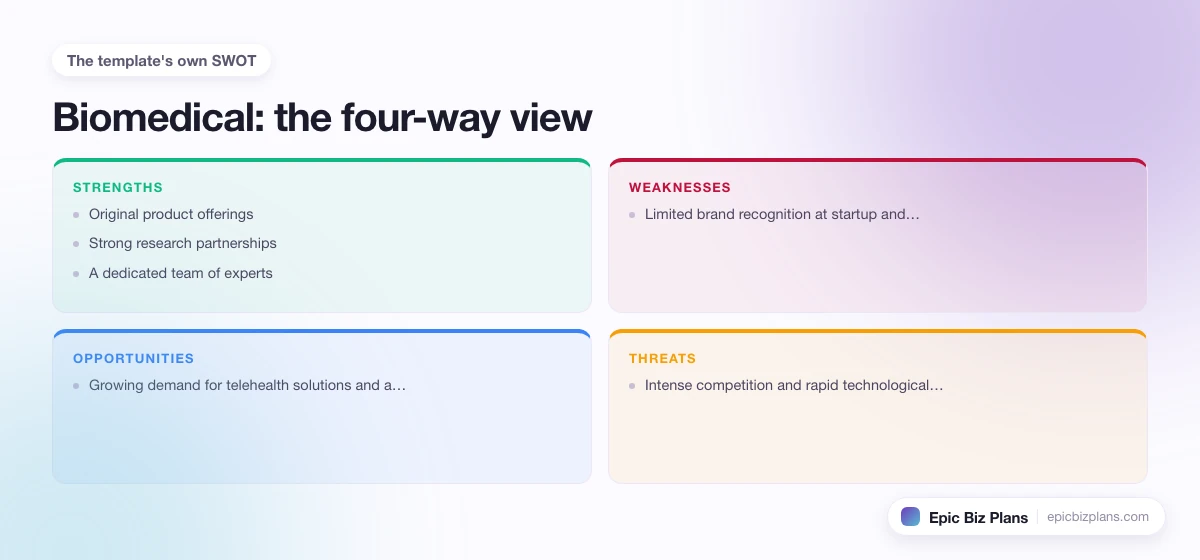
- Strengths: Original product offerings, strong research partnerships, and a dedicated team of experts.
- Weaknesses: Limited brand recognition at startup and reliance on regulatory approvals.
- Opportunities: Growing demand for telehealth solutions and a rising need for enhanced medical devices.
- Threats: Intense competition and rapid technological advancements that could render products obsolete.
Biomedical Business Name Ideas
Website
We will build our website using Shopify or Squarespace, which are ideal for businesses that sell products online and want a visually appealing storefront. These platforms will allow us to effectively showcase our biomedical innovations and engage with customers. For our general business site, we will also consider using Wix for its ease of use, particularly for users who may not be tech-savvy.
Marketing Details
Our marketing strategy will cover a full digital marketing approach. We will use Semrush to improve our website for search engines, enhance our online visibility, and drive organic traffic. In parallel, we will employ HubSpot for our email campaigns to develop relationships with potential clients and keep existing customers informed.
We will also use social media, specifically TikTok ads to capture the attention of younger demographics. This approach will allow us to engage with a broader audience and increase brand awareness through targeted advertising.
Industry Trends
We will closely monitor trends such as the advancement of telemedicine, the integration of artificial intelligence in diagnostics, and the growing importance of patient-centered care. These trends signify a shift in how healthcare is delivered and offer opportunities for innovation within our biomedical offerings. Founders pursuing the underlying science can compare our approach with a biotech business plan, which covers research-stage funding and partnerships in more depth.
Competitor Information
We will analyze both direct competitors, including established biomedical firms, and indirect competitors that operate in adjacent healthcare markets. To differentiate ourselves, we will emphasize our commitment to applied research, superior customer service, and partnerships with leading research institutions to ensure we stay at the forefront of technology. Adjacent healthcare service models, such as our dental billing business plan template, show how specialized billing operations support clinical providers. Companies shipping physical hardware should also review a focused medical device business plan for the regulatory and manufacturing detail that biomedical products demand.
Financial Information
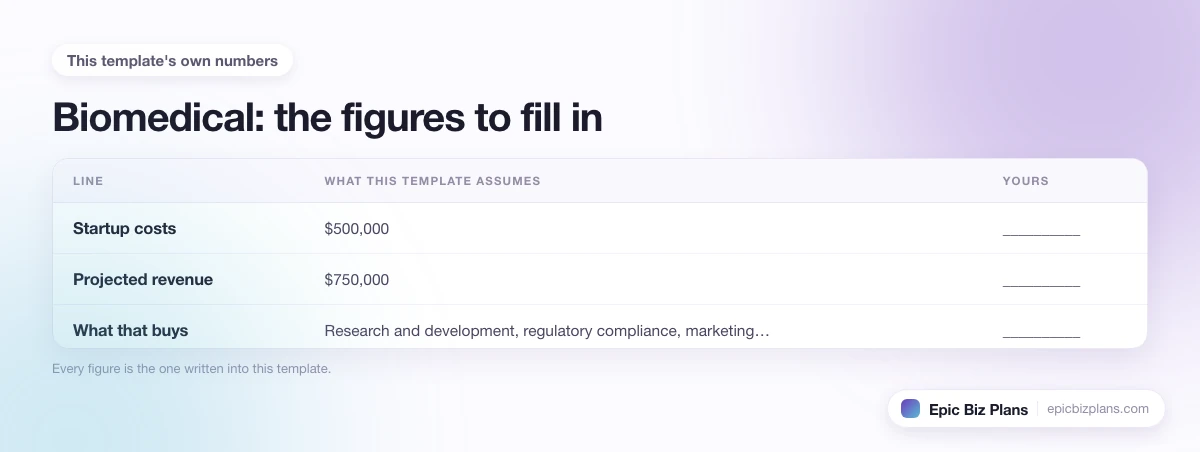
We anticipate startup costs to be approximately $500,000, covering research and development, regulatory compliance, marketing, and operational expenses. Our projected revenue for the first year is estimated at $750,000, with ongoing expenses including salaries, manufacturing, and marketing costs expected to total around $300,000 annually. For additional context, see our gene business plan template.
Cash flow management will be crucial, and we will develop a detailed Profit and Loss (P&L) statement to track income and expenses, ensuring we maintain positive cash flow as we grow.
Legal and Compliance
We will ensure compliance with all legal requirements, including business registration, intellectual property protections, and adherence to medical device regulations. This will involve consulting with legal experts to handle the complexities of the biomedical industry.
Operational Plan
Our operations will focus on efficient supply chain management, ensuring we can meet demand promptly without compromising quality. We will establish relationships with reliable suppliers for materials and components and implement logistics systems that improve delivery to healthcare providers.
-
 SemrushSemrush is a platform with literally any online tool you will need to promote your business. Spy on your competitors, get search traffic, keyword research, social info, ad copies and much more. Used by most of the top online companies in the world. Besides all its tools, Semrush also has many available integrations possible with many other tools that will make your work even better.
 -
 Surfer SEOSurfer SEO is an incredibly smart AI tool that will give you exact explanations what to do in order to make your website rank better. They use hundreds of parameters, check your competitors and decide on the best course of action. Whether it be inner links, bold text, paragraphs, headers, images and much more. Surfer is a must-have in 2026.
Contingency Planning
We will prepare for potential risks, including changes in regulatory requirements or unexpected market shifts by developing strong contingency plans. This will involve setting aside a financial reserve, regularly assessing market conditions, and maintaining flexibility in our operational strategies.
Meeting Regulatory Approval Requirements
Regulation is the part of a biomedical business that catches most first-time founders off guard, so plan for it early. Map out which pathway your product follows, whether that is FDA 510(k) clearance for a device with a clear predicate, premarket approval for higher-risk products, or a software-as-a-medical-device review. Each route carries its own timeline, documentation burden, and cost, and underestimating any of them can stall a launch by a year or more. Build the cost of clinical evidence, quality systems, and post-market surveillance directly into your financial model rather than treating them as afterthoughts.
It also helps to study how related health ventures handle compliance and distribution before they reach the market. The supply and field-sales mechanics in a medical sales business plan show how products move from approval to the hospitals that buy them. If your product leans toward software or remote care, the delivery model in a telehealth business plan and the operations in a medical lab business plan offer useful reference points for billing, data handling, and clinical workflow.
Build a Business Around Your Expertise
Imagine waking up each day driven by your work in life sciences, backed by a Biomedical business plan that reflects what you build and why it matters. Starting a business in this field means committing to research, careful engineering, and the promise of real clinical improvement. Whether you launch a biotech startup, an ecommerce platform for medical supplies, or a clinic offering modern treatments, the opportunities are wide. Each of these ventures can change patient lives and reshape how care is delivered.
Adapt and Evolve
Your work does not end with the first draft of your Biomedical business plan. As you grow, revisit and edit the plan to reflect your changing audience, pricing structures, product lines, and sales strategies. That ongoing adjustment is what keeps you competitive in a fast-moving market. Set a schedule to review it each quarter so it never drifts out of date.
Practical Applications
Think of your Biomedical business plan as a working tool. It can help you present your ideas to potential partners, plan a successful launch, secure funding, and clarify your long-term strategy. Use it as the reference you return to when a decision gets hard.
Remember, your Biomedical business plan is 100% free, with unlimited edits, unlimited downloads, and unlimited chances to get it right. Seize this moment to put your expertise to work and build something that improves care.
