
Billionaire Business Plan Template
-
 ShopifyPut your brand on Shopify. Launch your online store with tools designed for growth and success. Ready to turn your idea into profit? Start building your e-commerce business today.
 -
 SquarespaceShowcase your brand with Squarespace’s sleek designs. Build a professional online presence with ease. Start with a template that already looks finished.
 -
 WixBring your ideas to life with Wix. Customize every aspect of your site with unmatched flexibility. Start creating your unique online space and let your creativity shine.
 -
 ElementorCraft captivating websites effortlessly with Elementor. Enjoy complete creative control without coding. Make your site stand out to your audience. Start turning your vision into reality now.
- Executive Summary
- Business Info
- Business Model Overview
- SWOT Analysis
- Billionaire Business Name Ideas
- Website
- Marketing Details
- Industry Trends
- Competitor Information
- Financial Information
- Legal and Compliance
- Operational Plan
- Contingency Planning
- Capital Strategy and Funding Path
- Wealth Building and Long-Term Strategy
- Chasing Your Billionaire Business Plan
- Types of Businesses
- Adapt and Evolve
- Practical Applications
- Take the Leap
The Billionaire business plan is your starting point for building an operation with serious ambition. Markets shift quickly and consumer behavior changes faster than most plans account for, so a working plan that matches your brand and audience is essential. You are positioning at the intersection of opportunity and execution - and the plan needs to handle both.
This is more than a business strategy document - it is the foundation for whatever you build next. Your plan should reflect your specific vision, your read of the market, and the discipline required to push past common founder mistakes. The point is to write something you actually use, not a binder that sits unread after the launch meeting.
Executive Summary
Our mission is to build a platform that helps aspiring entrepreneurs grow successful, scaled businesses. We see a future where serious operators have direct access to resources, mentorship, and capital connections that shape what they can build.
Our value proposition rests on connecting individuals to the tools and support required to turn ideas into operating companies. Financially, we aim to reach profitability within the first two years and revenue near $10 million by year five. Founders looking at related models can also reference our millionaire business plan template for adjacent positioning.
Business Info
We will offer services for emerging entrepreneurs - mentorship programs, investment connections, and educational resources tailored to startup needs. The target market is driven individuals aged 18-35 who want to launch new ventures or scale existing operations.
Business Model Overview
The business will run on a subscription model, with tiered access to resources and mentor networks. Additional revenue will come from partnerships with educational institutions, sponsorships, and a small affiliate program. Capital efficiency will matter more than spend in year one - paying users carry more weight than free signups.
SWOT Analysis
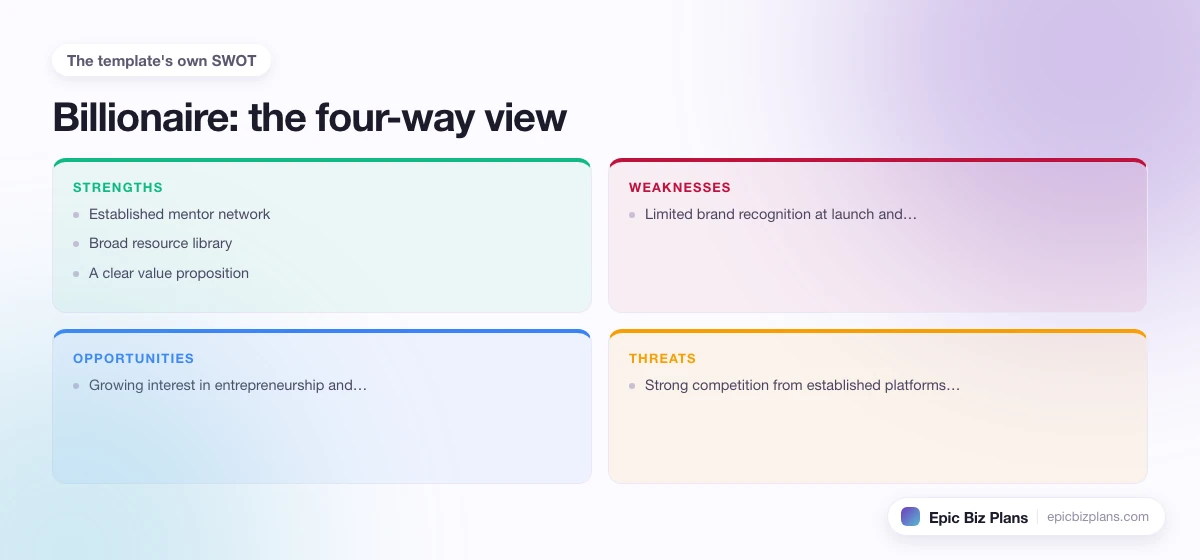
- Strengths: Established mentor network, broad resource library, and a clear value proposition.
- Weaknesses: Limited brand recognition at launch and reliance on paid digital acquisition.
- Opportunities: Growing interest in entrepreneurship and expanding online tools that small operators can use.
- Threats: Strong competition from established platforms and rapid shifts in technology.
Billionaire Business Name Ideas
Website
We will build the platform on Shopify because it supports both content access and product sales without custom development. If branding leans more design-led, Squarespace is a reasonable secondary option. The priority is a fast site, clean signup flow, and a clear path from free content to paid subscription tiers.
Marketing Details
Our marketing strategy uses digital channels heavily. Semrush will support keyword research and ongoing SEO so the site ranks for high-intent queries that aspiring founders search. HubSpot will run lifecycle email and lead nurturing across free and paid users.
For audience reach, TikTok and YouTube short-form content will drive top-of-funnel awareness with practical advice and case studies. Founders looking at adjacent education-focused models can also reference our entrepreneur business plan template for content positioning.
Industry Trends
Entrepreneurship education and mentorship platforms continue to grow, with AI tools, online networking, and digital mentorship reshaping how founders learn. We will keep our offerings current as new tools emerge - but the goal is real outcomes for users, not chasing every new feature trend. Quality of mentorship and quality of community remain the most defensible differentiators.
Competitor Information
Our main competitors are educational platforms, startup incubators, and online mentorship programs. Indirect competitors include self-help businesses and alternative finance products. Our differentiation rests on personalized mentorship, an active community, and a platform that gives users tangible ways to apply what they learn rather than just consume content.
Financial Information
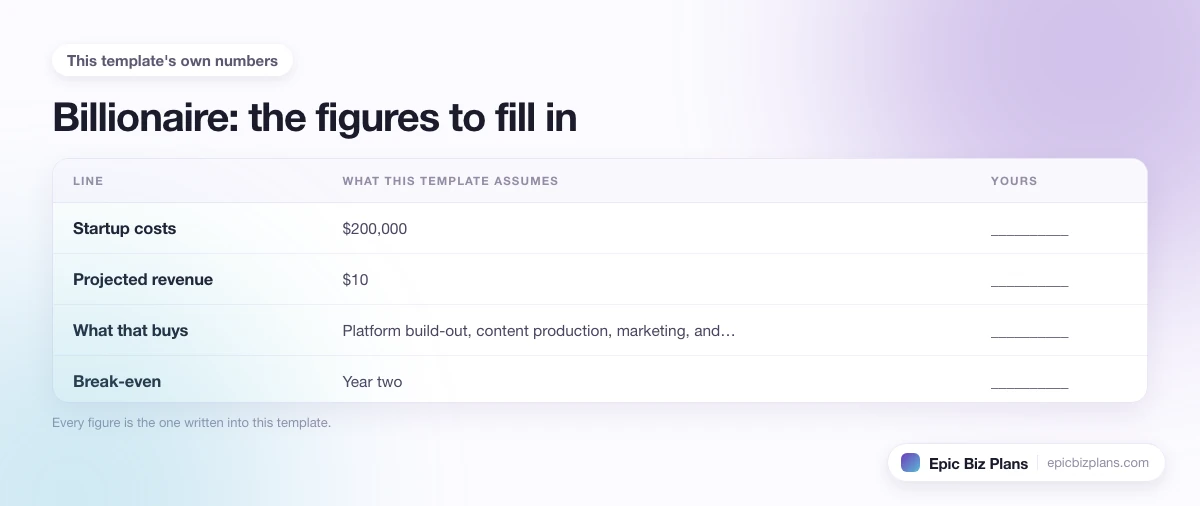
Initial startup costs are projected near $200,000, covering platform build-out, content production, marketing, and operating expenses. We aim to break even by the end of year two, with revenue projections approaching $10 million by year five. We will track ongoing expenses tightly and review cash flow monthly so spending stays aligned with subscriber growth.
Legal and Compliance
We will register the business properly, comply with state and federal regulations, handle tax obligations, and protect intellectual property tied to our content and platform. Legal counsel will be engaged for any partnership or sponsorship agreements that involve revenue sharing or co-branded products.
Operational Plan
Key operations include content production, mentor matchmaking, and customer support. We will document processes for onboarding new mentors, reviewing course content, and resolving subscriber issues so the platform stays consistent as it scales. Tech support and content quality reviews will run on regular cycles, not ad hoc.
Contingency Planning
Real risks include market shifts, competitor moves, and technology disruptions. To manage them, we will diversify revenue streams, run regular market reviews, and maintain a basic technology refresh roadmap so platform performance does not lag behind user expectations. Clear escalation procedures help the team respond quickly to outages, content disputes, or PR issues.
-
 SemrushSemrush is a platform with literally any online tool you will need to promote your business. Spy on your competitors, get search traffic, keyword research, social info, ad copies and much more. Used by most of the top online companies in the world. Besides all its tools, Semrush also has many available integrations possible with many other tools that will make your work even better.
 -
 Surfer SEOSurfer SEO is an incredibly smart AI tool that will give you exact explanations what to do in order to make your website rank better. They use hundreds of parameters, check your competitors and decide on the best course of action. Whether it be inner links, bold text, paragraphs, headers, images and much more. Surfer is a must-have in 2026.
Capital Strategy and Funding Path
Building a high-ambition business often involves outside capital. We will define a clear funding ladder - bootstrap to revenue, then a friends-and-family or seed round if growth supports it, then potentially institutional capital later. Each stage carries different obligations, dilution math, and reporting requirements. Founders interested in the investor side can reference our investment business plan template for context on how investors evaluate opportunities.
Wealth Building and Long-Term Strategy
The endgame for most ambitious founders is not just operating a profitable business - it is building real, transferable wealth. That means thinking early about ownership structure, equity allocation, exit options, and the difference between cash flow and enterprise value. Operators planning the longer arc may also reference our wealth creation business plan template for guidance on building long-term value beyond a single operating business.
Chasing Your Billionaire Business Plan
Why do we start businesses? Often it comes down to identity, freedom, ambition, and the desire to build something that matters. A Billionaire business plan is the blueprint for turning that desire into a real operation. Whether the goal is a regional service company, a software platform, or a product brand with national reach, the plan keeps decisions grounded in something other than enthusiasm.
Types of Businesses
The opportunities run wide - from operating businesses to platforms, marketplaces, subscription products, and consumer brands. You could build a marketplace for specialized professionals, a subscription product line, or a software tool that serves a clear customer pain. Skill, capital, and timing usually decide which path makes sense, not desire alone.
Adapt and Evolve
Your Billionaire business plan should evolve with the business. As you learn what customers respond to and what channels actually scale, update pricing, products, and target segments accordingly. Flexibility is what keeps a long-running plan useful.
Practical Applications
The plan supports many real needs: presenting to partners, organizing a launch, securing funding, and keeping the team aligned on priorities. Treat it as the working reference for the first 24 months - and update it regularly after that.
Take the Leap
Your Billionaire business plan is 100% free - with unlimited edits, unlimited downloads, and unlimited chances to get it right. Use it as the starting point for the kind of business you actually want to build.
