
Entrepreneur Business Plan Template
-
 ShopifyPut your brand on Shopify. Launch your online store with tools designed for growth and success. Ready to turn your idea into profit? Start building your e-commerce business today.
 -
 SquarespaceShowcase your brand with Squarespace’s sleek designs. Build a professional online presence with ease. Start with a template that already looks finished.
 -
 WixBring your ideas to life with Wix. Customize every aspect of your site with unmatched flexibility. Start creating your unique online space and let your creativity shine.
 -
 ElementorCraft captivating websites effortlessly with Elementor. Enjoy complete creative control without coding. Make your site stand out to your audience. Start turning your vision into reality now.
- Executive Summary
- Business Info
- Business Model Overview
- SWOT Analysis
- Entrepreneur Business Name Ideas
- Website
- Marketing Details
- Industry Trends
- Competitor Information
- Financial Information
- Legal and Compliance
- Operational Plan
- Contingency Planning
- Build the Entrepreneurial Business You Actually Want
- Types of Businesses in Your Niche
- Keep Your Entrepreneur Business Plan Flexible
- Put Your Plan to Work
An Entrepreneur business plan is the document that turns an idea into an operating company you can actually launch, fund, and grow. For founders making a complete career pivot, our fresh start business plan template offers a structured approach to planning a new venture from the ground up. The plan is not a one-time exercise; it is a working tool that records your assumptions, tests your numbers, and gives you a shared reference point when you bring on partners, hires, or investors.
This template walks through the sections every founder needs to write down, regardless of industry: market and customer definition, pricing, financials, operations, and risk. Founders building a retail concept can adapt these sections from a category-specific model such as our tech retailer business plan. Use it as the first draft of how your business actually makes money, then update it every quarter as real customer data replaces your early guesses.
Executive Summary
We will launch an entrepreneurial venture focused on solving a specific, well-defined problem for a clearly identified customer. Our mission is to help individuals and small businesses run more efficiently with high-quality products and services. Our vision is to become a trusted name in our category, built on consistent delivery and a strong customer feedback loop. Our financial target is profitability within 24 months, with positive cash flow by month 12. For a community-and-coworking model, see our district business plan template. More intimidating ventures use the daunting business plan template.
Business Info
We will offer a focused mix of products and services for small and mid-sized businesses (SMBs) and individual entrepreneurs. Initial offerings include consultancy, digital marketing services, and productivity tools that simplify common business workflows. Founders concentrating on advisory work can model their offer on a consulting business plan template. The plan starts narrow on purpose: one or two well-defined products in year one, with additional categories added only after we see real demand and repeat usage data.
Business Model Overview
We operate a hybrid B2B and B2C model, selling through both online and offline channels. Revenue comes from a mix of one-time sales, ongoing service retainers, and software-as-a-service subscriptions where applicable. Recurring revenue is the priority because it stabilizes cash flow and makes the rest of the plan easier to execute.
SWOT Analysis
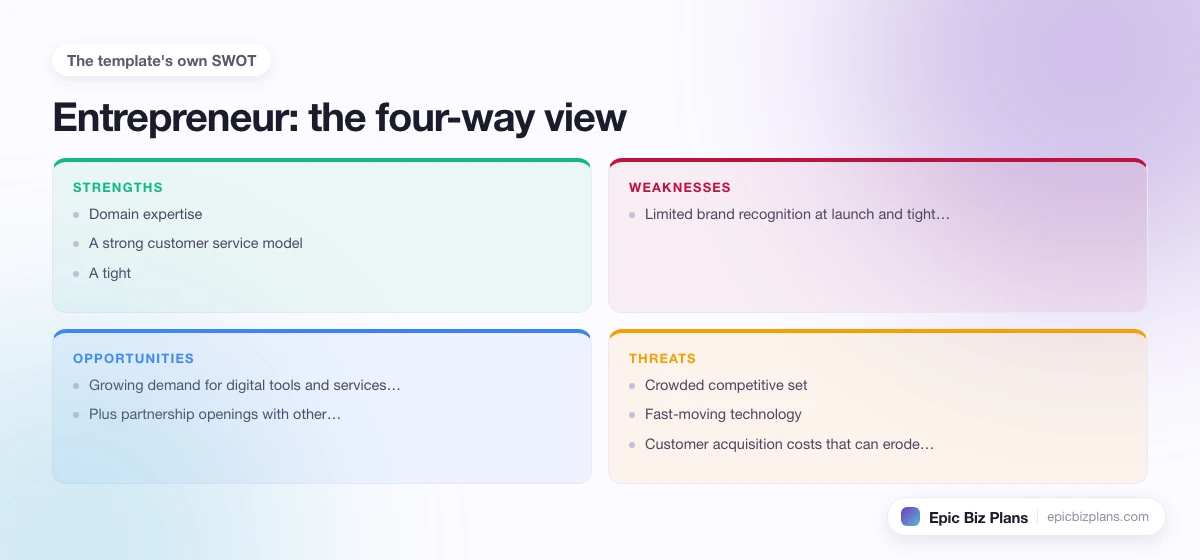
- Strengths: Domain expertise, a strong customer service model, and a tight, well-defined initial product line.
- Weaknesses: Limited brand recognition at launch and tight resource constraints during the first 12 months.
- Opportunities: Growing demand for digital tools and services among SMBs, plus partnership openings with other small-business platforms.
- Threats: Crowded competitive set, fast-moving technology, and customer acquisition costs that can erode margin.
Entrepreneur Business Name Ideas
Website
We will build the website on Shopify if the business sells physical or digital products, since it handles checkout, taxes, and shipping with minimal setup. If our model is consultancy-led, we will use Wix or WordPress with Elementor for a content-first site that highlights case studies, services, and lead capture. Either way, the site is structured around three goals: explain who we serve, prove we have done the work, and capture qualified leads.
For founders launching with a startup mindset and growth-stage milestones, the startup business plan template covers fundraising and milestone planning that complements the structure here.
Marketing Details
Our marketing mix runs on three layers: SEO for compounding organic traffic, email for retention and nurture, and paid social for targeted acquisition. We use Semrush for keyword research and rank tracking, HubSpot for email sequences and CRM, and a tight ad spend on Meta and TikTok aimed at our defined target customer.
Content marketing is central to the strategy. We will publish weekly blog posts, monthly case studies, and short-form video that explain how our products work in real customer environments. This content does double duty: it ranks for long-tail keywords and serves as sales collateral for partners and prospects.
Industry Trends
The SMB market continues to shift toward integrated, easy-to-deploy tools that replace multiple legacy point solutions. AI-assisted workflows, no-code automation, and self-serve onboarding are now baseline expectations rather than differentiators. Founders who can ship products that integrate cleanly with existing customer stacks win attention faster.
For founders building lean and testing aggressively, the side hustle business plan template covers validation tactics that work well in the first six months.
Competitor Information
We will identify our top five direct competitors and a wider set of indirect ones, then map their pricing, positioning, and customer reviews. The goal is to find the gaps where current solutions underserve our target customer, not to copy what they already do well. We differentiate on customer service, product focus, and pricing transparency. Entrepreneurs entering a market with a new approach, rather than competing on existing terms, will find a structured framework for first-mover strategy, market validation, and contingency planning in the trailblazing business plan template.
Financial Information
Our financial plan starts with realistic startup costs: licensing, website, branding, initial inventory or service tooling, and three months of marketing budget. Founders pursuing unconventional or non-traditional venture concepts should also reference our questionable business plan template. We will project revenue against a defined customer acquisition cost and lifetime value model rather than top-line wishful thinking. Monthly P&L, a 13-week rolling cash flow, and a runway calculation are non-negotiable from month one.
If you plan to bootstrap rather than raise capital, build a model that gets to cash-flow positive without external funding. If you plan to raise, build the same model and treat any funding as acceleration, not survival.
Legal and Compliance
We will register the business, secure the right entity type (LLC, S-Corp, C-Corp) for our funding and tax situation, and stay current on tax filings and any industry-specific licensing. Trademarks protect the brand name and core product names. NDAs cover early conversations with contractors and partners. We will work with a small-business attorney for entity formation and an accountant from day one.
-
 SemrushSemrush is a platform with literally any online tool you will need to promote your business. Spy on your competitors, get search traffic, keyword research, social info, ad copies and much more. Used by most of the top online companies in the world. Besides all its tools, Semrush also has many available integrations possible with many other tools that will make your work even better.
 -
 Surfer SEOSurfer SEO is an incredibly smart AI tool that will give you exact explanations what to do in order to make your website rank better. They use hundreds of parameters, check your competitors and decide on the best course of action. Whether it be inner links, bold text, paragraphs, headers, images and much more. Surfer is a must-have in 2026.
Operational Plan
Operations focus on shipping the product reliably, supporting customers fast, and keeping internal processes documented enough that a second person can step in. Supply chain and logistics partners are chosen for reliability over rock-bottom pricing in the first year. Entrepreneurs building a DTC brand with a strong product focus and quality-first positioning can also reference our Undefeated business plan for a detailed DTC e-commerce framework. For a related angle, see our partnership business plan template.
Contingency Planning
Top risks for new entrepreneurs are running out of cash, losing a key customer or channel, and burning out the founding team. We mitigate with a 90-day cash reserve, customer concentration limits (no single customer greater than 25% of revenue), and clear ownership of operational tasks so the founder is not the bottleneck. A simple crisis playbook documents what we do if a major customer leaves, a key supplier fails, or a product issue requires a recall or refund cycle.
Those who want a plan specifically focused on independent, self-directed ventures will find a Self Made business plan template useful as a reference point.
Operators thinking about a smaller, locally-focused first venture can also reference our small business plan for category-specific guidance.
Build the Entrepreneurial Business You Actually Want
Becoming an entrepreneur is about identity and lifestyle as much as financial outcome. Founders who succeed long-term are the ones who design the business around the life they want, not the other way around. Whether that means a high-growth tech startup, a local boutique with three employees, or a tightly run consultancy from a home office, the plan should reflect the trade-offs you are actually willing to make.
Types of Businesses in Your Niche
The category covers a wide range of business types: tech startups, ecommerce brands, service businesses, subscription products, local retail, and consulting firms. Pick the model that matches your capital, your appetite for risk, and the kind of work you want to do day to day. Each model has its own playbook for pricing, marketing, and operations, so let your business type shape the plan rather than the other way around.
Keep Your Entrepreneur Business Plan Flexible
Revisit the plan every quarter. Adjust the customer profile based on who is actually buying, change pricing as your gross margin data accumulates, and refine the product roadmap as customer feedback comes in. A static plan written in month one and never opened again is worse than no plan; an evolving plan is the working tool that keeps your decisions aligned with reality.
Put Your Plan to Work
Use the plan to pitch potential partners, apply for small business funding (with help from the pitch business plan), recruit a first hire, time your market entry with a launch business plan template, or simply keep yourself accountable on revenue and runway. The plan is most valuable when it lives in your workflow, not in a folder.
Your entrepreneur business plan is 100% free, with unlimited edits, unlimited downloads, and unlimited chances to get it right. Entrepreneurs specifically launching or growing a business in the Illinois market should also reference an Illinois business plan for state-specific regulatory, tax, and market conditions that affect business planning in that geography.
